Properties (15)
- purpleRed
- Characterizing the cognitive dimensions of misophonia using a qualitative approach
- (Woolley et al., 2026a)
•
Characterizing the cognitive dimensions of misophonia using a qualitative approach: from in-the-moment appraisals to intrusive thoughts about prior sounds
Status:: #status/reviewed
Metadata
- Item Type: #journalArticle
- Authors:: Mercedes G. Woolley, Hailey E. Johnson, Michael E. Levin, Danny Cottle, Julie M. Petersen, Karen Muñoz, Michael P. Twohig,
- Date Added: February 22, 2026
- URL: https://www.tandfonline.com/doi/full/10.1080/13284207.2026.2627945
- DOI: 10.1080/13284207.2026.2627945
- Cite Key: woolleyCharacterizingCognitiveDimensions2026
- Tags: #Misophonia, #qualatative, #cognitive-proccessing, #Internalizing-and-externalizing-appraisals, #rumination
- PDF Attachments
Abstract
| Background/Purpose | Background- • for cognitive - behavioral models of Misophonia, it is important to have info on both the immediate and post-triggering thinking the gain greater ecologically valid measures of cognitive features like rumination in Misophonia • many of the current assessments for Misophonia are adapted versions of scales for things like OCD and and PTSD, but these frameworks were employed without first assessing their fit to the specific biopsychosocial profile of Misophonics • existing qualitative studies of Misophonia have shown the utility of taking person-centered approaches to researching Misophonia Purpose- • Qualitatively characterize negative cognitions occurring during and after misophonia sound exposure. • Identify common cognitive patterns to inform cognitive models and treatment development. • Use inductive approach to allow categories to emerge from participant narratives. |
| Participants/samples | • N=60 treatment-seeking adults with clinically significant misophonia (DMI ≥20). • 90% women; 98.3% White; 96.7% non-Hispanic; 76.7% heterosexual. • Mean age 33.80 years (SD=12.18). • Recruited Mountain West USA region November 2022–November 2023. • Exclusions: DMI below threshold, trauma-related sensitivities, volume-related sensitivities, current mania, withdrawal of interest. • |
| Measures | • Duke Misophonia Interview (DMI): 18-item semi-structured interview assessing severity and functional impact; Items 3 (negative thoughts during sounds) and 4 (unwanted thoughts about prior sounds) analyzed qualitatively. • Diagnostic Interview for Anxiety, Mood, and OCD and Related Neuropsychiatric Disorders: assessed psychiatric comorbidities and ruled out other concerns. • Misophonia Questionnaire (MQ): screening tool for initial eligibility (severity item >5). • Self-report questionnaires: demographics, misophonia symptoms, mental health. • Audiological evaluation: hyperacusis, hearing loss (not analyzed here). |
| Procedures | • Structured interviews conducted by doctoral student under licensed psychologist supervision. • Interview questions read verbatim; clarification provided if participants reported emotions instead of thoughts. • Audio and video recorded; transcribed for analysis. • Participants compensated $60. |
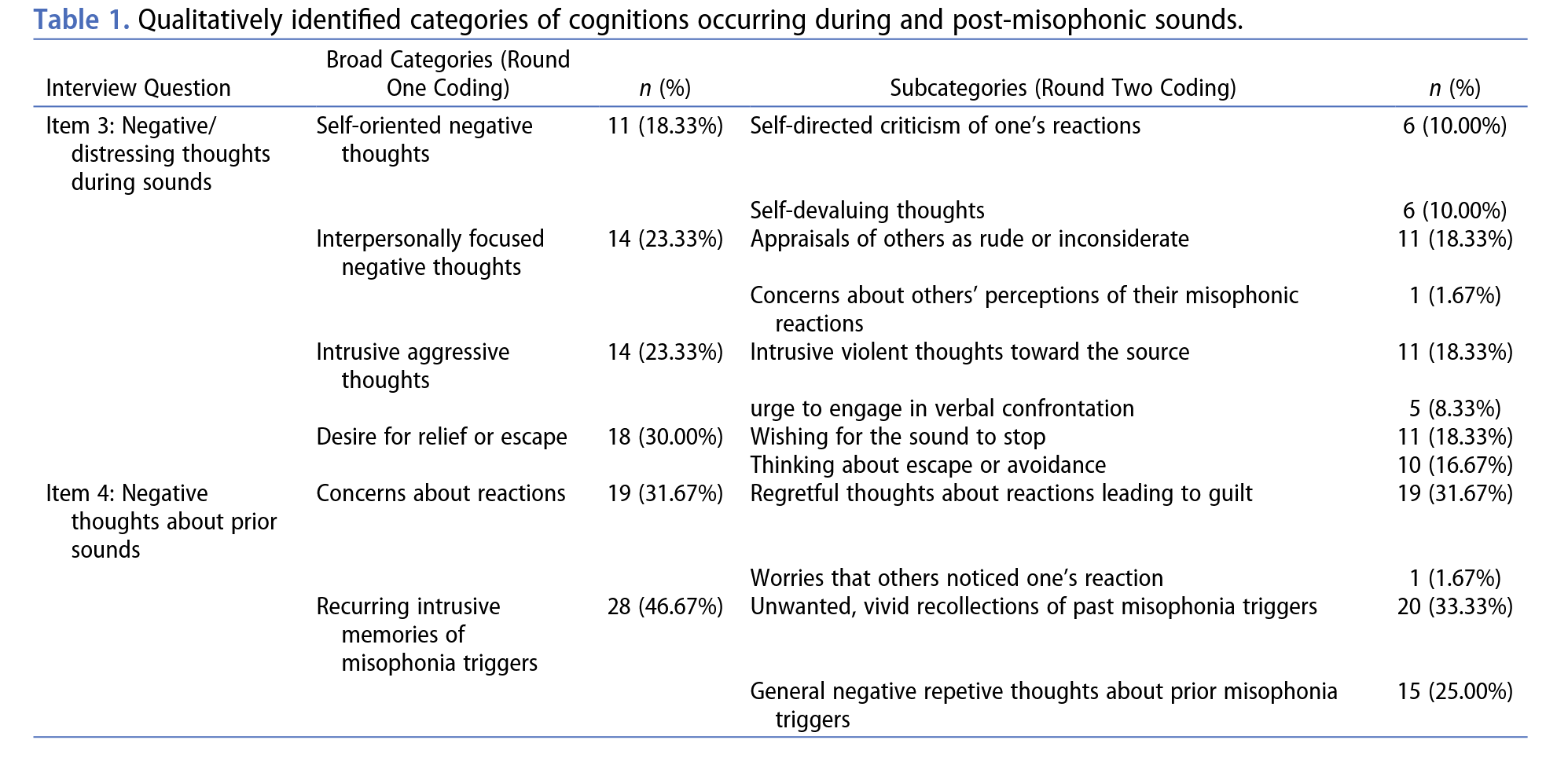
| Results | During-misophonic-event cognitions (DMI Item 3): • 12 participants (20%) self-oriented negative thoughts; 12 (20%) interpersonally focused; 14 (23%) intrusive aggressive thoughts; 18 (30%) escape/relief thoughts. • 12 participants (20%) denied negative thoughts during triggers. • Self-oriented negative thoughts involved self-directed criticism and self-devaluing thoughts with hopelessness/catastrophizing. • Interpersonally focused thoughts involved appraising others as rude/inconsiderate; one participant worried about others' perceptions of their reactions. • Intrusive aggressive thoughts included violent imagery toward sound source and verbal confrontation urges. • Escape/relief thoughts included urgent wishing for sound to stop and strategic thinking about avoidance/escape. Post-misophonic-event cognitions (DMI Item 4): • 19 participants (31.67%) concerns about reactions; 28 (46.67%) recurring intrusive memories. • 24 participants (40%) denied negative thoughts about prior sounds. • Concerns about reactions involved regretful evaluations leading to guilt; one participant worried others noticed their reaction. • Recurring intrusive memories included unwanted vivid recollections of specific past triggers and general negative repetitive thoughts about prior sounds. |
| Discussion/Limits | Conclusion- • many of the self reported thoughts during and immediately after trigger exposure acted to appraise the emotional responses they were suffering, suggesting a tight link between the physiological and affective dimensions of Misophonia (page 10) • The authors conclude that negative cognitions are central to misophonia both during and after sound exposure for most participants. • The findings indicate that cognitive processes extend distress beyond immediate sound exposure through post-event rumination and intrusive memories. • The data support that internalizing and externalizing appraisals occur at comparable rates in treatment-seeking samples. • The authors conclude that aggressive intrusive thoughts may be more prevalent in clinical populations than community samples. • The findings indicate that escape-related cognitions represent entry points for functional coping strategies. • The data support that regret, guilt, and social worries prolong distress after triggering events. • The authors conclude that intrusive memories may reflect transdiagnostic stress-related mechanisms similar to PTSD. • The findings indicate that 20–40% of participants did not report cognitive processes, suggesting heterogeneity in misophonia presentations. • The data support that cognitive patterns overlap with features of OCD, PTSD, and impulse control disorders but reflect a distinct condition. |
| Limitations:: | • Study not originally designed as qualitative research; no saturation-based sampling or extensive probing. • Responses relied on retrospective recall rather than real-time capture. • Frequencies of cognitive processes should not be interpreted as prevalence rates due to dependence on participant awareness and framing. • Sample demographically homogenous (predominantly White, female, Western USA). • Sample clinically homogenous (treatment-seeking adults only). • Generalizability to non-treatment-seeking individuals unclear. |
| Future Directions:: | • Use ecological momentary assessment to capture real-time cognitions during triggers. • Model interactions between cognitive processes, behaviors, and affect in real time. • Test whether cognitive processes maintain misophonia distress. • Examine whether appraisal patterns (internalizing vs externalizing) vary by trigger type (human vs mechanical sounds). • Investigate whether aggressive cognitions reflect broader anger reactivity beyond misophonia. • Recruit more diverse samples across gender, race, and sociodemographic characteristics. • Determine whether intrusive memories require targeted intervention components. • Explore whether cognitive processes represent mechanisms across all presentations or only in subgroups. |
| Statistics:: | • Sample characteristics: N=60; 90.0% women; 98.3% White; 96.7% non-Hispanic; 76.7% heterosexual; mean age 33.80 (SD=12.18). • During-sound cognitions endorsed: self-oriented 11 (18.33%); self-criticism 6 (10.00%); self-devaluing 6 (10.00%); interpersonal 14 (23.33%); appraisals of others as rude 11 (18.33%); concerns about others' perceptions 1 (1.67%); intrusive aggressive 14 (23.33%); violent thoughts 11 (18.33%); verbal confrontation urges 5 (8.33%); escape/relief 18 (30.00%); wishing sound stops 11 (18.33%); thinking about escape 10 (16.67%); no negative thoughts 12 (20.00%). • Post-sound cognitions endorsed: concerns about reactions 19 (31.67%); regret/guilt 19 (31.67%); worries others noticed 1 (1.67%); recurring memories 28 (46.67%); vivid recollections 20 (33.33%); general repetitive thoughts 15 (25.00%); no negative thoughts 24 (40.00%). • Interrater reliability: Cohen's κ ≥.61 for both undergraduate coders across both coding rounds (20% of transcripts double-coded); threshold met after calibration meeting for one coder. |
| Relevance:: | • took a qualitative approach to assessing the thinking of people experiencing Misophonia triggers. both the immediate and post trigger thoughts. • a good source for info on thinking in Misophonia resposnes. • A good source for procedures using qualitative clinical interviews in Misophonia research |
Notes
key terms and concepts
- inductive content analysis- a systematic approach to categorization that derives the categories from the trends in the data rather then a predetermined framework. (page 6)
- misophonia – intense, disruptive reactions to everyday sounds (e.g., chewing, breathing, pen clicking) that elicit unwanted emotional and physical responses, interfere with functioning, and are sustained by avoidance.
- internalizing appraisals – self-blaming cognitions in which individuals interpret their reactions as personal failings.
- externalizing appraisals – cognitions attributing blame to others for being rude, disrespectful, or inconsiderate regarding sound production.
- inductive content analysis – systematic qualitative approach deriving categories directly from data rather than applying predetermined frameworks.
- Duke Misophonia Interview (DMI) – semi-structured clinical interview assessing misophonia symptom severity and functional impact across 18 items.
my engagement notes
my questions
my comments
Bookmarks
-
bookmark for Negative thoughts during misophonia sounds results (page 7)
-
bookmark for Self-oriented negative thoughts results (page 7)
-
bookmark for Interpersonally focused negative thoughts results (page 8)
-
bookmark for Intrusive aggressive thoughts results (page 8)
-
During-misophonic-event cognitions (page 10)
-
tldr recap of the course of thinking in the miso response (page 14)
reading notes
-
there is a gap in research on the role of cognition, specifically negative thinking, in Misophonia (page 10)
-
Frequencies of cognitive processes should not be interpreted as prevalence rates due to dependence on participant awareness and framing. (page 13)
zettlekasten
strong link between physiological and affective dimensions of Misophonia
evidence of a central role of maladaptive thinking in Misophonia
evidence of the fit of internalizing vs externalizing appraisals in Misophonia