Properties (15)
- purpleRed
- (Norris et al., 2022)
•
Toward a Multidimensional Understanding of Misophonia Using Cluster-Based Phenotyping
Status:: #status/Bare-bones-review
Metadata
- Item Type: #journalArticle
- Authors:: Jordan E. Norris, Suzanne H. Kimball, Danna C. Nemri, Lauren E. Ethridge,
- Date Added: January 26, 2026
- URL: https://www.frontiersin.org/articles/10.3389/fnins.2022.832516/full
- DOI: 10.3389/fnins.2022.832516
- Cite Key: norrisMultidimensionalUnderstandingMisophonia2022
- Tags:: #Auditory, #Misophonia, #Bare-bones-review-🦴, #sensory-sensitivity, #cluster-analysis, #phenotype,
- PDF Attachments
Abstract
| Background/Purpose | Background- • Misophonia involves hypersensitivity and adverse reactions to specific auditory stimuli with emotional reactions and autonomic arousal. • Misophonia triggers elicit altered neural activity in auditory cortex and salience network, plus autonomic arousal. • Individuals with misophonia typically have normal hearing but show increased limbic and autonomic nervous system activation. • Misophonia presents with anxiety, auditory hypersensitivities, emotional fluctuations, autonomic arousal, and sometimes compulsive behavior. • Early cases were thought to be variants of other auditory conditions, anxiety disorders, or OCD. • Misophonia commonly co-occurs with tinnitus, hyperacusis, sensory processing disorders, and anxiety. • Approximately 20% of the population report clinically relevant misophonia symptoms. • Limited research has explored variability in clinical presentation of misophonia. • Like some neurodevelopmental disorders, misophonia may be syndromic where symptom patterns rather than single symptoms contribute to diagnosis. Purpose- • Explore symptom presentation in a non-clinical sample using cluster-based phenotyping. • Evaluate whether sensory processing is broadly affected in misophonia. • Characterize symptom clusters to better define sub-populations in misophonia. • Hypothesize approximately 20% will report clinically relevant misophonia symptoms. • Expect clusters with high misophonia symptoms to show increased prevalence of tinnitus, sensory processing disorders, and broad autism phenotype characteristics. |
| Participants/samples | • N = 343 undergraduate students at University of Oklahoma. • Age range 18–36; M = 18.96, SD = 1.7. • Gender: 69.7% female; 30.3% male; 0% non-binary. • Ethnicity: 76.7% Caucasian; 9.3% Black/African American; 13.4% Latino/Hispanic; 8.2% Asian/Asian American; 7.6% American Indian/Alaska Native; 0.6% Hawaiian/Other Pacific Islander; 0.6% other. • Primary vocation: 96.5% student. • Self-reported current diagnoses collected. |
| Measures | • Misophonia Questionnaire (MQ): 20-item self-report measure assessing auditory triggers, emotions/behaviors, and sound sensitivity severity; threshold score ≥7/10 indicates clinically significant symptoms. • S-Five (2018 version): 98-item measure assessing misophonia triggers and associated behaviors. • Tinnitus Handicap Inventory (THI): 25-item measure for individuals reporting tinnitus; assesses severity and quality-of-life impact. • Adolescent/Adult Sensory Profile (ASP): self-report measure of sensory processing patterns; assessed auditory processing and four sensory behavior quadrants. • Broad Autism Phenotype Questionnaire (BAPQ): assesses personality and language traits reflecting genetic predisposition for ASD. • Schizotypal Personality Questionnaire – Brief Revised Updated (SPQ-BRU): evaluates schizotypy and vulnerabilities to neurodevelopmental and schizophrenia spectrum features. |
| Procedures | • Participants recruited via university undergraduate psychology research participation pool. • Data collected anonymously via Qualtrics online survey. • Participants received 1 hour class credit for completion. • Survey comprised demographics section and six clinical measures (Spectrum Characteristic Survey). • Participants asked about triggers in other sensory domains. • Participants who reported tinnitus completed the THI. |
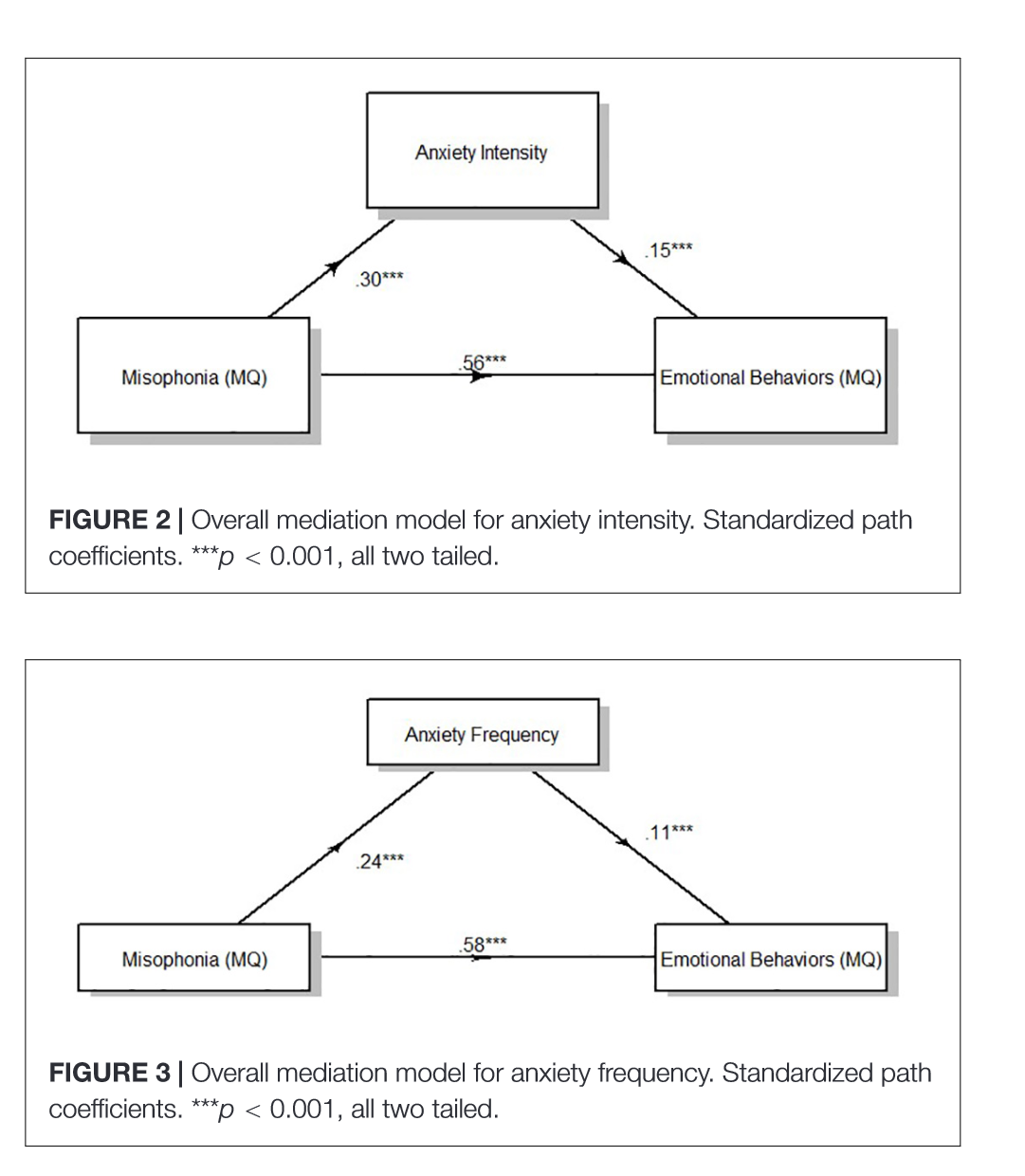
| Results | Misophonia Prevalence • 15.6% (54/343) reported clinically relevant misophonia symptoms (MQ severity ≥7). • Misophonia group showed greater scores on 14/16 clinical variables indexing sensory sensitivity. Trigger Endorsement • Eating sounds most frequently endorsed trigger on MQ (approximately 45% of sample). • S-Five results: loud chewing, crunching an apple, lip smacking, slurping, breathing most endorsed. • Misophonia group showed greater sensitivity across all MQ and most S-Five trigger items. • Non-auditory triggers (strong smells, visual stimuli) also differed between groups. Tinnitus • 50.4% of total sample reported tinnitus via screener. • 74.1% of misophonia group reported tinnitus versus 46% without misophonia. • Co-occurrence of misophonia and tinnitus among those reporting tinnitus was 23.1%. • Misophonia group reported greater tinnitus severity on THI. Cluster Analysis • Three-cluster solution retained based on Two-Step analysis, silhouette plots, and ANOVA results. • Cluster 1 (N=93): more severe misophonia symptoms; fewer formally diagnosed psychiatric conditions; intermediate BAP and SPQ scores; most sensory triggers in other modalities. • Cluster 2 (N=132): relatively unaffected by misophonia or sensitivities. • Cluster 3 (N=118): nuanced clinical presentation with broadband sensory hypersensitivities, tinnitus, increased social processing and psychiatric symptoms; highest THI, ASP, BAPQ, and SPQ scores. • 31 participants with misophonia clustered into Cluster 1; 22 into Cluster 3; 1 into Cluster 2. • Cluster 1 showed greater tinnitus presence; Cluster 3 showed greater tinnitus severity. Other Sensory Triggers • No group differences in presence of other sensory triggers. • Misophonia group reported greater severity across visual, smell, taste, and texture triggers. • Cluster 1 showed greatest endorsement and severity of other sensory triggers. Sex Differences • Only BAPQ aloof subscale differed by sex. • Significant interaction between group and sex for THI: females with misophonia reported greater tinnitus severity than males with misophonia. Anxiety Mediation • Anxiety intensity mediated 7.41% of effect of misophonia severity on emotional behaviors. • Anxiety frequency mediated 4.22% of effect. • By cluster: anxiety intensity mediated relationship in Clusters 1 and 3 but not Cluster 2. • Anxiety frequency did not mediate by cluster. |
| Discussion/Limits | Conclusion- • approximately 15% of undergraduate students report clinically relevant misophonia symptoms, supporting previous prevalence estimates. • findings indicate eating sounds and breathing/nasal sounds are primary triggers for individuals with misophonia. • The data support increased co-occurrence of misophonia and tinnitus, suggesting shared basic sensory processing abnormalities. • cluster analysis identified two potential subgroups: one with "pure form" misophonia (severe symptoms, fewer co-occurring conditions), and one with complex presentation (broadband sensory hypersensitivities, tinnitus, social processing and psychiatric symptoms). • misophonia symptoms may lie on a spectrum with varying overlap with other brain disorders. • The findings indicate anxiety partially mediates the relationship between misophonia symptom severity and emotional behaviors, with intensity more influential than frequency. • individuals with misophonia show overlap with autism-like symptoms, particularly behavioral rigidity. • subgroups may reflect different underlying pathways related to sensory processing difficulties versus higher-order cortical control. • The findings indicate sensory difficulties in other modalities may be a universal experience for those with clinically relevant misophonia. • increased rates of OCD, PTSD, and GAD among misophonia group suggest psychiatric symptom overlap reflects misophonia mechanisms rather than discrete conditions. |
| Limitations:: | • Lack of psychiatric evaluation to confirm diagnoses and assess background of symptoms. • Self-reported diagnoses without medical record verification; possible self-diagnosis. • Broad anxiety questions encompassing any form of anxiety, limiting interpretation of specific anxiety roles. • Self-reported tinnitus via screener may include false positives (typical aural fluctuations). • Use of older S-Five version (2018); newer validated version published after data collection. • THI has functional limitations and should be interpreted as index of tinnitus impact on quality of life. • Non-clinical sample of young adults limits generalizability. |
| Future Directions:: | • Future work should evaluate auditory stimuli and responses to complex auditory stimuli. • Experimental assessment of cognitive control difficulties in misophonia needed. • Research should address potential syndromic or subgrouped relationship between misophonia, sensory processing disorders, executive function, and anxiety. • Studies should include formal psychiatric evaluation and medical record verification. • Investigation of top-down control connectivity patterns in misophonia could establish shared biological pathways with ASD. |
| Relevance:: | • study use exploratory k-means Clustering to cluster symptom presentation in Misophonics and controls, finding three distinct clusters, differentiated by the intensity of Misophonia symptoms and presence of co occurring disorders. • results demonstrate the “spectrum” nature of Misophonia with symptoms appearing on a spectrum of pure Misophonia to Misophonia mixed with other sensory related disorders • results confirm eating sounds as the most commonly endorsed trigger (supporting Jager 2020) while also demonstrating the commonality of non orofacial trigger sounds ( supporting Hansen 2021) • found the use of the S-Five triggers to give more detailed options for trigger endorsements and be characterized responses from Misophonics |
Notes
key terms and concepts
- misophonia – a condition characterized by hypersensitivity and strong emotional reactivity to specific auditory stimuli, triggering impulsive emotional reactions and autonomic arousal.
- tinnitus – an auditory sensation without an external sound stimulation; can be objective (internally generated) or subjective (idiopathic); may impact quality of life.
- sensory processing disorder (SPD) – a condition involving abnormalities in how the nervous system receives and responds to sensory information.
- broad autism phenotype (BAP) – mild personality and language traits reflecting phenotypical expression of genetic predisposition for autism spectrum disorder, observed in individuals who do not meet full ASD criteria.
- cluster analysis – a statistical method for grouping individuals based on shared characteristics or symptom patterns.
- trigger – specific patterns of auditory stimuli that evoke hypersensitivity and behavioral responses in individuals with misophonia.
my engagement notes
my questions
my comments
Bookmarks
reading notes
- Eating sounds most frequently endorsed trigger on MQ (approximately 45% of sample). (page 11)
Methods (Clustering Procedures)
-
Variables (N = 16 subscales) selected from clinical measures indexing misophonia, tinnitus, sensory processing, and psychiatric traits.
-
Subscales used instead of total scores to preserve symptom specificity and avoid conflating constructs.
-
All variables standardized (z-scores) prior to clustering.
-
Initial subgroup estimation conducted using Two-Step cluster analysis:
-
Pre-clustering followed by hierarchical clustering.
-
Provided data-driven estimate of optimal number of clusters.
-
-
Cluster validity evaluated using silhouette plots:
-
Assessed cohesion and separation of clusters.
-
Compared two-cluster vs three-cluster solutions.
-
-
Final clustering conducted using k-means clustering:
-
Tested both two-cluster and three-cluster solutions.
-
Algorithm minimized within-cluster Euclidean distance.
-
Iterative convergence achieved (more iterations for three-cluster solution).
-
-
Model selection:
-
Two-step suggested two clusters (based on symptom presence).
-
Silhouette plots indicated potential third cluster.
-
Three-cluster solution retained due to additional structure and interpretability.
-
-
Cluster validation and characterization:
-
Univariate ANOVAs tested differences across clusters for all input variables.
-
Post-hoc Fisher’s LSD used for pairwise comparisons.
-
Variables categorized as trichotomous (all clusters differ) or dichotomous (two clusters differ).
-
-
Additional analyses by cluster membership:
-
Chi-square tests for categorical variables (e.g., diagnoses, tinnitus presence).
-
Kruskal–Wallis tests for non-parametric comparisons (e.g., sensory triggers).
-
-
Interpretation approach:
- Clusters defined based on patterns across misophonia severity, sensory hypersensitivity, tinnitus, and psychiatric traits.
narrative
The authors applied a data-driven clustering approach by first standardizing symptom variables and using a Two-Step cluster analysis to estimate the number of subgroups, followed by silhouette plots to evaluate cluster separation. Because the initial method suggested two clusters but additional structure was evident, they tested both two- and three-cluster solutions using k-means clustering to refine subgroup classification.
The three-cluster solution was retained as it better captured variation in misophonia severity, sensory hypersensitivity, tinnitus, and psychiatric traits across participants. Cluster differences were then validated using ANOVAs and additional statistical tests, confirming distinct symptom profiles across the identified subgroups.
contextual statement
In a 2022 study, Norris attempted to characterize misophonia symptom presentation using cluster-based phenotyping by administering a comprehensive self-report survey indexing misophonia, tinnitus, sensory hypersensitivity, and psychiatric symptoms to 343 undergraduate students.
zettlekasten
clustering approach to Misophonia finds comorbidities
three cluster description of Misophonia symptoms
evaluating Misophonia symptoms via clustering by presentations
the Five-S as a more granular assessment of Misophonia triggers