Properties (14)
- purpleRed
- Real-time emotional responses to trigger sounds in misophonia
- (Shan et al., 2026)
•
Real-time emotional responses to trigger sounds in misophonia: An ecological momentary assessment study
Status:: #status/reviewed
Metadata
- Item Type: #journalArticle
- Authors:: Yanyan Shan, Bill Chen, Ashley A. Moskovich, Marta Siepsiak, Siyuan Wang, M. Zachary Rosenthal,
- Date Added: February 22, 2026
- URL: https://linkinghub.elsevier.com/retrieve/pii/S0165032726002806
- DOI: 10.1016/j.jad.2026.121429
- Cite Key: shanRealtimeEmotionalResponses2026
- Tags: #Misophonia, #Ecological-momentary-assessment, #Emotion-regulation, #Emotional-responses, #Individual-differences
- PDF Attachments
Abstract
| Background/Purpose | Background- • Misophonia characterized by intense negative emotional responses to specific sounds; growing evidence of complex multi-modal responses involving cognitive, physiological, and behavioral systems. • Prior research relies predominantly on retrospective self-report and laboratory paradigms; lacks ecological validity and temporal resolution. • Emotional responses include anger, disgust, anxiety; heightened sympathetic arousal; freeze-flight-fight behavioral patterns. • Limited understanding of real-time emotional dynamics, recovery patterns, and individual differences in naturalistic settings. • High prevalence (4.6% of U.S. adults); associated with functional impairment; co-occurring psychopathology common. • Emotion dysregulation central to misophonia; neurobiological evidence shows hyperactivation in salience/emotion regulation regions. • there is a gap in the understanding of the time course of the Misophonic response. describing the time course (rapid,, long, variable) could inform future interventions • there is a lack of info on the variability in Misophonic reactivity/response recovery that could be useful for advancing clinical understandings and broader affect science frameworks for Misophonia Purpose- • Characterize range and intensity of negative emotions during trigger versus no-trigger states. • Examine temporal recovery patterns following trigger exposure. • Evaluate individual differences in emotional reactivity and recovery trajectories. • Assess how misophonia severity influences emotional reactivity and recovery. • Investigate whether no-trigger emotional states predict triggered responses. • Examine associations between co-occurring psychiatric disorders and emotional reactivity patterns. |
| Participants/samples | • N = 40 adults (after applying ≥50% compliance criterion from initial N = 51). • Age M = 36.43 years (SD = 11.60, range 18–65); 75% female, 25% male; 82.5% White/Caucasian. • Inclusion: MQ Severity ≥7; MQ Symptoms >2; MQ Emotions/Behaviors >2. • Exclusion: current psychotic disorder, mania, anorexia nervosa; inability to read English fluently. • 70% met criteria for current co-occurring psychiatric disorder; anxiety disorders most common (60%). |
| Measures | • Misophonia Questionnaire (MQ): Symptom Scale, Emotions/Behaviors Scale, Severity Scale (7–9 moderate; 10–12 severe; 13–15 very severe). • Structured Clinical Interview for DSM-5 (SCID-5): comprehensive psychiatric assessment; lifetime and current diagnoses. • Mini-International Neuropsychiatric Interview (M.I.N.I.): screening for exclusionary conditions. • EMA emotion ratings: 16 negative emotions rated 1–5 (distressed, upset, guilty, disgusted, scared, hostile, irritated, ashamed, nervous, afraid, loathing, frightened, shaky, jittery, angry, scornful). • Trigger-specific reactions: 12 items measuring fight (yelling, argumentative, confrontational, outraged), flight/fear (terrified, fearful, frightened, scared), freeze (vacant, detached, disconnected, disengaged) responses. |
| Procedures | • Recruitment via Duke Center for Misophonia and Emotion Regulation website; online screening; telephone M.I.N.I. • Baseline assessment: SCID-5, MQ. • 10-day EMA protocol delivered to personal smartphones. • Time-based assessments: 5 random prompts daily (8 AM–10 PM); 2-hour minimum interval. • Event-based assessments: self-initiated immediately upon encountering misophonia trigger. • Trigger timing classified: during-trigger, post-trigger (<15 min, 16–30 min, 31–60 min, 61–120 min, >120 min), before-trigger, no-trigger. • Incentive: $75 for ≥50% compliance; $25 bonus for ≥85% compliance. |
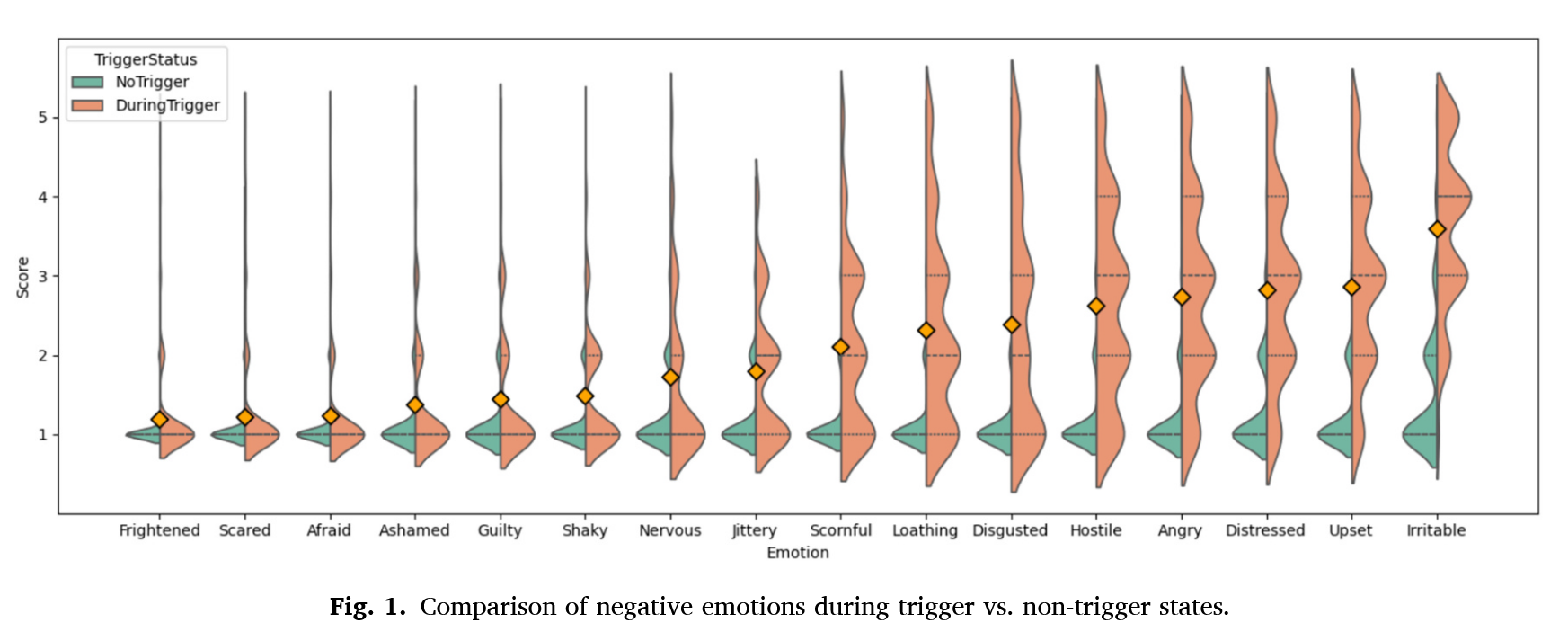
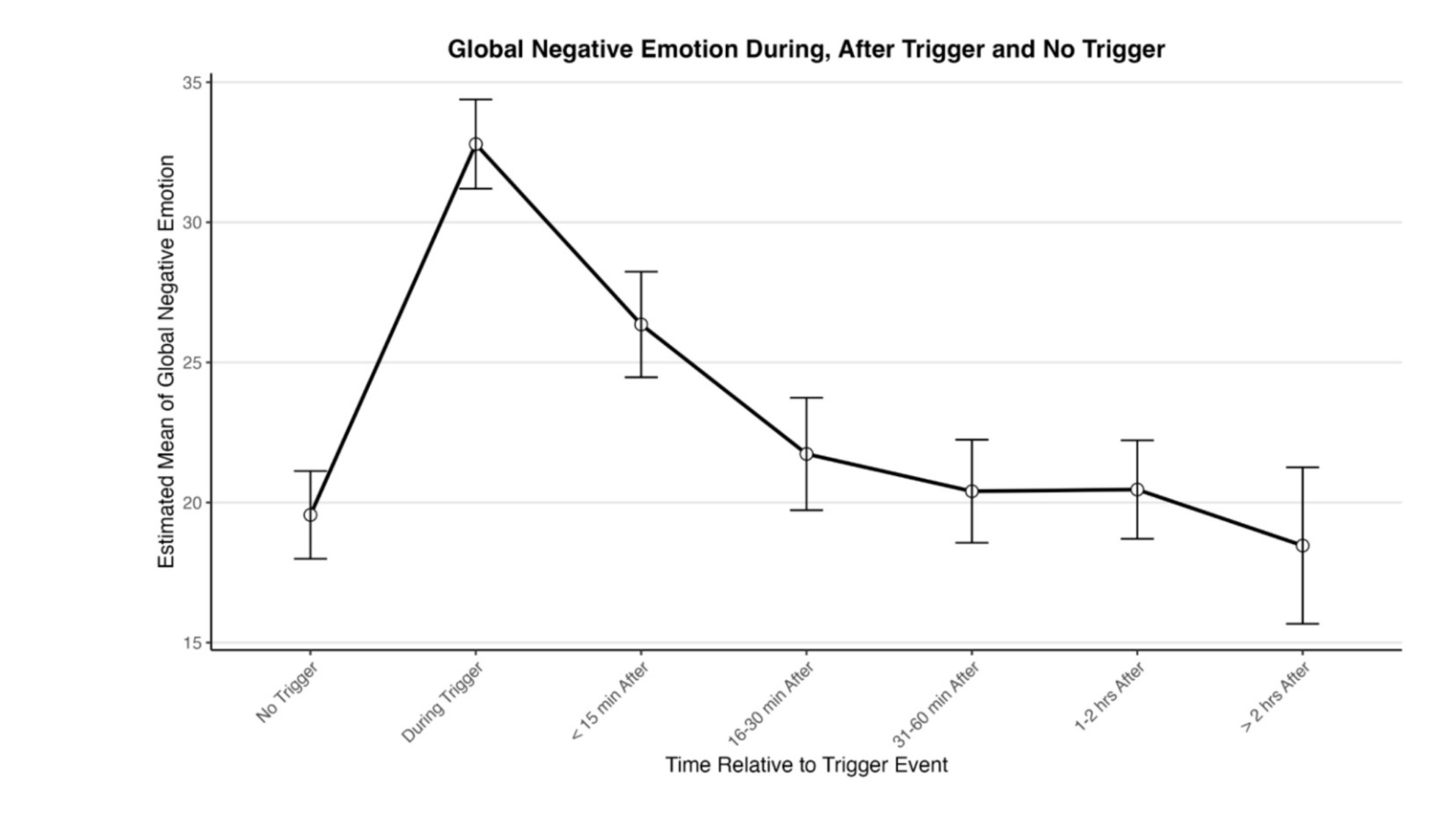
| Results | Emotional reactivity during trigger vs. no-trigger • Global negative affect significantly higher during triggers versus no-trigger periods. • All 16 negative emotions showed significant increases during triggers. • Largest increases: irritability, upset, anger, distress. • Smallest increases: afraid, frightened, scared. • Most intense trigger reactions: outraged, confrontational. • Least intense trigger reactions: fearful, terrified. Temporal recovery patterns • Within 15 min post-trigger: global negative affect remained significantly elevated above baseline but lower than during-trigger. • 16–30 min post-trigger: global negative affect marginally elevated above baseline. • 31–60 min post-trigger: complete recovery; no significant difference from baseline. • 12 of 16 emotions remained elevated within 15 min; irritability persisted longest (still elevated at 16–30 min). • 52.5% of participants returned to baseline within 15 min; 72.5% within 30 min; 87.5% within 60 min; 95% within 2 hours. Individual differences • Significant within-person variability across trigger events for all 16 emotions. • Substantial between-person variability in reactivity magnitude (difference scores ranged 2.99–28.56 for global negative affect). • Highest between-person variability: hostile, disgusted, loathing. • Lowest between-person variability: afraid, scared, frightened. • ICC values ranged 0.21–0.50; within-person variability accounted for 50–79% of total variance. • Significant between-person variability in recovery trajectories; 11 of 16 emotions showed significant random-slope effects. • 97.5% of participants showed statistically significant elevation during triggers. Misophonia severity effects • Severe group reported greater intensity for distress, upset, disgust, irritability. • Severity significantly predicted irritable, upset, distressed, disgusted intensity. • Outraged reaction significantly stronger in severe group. • Recovery patterns did not differ by severity group. No-trigger emotional states predicting triggered responses • All 16 baseline emotions significantly predicted during-trigger global negative affect. • Baseline nervousness strongest predictor (R² = 0.09), followed by irritable (R² = 0.09), distressed (R² = 0.07), hostile (R² = 0.07), loathing (R² = 0.07). • Fear-related emotions showed largest effect sizes despite lower absolute intensity: frightened (β = 9.26), afraid (β = 7.64), scared (β = 6.74). Co-occurring psychiatric disorders • Significant condition (triggering vs non triggering period) × co-occurring disorder interaction. • Anxiety disorders (most common, present in 60%): panic disorder, agoraphobia, social anxiety disorder, specific phobia, generalized anxiety disorder • Mood disorders (25% current): major depressive disorder, persistent depressive disorder, premenstrual dysphoric disorder • Externalizing disorders (30%): ADHD, intermittent explosive disorder • Eating disorders (20% current): binge eating disorder, bulimia nervosa, anorexia nervosa • Trauma-related disorders (10% current): PTSD • OCD and related disorders (7.5% current): OCD, trichotillomania, excoriation disorder, body dysmorphic disorder • Personality disorders (17.5%): avoidant, obsessive-compulsive, dependent, paranoid, borderline • Trigger-related increase larger among participants with co-occurring diagnoses versus those without. • Baseline affect did not differ by co-occurring disorder status. • During-trigger affect significantly higher in participants with co-occurring conditions. Demographic effects • No significant gender differences in no-trigger affect, during-trigger affect, or emotional reactivity. • Age unrelated to emotional measures; no differences across age groups. |
| Discussion/Limits | Conclusion- • The authors conclude that anger is the primary basic emotion experienced during misophonia triggers in naturalistic settings. • The findings indicate that misophonia involves heightened global negative affect during trigger episodes compared to no-trigger periods, with large effect sizes underscoring clinical significance. • The authors conclude that emotional responses in misophonia are not primarily characterized by fear or anxiety, despite high anxiety disorder comorbidity. • The data support that emotional recovery is relatively rapid; most individuals return to baseline within 31–60 minutes. • The findings indicate irritability shows greatest persistence among emotions; anger-related states particularly resistant to rapid downregulation. • The authors conclude that misophonia is characterized by phasic, context-dependent emotional reactivity rather than chronic negative affect or persistent mood disturbance. • The data support substantial individual variability in both reactivity magnitude and recovery trajectories, with between-person differences particularly pronounced for anger-related and disgust emotions. • The findings indicate that symptom severity influences intensity of emotional responses but not recovery duration, suggesting these processes may be dissociable. • The authors conclude that baseline nervousness predicts during-trigger emotional intensity, potentially indexing heightened affective arousal or vigilance that amplifies reactivity. • The data support that co-occurring psychiatric disorders confer heightened vulnerability to state-dependent emotional escalation rather than reflecting generalized negative mood. • The authors conclude that emotional responses in misophonia extend beyond auditory sensitivity and involve broader dysfunction in emotional systems. • The findings indicate that person-specific trajectories exist; some individuals show persistently intense responses while others recover rapidly. • The authors conclude that treatment should target anger regulation, distress tolerance, and inhibitory learning-based approaches rather than traditional fear-based habituation exposure. • The data support a process-based, personalized treatment framework emphasizing collaborative case conceptualization and ongoing monitoring. • The authors conclude that anger is the primary basic emotion experienced during misophonia triggers in naturalistic settings. (page 9) |
| Limitations:: | • Study was not preregistered. • MQ assesses sound sensitivity broadly; hyperacusis presence unknown; results may not be specific to misophonia alone. • More recently validated measures (DMQ, MisoQuest, S-Five, Sussex Misophonia Scale) now available; replication needed. • Demographic homogeneity (predominantly female, White/Caucasian) limits generalizability. • Sample size (N = 40) adequate for EMA analyses but larger samples needed for broader population assessment. • Reliance on self-report; subject to reporting, interpretation, momentary awareness biases. • Intensive sampling schedule may have influenced participant engagement over time. • Naturalistic design introduces uncontrolled variability (acoustic properties, environment, social context, concurrent activities). • Cross-sectional design precludes causal inferences. • No objective physiological or acoustic measures. |
| Future Directions:: | • Incorporate passive sensing technologies (physiological monitoring, acoustic sampling) for objective correlates. • Examine target of anger and hostility (outward vs. inward); use attribution items paired with momentary ratings. • Investigate contextual and dispositional moderators of emotional response intensity and recovery speed. • Clarify mechanisms underlying dissociation between reactivity magnitude and recovery duration. • Examine distinct cognitive, attentional, regulatory processes contributing to reactivity versus recovery. • Integrate laboratory-based paradigms with real-world assessments; include detailed contextual measurement. • Conduct longitudinal studies tracking misophonia responses over extended periods. • Replicate findings using updated assessment tools (DMQ, MisoQuest, S-Five, Sussex Misophonia Scale, Duke Misophonia Interview). • Recruit diverse samples including underrepresented groups. • Examine developmental trajectories and potential causal mechanisms. • Test whether distinct processes contribute to emotional reactivity versus recovery. |
| Statistics:: | Compliance • Overall compliance 75.88% (1935 of 2550 prompts); individual M = 75.9%, SD = 25.1%, median = 86.00%, IQR = 36.9%. • Compliance by day: Day 1 86.5%; Day 2 84.85%; Day 3 79.53%; Day 4 78.21%; Day 5 75.9%; Day 6 73.85%; Day 7 72.55%; Day 8 73.71%; Day 9 70.04%; Day 10 68.38%. • Daily compliance decline: β = −1.91, SE = 0.17, t(8) = −11.08, p < .001, R² = 0.94. • Final sample (N = 40) compliance: M = 86.3%, SD = 13.1%, median = 90.0%, IQR = 16.4%. • Scheduled prompts: 86.5% (1729 of 2000); event-based prompts: 99.6% (264 of 265). Sample characteristics • MQ Severity: M = 9.05, SD = 1.30, range 7–12. • MQ Total: M = 48.18, SD = 6.30, range 38–66. • MQ Symptom subscale: M = 21.93, SD = 4.24, range 15–32. • MQ Reaction subscale: M = 26.25, SD = 3.58, range 20–36. • 70% current psychiatric diagnosis; 30% no current diagnosis. • Diagnostic complexity: 15% one diagnosis, 7.5% two, 15% three, 20% four, 7.5% five, 5% six. EMA data distribution • Total reports: 2564 (M = 64.10, SD = 9.03, range 53–101 per participant). • No-trigger: 52.8% (n = 1354); during-trigger: 25.6% (n = 656); <15 min post-trigger: 3.9% (n = 101); 16–30 min: 2.9% (n = 74); 31–60 min: 4.6% (n = 118); 1–2 h: 6.5% (n = 167); >2 h: 0.9% (n = 22); before-trigger: 2.8% (n = 72). Emotional reactivity (Objective 1) • Global negative affect: during-trigger M = 32.79, SE = 0.60 vs. no-trigger M = 19.56, SE = 0.60; t(1795) = 36.07, p < .001, d = 0.85. • Individual emotions (all p < .001): irritability trigger M = 3.59, SD = 1.03 vs. no-trigger M = 1.54, SD = 0.85; upset 2.86/1.12 vs. 1.25/0.59; anger 2.74/1.18 vs. 1.21/0.59; distress 2.83/1.16 vs. 1.32/0.64; afraid 1.23/0.61 vs. 1.07/0.28; frightened 1.20/0.54 vs. 1.04/0.22; scared 1.22/0.60 vs. 1.06/0.28. • Trigger reactions: outraged M = 2.31, SD = 1.20; confrontational M = 2.20, SD = 1.12; fearful M = 1.24, SD = 0.62; terrified M = 1.17, SD = 0.54. Recovery patterns (Objective 2) • <15 min post-trigger: significantly elevated vs. baseline t(2255) = −11.29, p < .001, d = −0.24; significantly lower than during-trigger t(2249) = −10.64, p < .001, d = −0.22. • 16–30 min: marginally elevated vs. baseline t(2249) = −3.12, p = .030, d = −0.07. • 31–60 min: no significant difference from baseline. • Individual emotions: 12 of 16 remained elevated <15 min; irritability strongest persistence t(2259) = −12.25, p < .001, d = −0.26; anger t(2258) = −9.35, p < .001, d = −0.20; hostility t(2258) = −9.36, p < .001, d = −0.20. • 16–30 min: only irritability elevated t(2251) = −3.37, p = .014, d = −0.07. • |
| Relevance:: | • the first study that i know of to look at real time emotional reactivity in Misophonia resposnes . (though Real time might be a stretch seeing how it basically was just using an app to ping people randomly throughout the day and to allow for self reports manually during trigger events) • used ecological momentary assessment (EMA) to look at real time emotional experiences of Misophonics in a trigger response, finding trends of variable recovery times across individuals ( though most fully recover in an hour) • found a link between emotional reactivity and baseline negative affect/ Misophonia intensity • a great source on info about real time assessments of emotional resposnes and the temporal dynamics of the Misophonic response |
Notes
key terms and concepts
-
Misophonia – Clinical condition characterized by intolerance to specific aversive sounds and cues; individuals respond with intense negative emotions to oral, facial, and repetitive sounds; reactions range from mild discomfort to severe distress with functional impairment across social, occupational, and educational domains.
-
Ecological Momentary Assessment (EMA) – Research methodology capturing real-time data in participants' natural environments; enhances ecological validity and allows fine-grained analysis of emotional patterns, variability, and predictors; reduces recall biases inherent in retrospective self-report.
- in this study, Participants completed baseline psychiatric interviews and questionnaires, then received smartphone surveys for 10 days that included five randomly-timed daily prompts plus self-initiated surveys whenever they encountered misophonia triggers. Each survey asked them to rate the intensity of 16 negative emotions and, when applicable, report timing and reactions to bothersome sounds.
-
Emotional reactivity – Magnitude of emotional response to a stimulus; in this study, measured as difference in negative affect intensity between trigger and no-trigger states.
-
Emotional recovery – Temporal dynamics of emotion intensity following a triggering event; measured as time required for affect to return to baseline levels.
-
Intraclass correlation coefficient (ICC) – Statistical measure quantifying proportion of variance attributable to between-person differences versus within-person variability across repeated assessments.
my engagement notes
my questions
my comments
Bookmarks
reading notes
zettlekasten
Shan et al., 2026 gaps in research with good utility
Characterizing real time course of Misophonic responses
Shan et al., 2026 findings on co occurring conditions with Misophonia