Properties (14)
- purpleRed
- (Siepsiak et al., 2025)
•
Is 'Better' Always Better? Cognitive Performance in Children with Misophonia vs. Controls
Status:: #status/Bare-bones-review
Metadata
- Item Type: #journalArticle
- Authors:: Marta Siepsiak, Anna Turek, Magdalena Michałowska, Małgorzata Gambin,
- Date Added: December 4, 2025
- URL:
- DOI: 10.5709/acp-0467-2
- Cite Key: siepsiakBetterAlwaysBetter2025
- Tags:: #Misophonia, #Cognitive, #in-review, #Children, #inhibitory-control, #Bare-bones-review-🦴
- PDF Attachments
Abstract
| Background/Purpose | Background- • Misophonia typically begins in childhood/adolescence and can involve significant distress, sometimes co-occurring with anxiety, depression, or ADHD. • Most cognitive studies on misophonia have focused on adults and on tasks involving emotional triggers ("hot" cognition), leaving "cold" cognitive processing in children underexplored. • Prior adult studies found mixed or null effects regarding executive dysfunction in misophonia; pediatric studies are rare but suggest heightened sensitivity to stimuli. Purpose- • To assess "cold" cognitive functioning—specifically selective/divided attention, inhibitory control, and reasoning—in children with vs. without misophonia, under neutral (non-triggering) conditions. • To determine whether misophonia is associated with cognitive deficits or enhancements, particularly in inhibitory control. |
| Participants/samples | • Total participants: 62 children (32 misophonia, 30 controls), aged 7–17. • No significant age difference; more females in the misophonia group. • Inclusion for misophonia: aversive responses to human mouth sounds. • Exclusion: intellectual disabilities, ASD, hearing/vision impairments, or phonophobia. |
| Measures | • IDS-2 battery: • Select Attention: Visual discrimination task ("Two Characteristics" subtest). • Inhibitory Control: Modified Stroop task with color-incongruent stimuli. • Divided Attention: Dual-task combining visual search and verbal fluency. • Verbal/Abstract Reasoning: Category generation and matrices. • Academic indicators: School grades and behavioral ratings. |
| Procedures | • Testing conducted by trained psychologists, either in labs or participant homes. • Testing conditions standardized as much as possible despite setting differences. • Supplementary data (e.g., psychiatric comorbidities) collected but not analyzed in this study. |
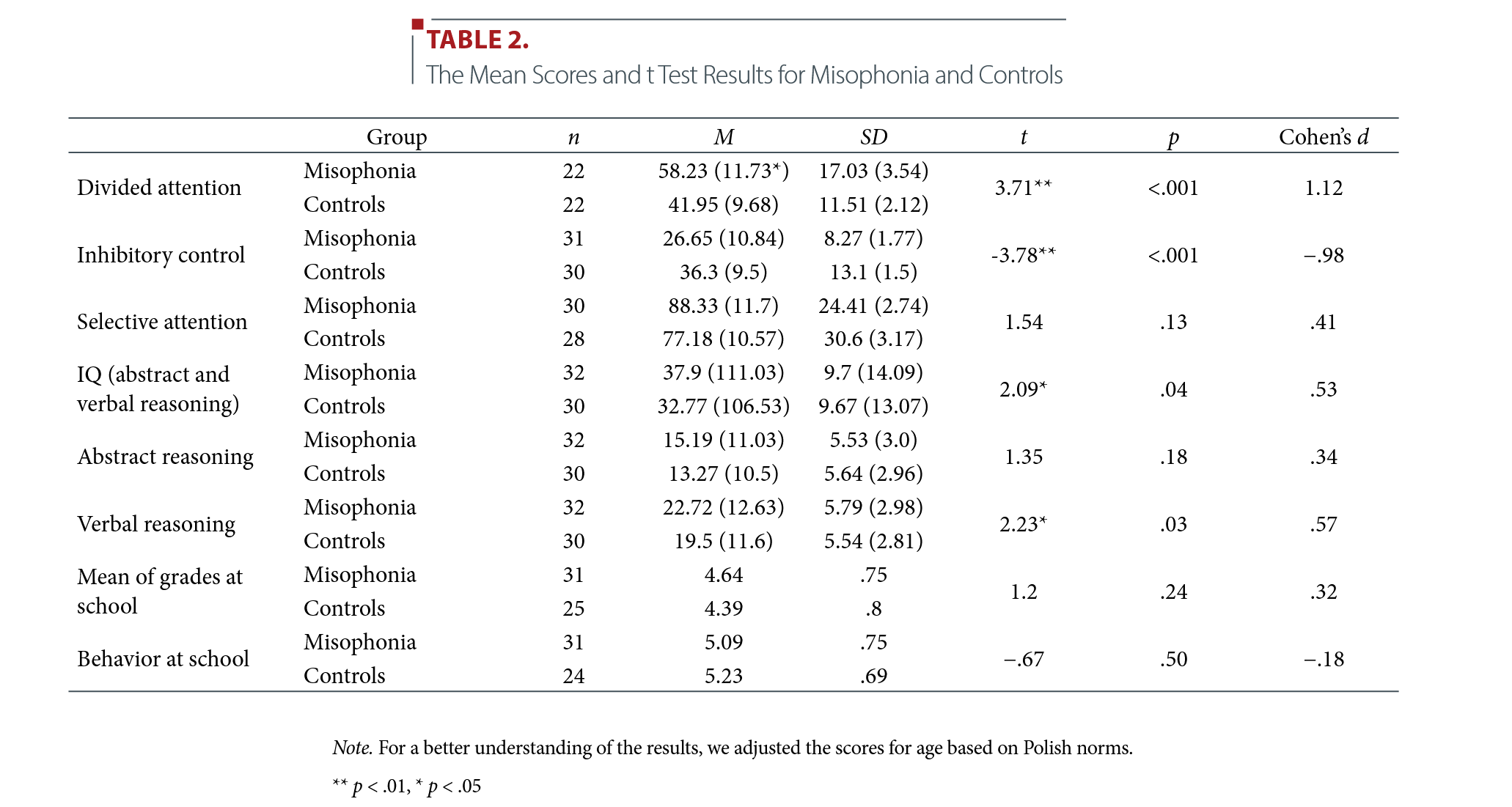
| Results | • Significant group differences: • Misophonia group showed: Better divided attention (large effect size, p < .001), Better inhibitory control (lower error scores; p < .001), Slightly better verbal reasoning and higher composite IQ (p < .05). • No group differences in: Selective attention, Abstract reasoning, School grades, or behavioral ratings • Regression analyses: • Logistic regression: Better inhibitory control significantly predicted misophonia diagnosis. • Linear regression: Selective attention and misophonia status significantly predicted better inhibitory control, controlling for IQ, age, and sex. |
| Discussion/Limits | Conclusion- • Children with misophonia do not exhibit cognitive deficits; instead, they show enhanced inhibitory control and divided attention. • Enhanced cognitive control may be a compensatory mechanism developed to manage aversive stimuli. • Misophonia may exhibit cognitive profiles distinct from other neurodevelopmental disorders like ADHD and ASD, where executive dysfunction is common. |
| Limitations:: | • Small sample size and incomplete data for some subtests (e.g., divided attention). • Home testing environments may introduce uncontrolled variability. • Comorbidities like anxiety and depression were not controlled, though they did not appear to impair cognitive performance in this sample. |
| Future Directions:: | • Larger and more representative samples. • Longitudinal studies to track cognitive trajectories. • Focus on auditory-specific tasks to explore modality-specific effects. • Comparative studies with other clinical populations (e.g., ADHD, ASD). |
| Relevance:: | • looked at differences in “cold cognitive processes” like inhibitory control, selective/divided attention, and verbal/abstract reasoning in kids with and without Misophonia using standard assessments. they found that Misophonics had better divided attention and inhibitory control suggesting that Misophonia may be linked to enhanced inhibitory control rather then impaired cognitive functioning • this could be a reason for why we have not found the trigger specific behavioral effects from my dissertation task ( though it doesn’t explain the overall worse performance I saw) • notable for focus on kids (7-17)rather then the standard adult population |
Notes
key Terms
-
Misophonia – A disorder characterized by aversive emotional, behavioral, and physiological reactions to specific, typically repetitive sounds, such as chewing or tapping.
-
Cold cognitive processes – Cognitive functions not influenced by emotional or motivational factors, such as selective attention, divided attention, and inhibitory control.
-
Inhibitory control – The ability to suppress prepotent responses;
-
Selective attention – The ability to focus on specific stimuli while ignoring others; tested with a visual discrimination task.
-
Divided attention – The capacity to manage multiple tasks or stimuli simultaneously.
-
CHC theory – The Cattell-Horn-Carroll theory of intelligence, used as the framework for the IDS-2 test.
my engagement notes
my questions
my comments
Bookmarks
- bookmark talking about using these findings to differentiate Misophonia from ADHD (page 7)
reading notes
- the authors note 3 studies that have looked at cold cognitive processes in Misophonia. specifically they mention (Eijsker et al., 2019), (Frank et al., 2020), and (Abramovitch et al., 2023) (page 2)
Compensatory Mechanism Hypothesis:
- Findings parallel those in anxiety and Tourette’s syndrome, where heightened cognitive control may serve as an adaptive response to chronic internal demands.
Transdiagnostic Relevance:
- Misophonia might lack the cognitive impairments seen in many psychiatric disorders, raising questions about its nosological classification and suggesting distinct neurocognitive mechanisms.
Comorbidity Considerations:
- Despite high rates of anxiety/depression symptoms, the misophonia group’s superior performance challenges assumptions about cognitive deficits in comorbid contexts.