Properties (13)
- purpleRed
- (Berger et al., 2024)
- Misophonia
- anterior insular cortex (AIC)
- Perception–action link
- Mimicry
- Social cognition
- Chameleon effect
- Hyper-mirroring
- auditory imagery
A social cognition perspective on misophonia
Status:: #status/reviewed
Metadata
- Item Type: #journalArticle
- Authors: Joel I. Berger, Phillip E. Gander, Sukhbinder Kumar,
- Date Added: August 14, 2025
- URL: https://royalsocietypublishing.org/doi/10.1098/rstb.2023.0257
- DOI: 10.1098/rstb.2023.0257
- Cite Key: bergerSocialCognitionPerspective2024
- Tags: #Misophonia, #Auditory, #literature-review, #model, #action-perception, #theoretical
- PDF Attachments
Abstract
| Background/Purpose | Background- • Misophonia has been defined since the early 2000s but remains under-researched. • Existing models primarily describe it as a disorder of emotional reactivity to specific sounds. • Prior models have emphasized the role of the limbic system but have not deeply engaged with the broader social or cognitive context. Purpose- • Propose and justify a new model of misophonia grounded in social cognition and action perception, moving beyond an auditory-only framework. • Present neurobiological and behavioral evidence for the involvement of motor cortex, insula, and social-emotional processes in misophonia. • Review behavioural and neuroimaging evidence supporting a social cognitive framework. Outline therapeutic implications of a context-based model. |
| Participants/samples | • As an opinion/theoretical paper, no new empirical data were collected. • Synthesizes findings from prior fMRI, behavioral, and survey studies, including prior work by the authors. |
| Measures | Review integrates measures from prior studies including: - fMRI and resting-state connectivity data - Behavioral rating of sound aversiveness - Galvanic skin responses (physiological stress markers) - Self-reported mimicry incidence - Online surveys (n > 600 in some referenced studies) |
| Procedures | N/A |
| Results | major take aways from discussed studies include: • Source context matters: Perceived origin of sounds significantly affects their aversiveness. • Anterior insula: Consistently hyperactive in misophonia; linked to social emotions and interoception. • Motor cortex: Increased activation in misophonia; especially ventral premotor cortex, even at rest. • Auditory cortex: No consistent difference between misophonia and controls; suggests misophonia is not a simple auditory processing disorder. • Mimicry: High prevalence (>45%), especially for orofacial triggers; correlates with symptom severity; can provide subjective relief. |
| Discussion/Limits | Conclusion- • Misophonia is better understood as a disorder of social cognition and action perception, not just of sound processing. • Trigger sounds are proxies for socially-relevant actions, activating motor representations and emotional circuits. • Hyperactivation in insula and motor cortex supports this social model. • Mimicry may reflect either coping, hyper-mirroring, or heightened motor empathy. |
| Limitations:: | • Theoretical model; lacks direct experimental validation. • Unclear how non-social trigger sounds (e.g., ticking clock) fit the model. • Existing neuroimaging studies often ignore comorbidities (e.g., anxiety, hyperacusis). • Precise roles of motor cortex and anterior insula remain unclear. • Existing neuroimaging studies do not account for comorbidities such as hyperacusis or anxiety. • Model does not fully account for non-social triggers (e.g., ticking clock, animal sounds). • Specificity of motor cortex activation by trigger type not yet tested. • Neural mechanisms of action perception remain debated. |
| Future Directions:: | • one way to test the current model is to test the specificity of motor cortex activation, where one would expect greater activation in areas related to the trigger modality (ex: more orofacial activation for orofacial triggers, etc..) (page 5) • Empirical tests of the proposed model using neuroimaging with specificity (e.g., hand vs. orofacial motor cortex). • Study empathy subtypes (especially motor empathy) in misophonia. • Investigate general sensory hypersensitivity and its link to mimicry or social awareness. • Explore cognitive-behavioral therapy (CBT) approaches that reframe sound context to mitigate distress. • future work should look into the idea that Misophonia reflects more generalized hypersensitivity to stimuli in other sensory modalities as well (ex: visual triggers) • work should be done studying how the perception–action system drives mimicry in misophonia and in typical populations, which could clarify its neural basis, with implications for both the disorder and broader social cognition. |
| Relevance:: | • describes a model of misophonia ( the most up to date Kumar model as of this publication) • good source for review on the cognitive-social aspects of misophonia •gives good talk on the role of mimicry in misophonia • gives review of major point to consider for any model of Misophonia •describes potential therapeutic implications of incorporating social cognitive aspects of Misophonia • brings up the interesting idea about a role of different kinds of empathy in Misophonia • a fantastic source for perspectives and future directions on Misophonia that I had not considered before |
| Statistics:: | • Prevalence 5–18%. • Suicidal thoughts up to approximately 20%. • Early mimicry self-report ~55% (n=11). • Large-scale mimicry prevalence >45% (n=676). |
Notes
key terms and concepts
-
Misophonia – A condition characterized by strong negative emotional and physiological reactions (e.g., anger, disgust) to specific trigger sounds, typically those produced by other humans (e.g., chewing, breathing).
-
Anterior insula – A brain region involved in interoception, emotion processing, and social cognition, shown to be hyperactive in misophonia during exposure to trigger sounds.
-
Perception–action link – A theoretical framework where perceiving an action (e.g., hearing someone chew) activates a motor representation of that action in the observer’s brain.
-
Mimicry – Involuntary or voluntary imitation of another’s actions (e.g., copying a chewing motion), common among people with misophonia and sometimes used to reduce distress.
-
Social cognition – The cognitive processes involved in understanding and interpreting social cues, emotions, and intentions; proposed as central to misophonia in this model.
-
Chameleon effect – A social phenomenon where individuals nonconsciously mimic others’ behavior, enhancing social bonding; discussed in relation to mimicry in misophonia.
-
Hyper-mirroring – A proposed phenomenon where individuals over-activate perception–action links, potentially contributing to misophonic reactions.
my engagement notes
my questions
my comments
Bookmarks
- bookmark talking about mimicry in misophonia (page 3)
- Bookmark for talking about Sound Perception to Action Perception (page 3)
- Bookmark for talking about mimicry (page 4)
- Bookmarking for chameleon effect and possible role of empathy in misophonia (page 4)
- Bookmark for the neural model for a social cognitive perspective of misophonia (page 4)
reading notes
the authors list several key factors to consider for any model of Misophonia
- the source of the sound is an important factor in triggering events
- trigger sounds recruit involvement of the insular cortex
- Trigger sounds causes hyperactivation of motor cortex in Misophonia
- the auditory cortex is not activated differently in Misophonia compared to controls
- there is a high prevalence of mimicry in Misophonia (page 2)
the authors note a conflict between Kumar and Schröder
- (Kumar et al., 2017) findings contrast with (Schröder et al., 2019)’s results, which showed increased activity in the posterior right superior temporal cortex in people with misophonia.
- Schröder et al. found this increased activation in the lateral posterior superior temporal gyrus/sulcus, a higher-order multimodal area involved in visual motion and social perception, not in the primary auditory cortex.
- The absence of differential activation in the core auditory cortex suggests that misophonia trigger sounds are not processed differently there compared to controls.
mimicry in Misophonia
- Mimicry has been frequently reported among people with misophonia, presenting a challenge to current conceptual frameworks.
- Early case studies noted mimicry as a key feature of misophonia.
- Self-report data indicated mimicry in ~55% of sufferers, though based on a small sample (n=11).
- A larger online study (n=676) found a similar incidence (>45%).
- Findings showed:
- Mimicry increases with greater misophonia severity.
- Orofacial sounds (e.g., eating, chewing) are more likely to trigger mimicry than environmental or other human sounds.
- Mimicry can provide relief from distress for individuals with misophonia. - These patterns raise important theoretical questions about why mimicry occurs and why it provides relief, suggesting the need to integrate mimicry into models of misophonia. (page 3)
chameleon effect and possible role of empathy in misophonia
- The chameleon effect; refers to automatic mimicry, which can enhance interpersonal liking and create smoother interactions.
- The impact of mimicry varies depending on the social context and the orientation of the mimicked behaviors.
- This effect is more pronounced in individuals with higher levels of empathy.
- Empathy is generally divided into cognitive, affective, and motor types, each possibly associated with distinct neural mechanisms.
- The connection between empathy and misophonia has not yet been fully explored.
- Understanding this link could reveal whether mimicry in misophonia is due to heightened cognitive functioning or a coping mechanism to manage hyperactivity in the insula.
- The anterior insula, a brain region overactive in misophonia, is also tied to empathetic processing.
- Hyperactivity in the insula may reflect an increased presence of a specific type of empathy in those with misophonia.
- No current studies have examined the influence of different empathy subtypes in misophonia.
- Motor empathy, involving the automatic imitation of others' motor actions, may be especially relevant in misophonia, rather than cognitive or affective empathy.
tldr of the neural model for social cognitive perspective of Misophonia
- Auditory stimuli travel through lower auditory pathways to motor regions and higher auditory areas like the superior temporal sulcus, where they are transformed into motor representations.
- People with misophonia show increased connectivity between the auditory system and motor regions.
- The aberrant auditory signal is communicated to the insula, supported by evidence of stronger motor–insula connectivity and increased insula activation.
- Neuroimaging shows the anterior insula activates when countering mirrored actions, suggesting it processes error signals.
- The insula may then relay signals to the amygdala, driving emotional responses, and to autonomic areas like the periaqueductal gray, producing physiological changes (e.g., heart rate, skin response).
- This perception–action network provides a possible explanation for mimicry in misophonia, where unconscious or deliberate imitation may help relieve distress by dampening insula hyperactivity. (page 4)
Theoretical Integration
-
Strong argument for aligning misophonia with social disorders (e.g., social phobia, social pain).
-
Important reframing: misophonia is not "hatred of sound" but possibly hypersensitivity to social signals.
Clinical Implications
-
CBT may be effective due to its contextual reframing approach.
-
Potential therapeutic focus: altering perceived meaning of sounds rather than suppressing the sound itself.
-
Possible overlap with misokinesia; same theoretical model may apply.
Neuroanatomical Focus
-
Emphasis on a perception–action–emotion loop involving:
-
Auditory/visual cortices
-
Motor cortex
-
Anterior insula
-
Amygdala
-
Autonomic regulation centers (e.g., periaqueductal gray)
-
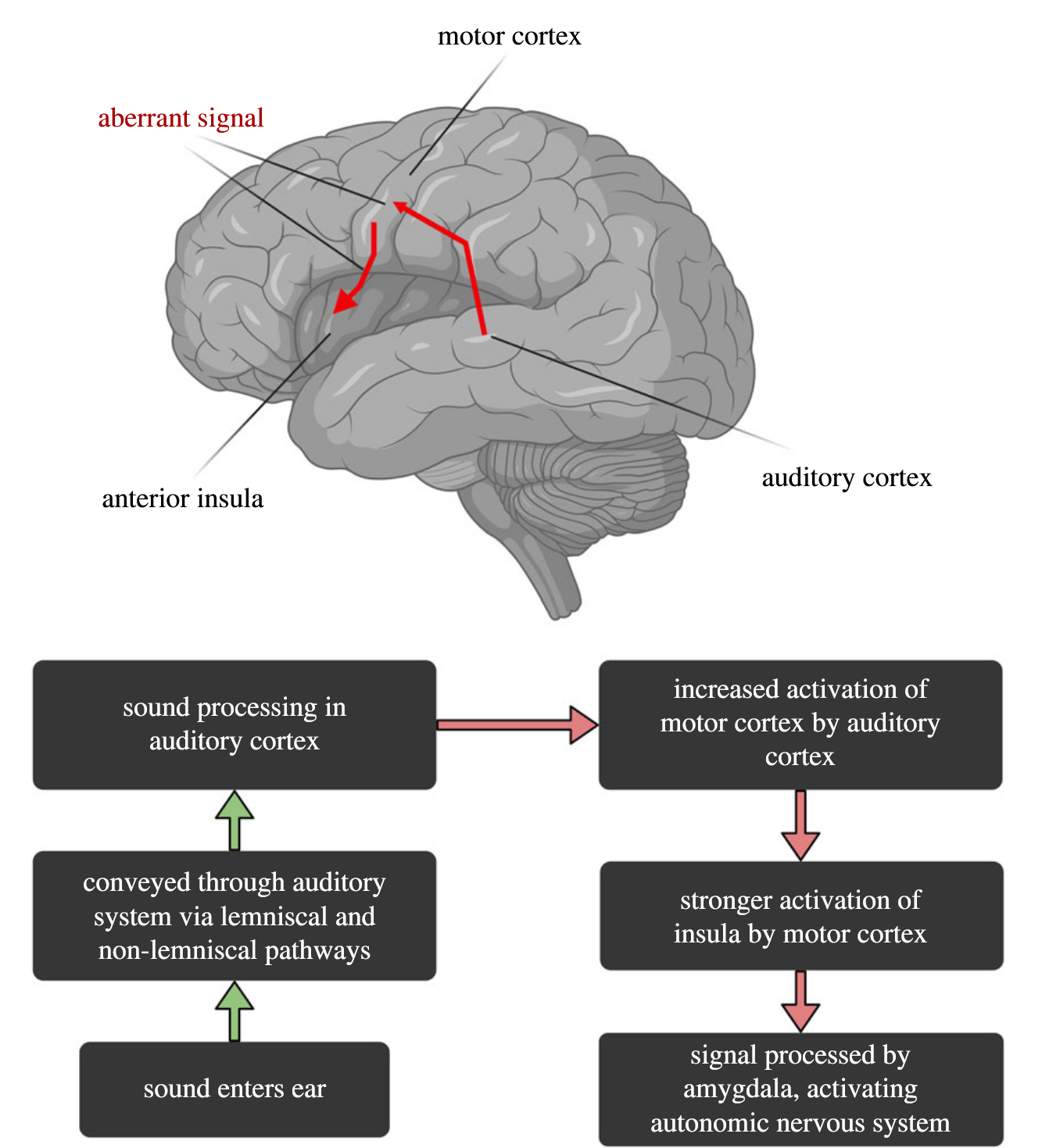
-
citations showing sound source effects for generally aversive sounds in non-Misophonia context (page 6)
-
source showing prevalence of mimicry in misophonia (page 7)
potential therapeutic implications of incorporating social cognitive aspects of Misophonia
- A therapeutic implication of a social cognitive model of misophonia is testing whether neurobiological or physiological responses to triggers change when the context of the sound is altered.
- Re-framing a trigger sound in a different context may reduce the severity of misophonic responses.
- Training participants to re-frame the context of triggers could provide relief and serve as a treatment strategy.
- In non-misophonia participants, stress responses to unpleasant sounds (e.g., nails on a blackboard) were reduced when reframed as contemporary music.
- Therapies emphasizing context rather than the sound itself could also apply to misokinesia (visual analogue of misophonia).
- Preliminary evidence supporting cognitive behavioral therapy for misophonia suggests context is a key factor in aversive responses. (page 4)
zettelkasten
Berger 2024 discussing key factors of consideration for any Misophonia model
Berger 2024 describes the conflict between Kumar Schroder
Berger 2024 review of the role of mimicry in Misophonia
Berger 2024 on the chameleon effect and possible role of empathy in misophonia