Properties (14)
- purpleRed
- (Dheerendra & Ramesh, 2025)
•
Is iron dysregulation in the mirror motor cortex associated with misophonia?
Status:: #status/reviewed
Metadata
- Item Type: #journalArticle
- Authors:: Pradeep Dheerendra, Soumita Ramesh,
- Date Added: October 2, 2025
- URL: https://linkinghub.elsevier.com/retrieve/pii/S030698772500204X
- DOI: 10.1016/j.mehy.2025.111765
- Cite Key: dheerendraIronDysregulationMirror2025
- Tags: #Misophonia
- PDF Attachments
Abstract
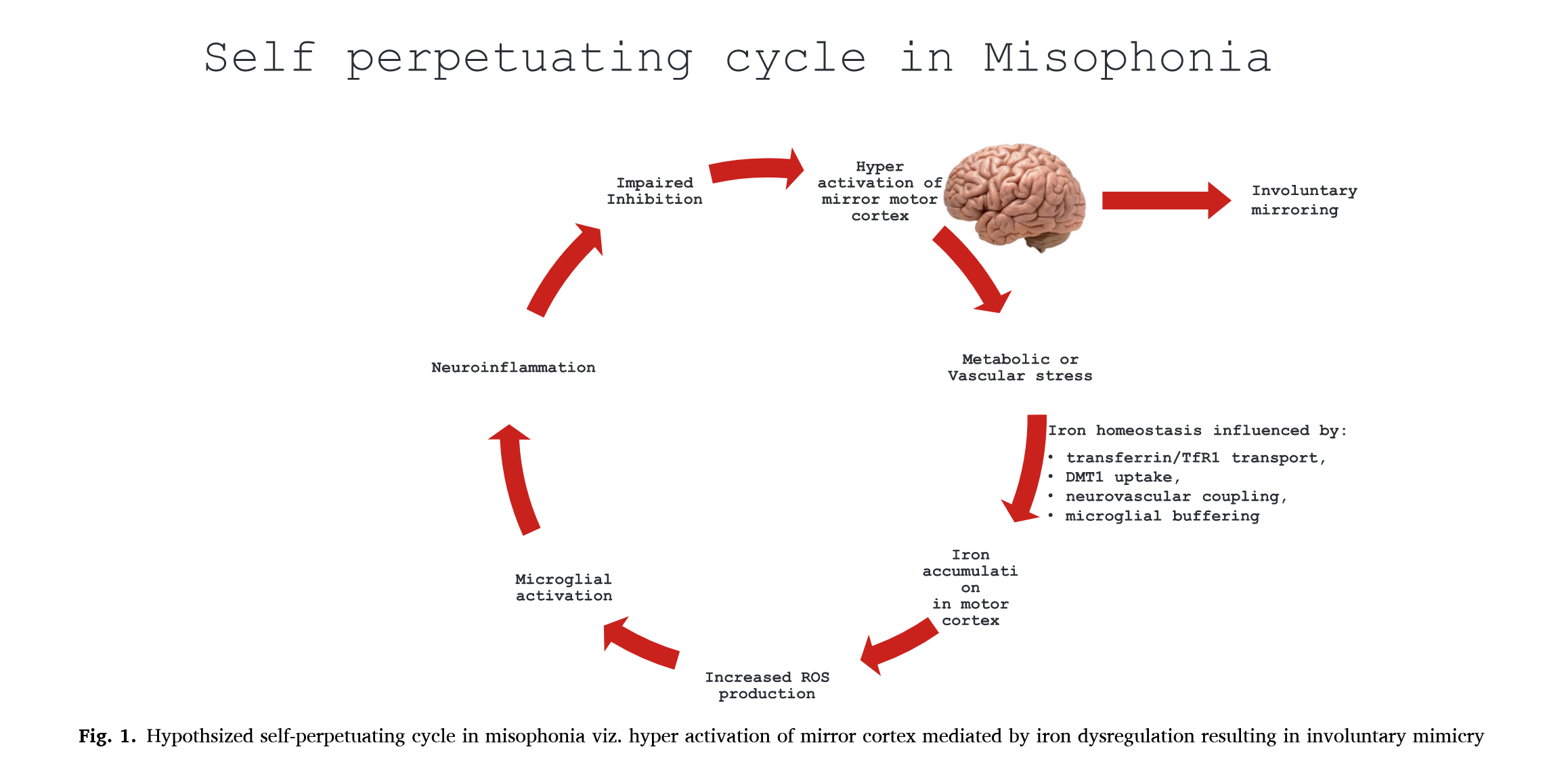
| Background/Purpose | Background- • Iron is vital for various neurobiological processes but becomes harmful when dysregulated, contributing to neurodegenerative and psychiatric disorders (e.g., Parkinson’s, Alzheimer’s, schizophrenia). • Emerging evidence suggests iron dysregulation may underlie aspects of severe mental illnesses. • Misophonia has been linked to overactivation in the orofacial motor cortex during trigger sound perception, particularly involving mirror neuron systems. Purpose- • To propose a novel hypothesis linking iron dysregulation in the mirror motor cortex with misophonia. • To suggest a self-perpetuating feedback loop: mirror system hyperactivity → increased metabolic demand → cerebral iron accumulation → neuroinflammation → impaired inhibition → further hyperactivity. • To highlight directions for future neuroimaging and therapeutic interventions targeting this proposed cycle. |
| Participants/samples | N/A |
| Measures | N/A |
| Procedures | N/A |
| Results | N/A |
| Discussion/Limits | Conclusion- • The authors propose that misophonia involves a self-sustaining loop of neural hyperactivity and iron dysregulation centered on the mirror motor cortex. • Intervening in this loop (e.g., reducing mirror neuron hyperactivity or targeting iron accumulation) could yield therapeutic benefits. |
| Limitations:: | • The model is theoretical; no direct empirical evidence yet links cortical iron accumulation to misophonia. • Mechanistic inferences are drawn from analogous conditions (e.g., Parkinson’s, Alzheimer’s, epilepsy) with distinct pathophysiology. |
| Future Directions:: | • Use neuroimaging to quantify iron in misophonia patients, particularly in the mirror motor cortex. • Investigate behavioral and sensory phenotypes alongside iron imaging (e.g., sensory responsivity, attentional bias). • Combine in vivo imaging with post-mortem histological analysis. • Explore therapeutic avenues: antioxidants, iron chelators, anti-inflammatory agents, or neuromodulation targeting mirror neuron systems. |
| Relevance:: | • a quick communication describing a hypothesis around the Iron accumulation in the mirror system of the brain being the cause of Misophonia. • a novel idea with some suggestions for how to test it. at the time of my regarding this proposal I don't have a use for it beyond cataloging another Misophonia model., but I should keep an eye out to follow ups to this idea. |
Notes
Key terms
-
Misophonia – A condition marked by intense emotional and physiological reactions to specific human-generated sounds (e.g., chewing, breathing), often resulting in avoidance of social situations.
-
Mirror neuron system – A brain network involved in mirroring observed actions, hypothesized to play a key role in misophonia due to overactivation during trigger sound perception.
-
Mirror motor cortex – A region of the motor cortex implicated in action observation and mimicry, thought to be pathologically hyperactive in misophonia.
-
Iron dysregulation – Abnormal accumulation or depletion of iron in the brain, associated with oxidative stress, neuroinflammation, and synaptic dysfunction.
-
Neuroinflammation – Chronic, low-grade activation of immune responses in the brain that can drive maladaptive plasticity and neural dysfunction.
-
Long-term potentiation (LTP) – A persistent strengthening of synapses that can lead to enhanced connectivity; in this context, potentially pathological.
-
Quantitative Susceptibility Mapping (QSM) – An MRI technique that allows precise measurement of iron distribution in the brain.
my engagement notes
my questions
my comments
Bookmarks
reading notes
Summary of the Model Proposed in the Article
The authors propose a self-perpetuating neurobiological model of misophonia that centers on iron dysregulation in the mirror motor cortex. This model integrates findings from misophonia research, iron metabolism, and broader neuroscience literature:
-
Mirror Motor Cortex Hyperactivity:
-
Individuals with misophonia show chronic hyperactivation of the orofacial mirror motor cortex during both rest and perception of trigger sounds.
-
This region is involved in encoding observed oral movements (e.g., chewing, breathing) and is linked to the mirror neuron system.
-
-
Increased Metabolic Demand and Cerebral Blood Flow:
-
Persistent overactivation increases local metabolic demand.
-
This elevates cerebral blood flow to the region, enabling greater iron influx into the cortical tissue.
-
-
Iron Accumulation and Neuroinflammation:
-
Excess iron induces oxidative stress and low-grade, chronic neuroinflammation.
-
This disrupts synaptic plasticity and may promote maladaptive long-term potentiation (LTP).
-
-
Disinhibition and Hyperconnectivity:
-
Chronic LTP reduces inhibitory control over the mirror motor cortex.
-
This enhances functional connectivity with sensory areas (auditory, visual), promoting pathological mirroring and involuntary mimicry of trigger actions.
-
-
Self-Reinforcing Feedback Loop:
-
The process is theorized to form a vicious cycle:
- Hyperactivity → Iron influx → Neuroinflammation → Reduced inhibition → Further hyperactivity, reinforcing misophonic responses.
-
-
Therapeutic Implications:
-
Breaking this cycle could involve:
-
Reducing mirror cortex hyperactivity.
-
Using antioxidants, iron chelators, or anti-inflammatory agents.
-
Employing imaging techniques (e.g., QSM, SWI) to detect and monitor cortical iron.
-
-
In essence, the model posits that iron-driven pathophysiological mechanisms underlie and sustain the aberrant sensorimotor coupling seen in misophonia, representing a novel and potentially targetable mechanism.
Relevance of Iron Dysregulation Models in Other Disorders
-
Parkinson’s: Iron buildup in substantia nigra triggers oxidative stress and neuron death.
-
Alzheimer’s: Iron promotes amyloid and tau aggregation, feeding into inflammatory cycles.
-
Multiple Sclerosis: Iron exacerbates demyelination and immune-related CNS damage.
-
Epilepsy: Seizure-induced hyperexcitability leads to iron accumulation, oxidative stress, and further seizures.
Conceptual Innovation
- While iron dysregulation has been tied to neurodegeneration, this model applies the logic to a developmental neuropsychiatric context (misophonia), proposing a unique mechanism not previously explored in this disorder.
Diagnostic & Therapeutic Implications
- If validated, this model suggests biomarker potential (e.g., MRI-visible iron distribution) and novel interventions (e.g., targeting cortical iron or neural activity).
zettlekasten
Dheerendra & Ramesh 2025 Iron dysregulation model of Misophonia