Properties (14)
- purpleRed
- Does Misophonia Affect Spatial Hearing?
- (Roy et al., 2026)
•
Does Misophonia Affect Spatial Hearing? A Study Using Closed-Field Assessment Tools
Status:: #status/reviewed
Metadata
- Item Type: #journalArticle
- Authors:: Urmi Roy, Prashanth Prabhu, Kavassery Venkateswaran Nisha,
- Date Added: March 14, 2026
- URL: https://pubs.asha.org/doi/10.1044/2025_AJA-25-00058
- DOI: 10.1044/2025_AJA-25-00058
- Cite Key: royDoesMisophoniaAffect2026
- Tags: #Misophonia, #clinical, #audiology, #diagnosis, #IDL
- PDF Attachments
Abstract
| Background/Purpose | Background- • Spatial hearing relies on binaural cues (ITD for low frequencies, ILD for high frequencies) processed via circuits from brainstem to cortex. • Misophonia and attentional processing share overlapping neural substrates: anterior insula cortex (AIC), prefrontal cortex, and auditory cortex. • AIC is hyperactive in misophonia and involved in both interoception/emotional salience and attentional functioning. • Prefrontal cortex modulates selective attention to spatial sound sources; excessive attentional bias in misophonia may disrupt cognitive resources for spatial processing. • Prior research on temporal auditory processing (gap detection, TMTF, frequency pattern recognition, duration discrimination) showed no group differences in misophonics vs. controls. • No prior study had examined spatial hearing (ITD, ILD, VASI) in individuals with misophonia. Purpose- • Overall: to determine whether misophonia affects spatial hearing by comparing ITD thresholds, ILD thresholds, and VASI scores between misophonic and non-misophonic individuals. • Hypothesis: altered attentional mechanisms in misophonia, mediated by AIC and prefrontal hyperactivity, impair spatial sound localization by disrupting integration of binaural auditory cues. • Secondary goal: examine correlations between A-MISO-S severity scores and spatial hearing measures within the misophonic group. • Tertiary goal: determine whether ITD, ILD, and VASI can classify group membership using Fisher discriminant analysis. |
| Participants/samples | • N = 40 normal-hearing adults; ages 18–30 years. • Misophonia group: n = 20; all female; mean age = 21.7 years. • Control group: n = 20; 15 males, 5 females; mean age = 22.3 years. • Gender imbalance acknowledged; authors cite prior literature indicating no significant gender differences in horizontal azimuthal localization to justify proceeding. • Inclusion (misophonia group): met all 6/6 Schröder et al. (2013) diagnostic criteria; A-MISO-S score ≥ 5. • Exclusion (all): history of middle ear infections, neurological/psychological disorders, systemic conditions, hyperacusis, tinnitus, frequent vertigo, significant noise exposure, ototoxic medication use, audiometric notch (≥5 dB elevation at 4000 or 6000 Hz with ≥5 dB recovery at 8000 Hz). |
| Measures | • A-MISO-S: 6-item severity questionnaire; scores 0–24; five severity categories (subclinical to extreme); Cronbach's α = .81. • Schröder et al. (2013) diagnostic criteria checklist: 6-item; all 6 required for inclusion. • ITD threshold: 3I-2AFC psychoacoustic task; 330-Hz pure tone, 250 ms, 65 dB SPL; Maximum Likelihood Procedure (MLP); 30 trials; threshold = 70.7% correct on cumulative logistic function. • ILD threshold: 3I-2AFC; 5000-Hz pure tone, 250 ms, 65 dB SPL; MLP; 30 trials; threshold = 70.7% correct. • VASI: 80 trials (8 azimuthal locations × 10 trials); 250-ms white band noise convolved with HRTF from SLab3D; locations: 0°, 45°, 90°, 135° right and left, 180°; GUI-based response via mouse click; overall and location-specific accuracy scores. • Pure-tone audiometry: AudioStar Pro audiometer; TDH 39 supra-aural headphones; modified Hughson–Westlake technique. • Immittance: tympanometry and acoustic reflexes via GSI TympStar. |
| Procedures | • All psychoacoustic tests conducted under headphones (closed-field); stimuli calibrated at 65 dB SPL via acoustic manikin and sound level meter; routed through MOTU MicroBook II sound card to Sennheiser HD 280 Pro headphones. • Participants completed ITD and ILD familiarization (10 trials each; large step sizes: 200 μs ITD, 10 dB ILD) before threshold testing. • ITD task: three successive stimuli; two midline (0° azimuth), one lateralized via ITD (leading ear randomized); participants pressed keyboard keys 1/2/3 to indicate which interval was lateralized; step size adjusted logarithmically (±2 to ±500 μs). • ILD task: identical 3I-2AFC structure; ILD imposed by symmetric intensity adjustment across ears (overall level held constant); participants identified lateralized interval. • VASI familiarization: 10 mouse clicks per virtual location with corresponding spatial stimulus feedback; testing phase: 80 trials; responses recorded via Paradigm software GUI; correct = 1, incorrect = 0; confusion matrix generated in MATLAB. • Statistical sequence: Shapiro–Wilk normality test → MANOVA (ITD/ILD/VASI group differences) → Pearson correlations (A-MISO-S vs. spatial measures, misophonia group only) → Fisher discriminant analysis (group classification). |
| Results | Group differences in spatial processing • Misophonic group showed elevated (poorer) ITD thresholds relative to controls. • Misophonic group showed lower overall VASI accuracy scores relative to controls. • ILD thresholds did not differ between groups (null finding). Location-specific VASI performance • Misophonic group showed poorer accuracy specifically at R45 and L45 positions. • No group differences at R90, R135, 180°, L135, L90, or 0° positions. Correlation with misophonia severity (misophonic group only) • Higher A-MISO-S scores were negatively associated with overall VASI accuracy scores. • A-MISO-S scores were not significantly correlated with ITD or ILD thresholds (null findings). Discriminant classification • ITD and VASI accuracy together effectively predicted group membership; ILD contributed minimally. • ITD was the strongest predictor; VASI accuracy was a moderate predictor. • Overall classification accuracy was high; cross-validated accuracy was slightly lower. |
| Discussion/Limits | Conclusion- • The authors conclude that elevated ITD thresholds in misophonia indicate functional deficits in brainstem circuits for binaural temporal integration, specifically implicating the MSO; however, authors note this interpretation is tentative pending neurophysiological confirmation. • normal ILD thresholds alongside elevated ITD thresholds suggest intensity-based spatial processing is preserved while temporal binaural processing is affected (pdf) . • The authors conclude that the discrepancy between impaired ITD performance and previously reported normal temporal processing (gap detection, TMTF, frequency patterns) is explained by differing neural demands: ITD requires binaural brainstem interaction, whereas those tasks are monaural or thalamocortical. • normal ABRs previously reported in misophonics do not preclude subtle binaural temporal deficits, as ABRs assess monaural onset-based processing rather than fine interaural timing. • reduced VASI performance reflects limited cognitive resources (attentional control, working memory, decision-making) available for complex spatial tasks in misophonic individuals. • the negative correlation between A-MISO-S and VASI scores reflects shared attentional resource demands: increased misophonia severity amplifies vigilance for triggers, depleting resources available for spatial processing. • specific impairment at R45 and L45 is consistent with inherent difficulty integrating binaural cues at intermediate azimuthal angles, compounded by misophonia-related attentional interference. • ITD and VASI accuracy are robust diagnostic markers for spatial processing deficits in misophonia and may have clinical utility for early identification. • The authors conclude that misophonia, even in mild form, may impair performance on auditory tasks requiring higher cognitive load and attentional engagement. |
| Limitations:: | • VAS externalization was not assessed; non-individualized HRTFs may reduce perceptual realism, potentially limiting generalizability to real-world listening contexts. • Emotional arousal, cognitive load, and attentional engagement were not directly measured during tasks; proposed links between affective states and spatial performance are theoretical, not empirically demonstrated within this dataset. • Gender imbalance between groups (all-female misophonia group vs. predominantly male controls); authors argue this is unlikely to affect horizontal azimuthal results based on prior literature. • Sample restricted to mild-to-moderate misophonia severity; spectrum of deficits at higher severity levels is uncharacterized. • Violation of homogeneity of covariance assumption in FDA; addressed by equal group size criterion. • No neuroimaging or neurophysiological measures included to link behavioral deficits to neural substrates. |
| Future Directions:: | • Include participants across a broader range of misophonia severity, particularly those with clinically significant impairment. • Incorporate neuroimaging (fMRI, EEG) to clarify roles of anterior insula, prefrontal cortex, and auditory cortex in spatial hearing deficits. • Develop and test targeted interventions for attentional control: computerized cognitive training, mindfulness-based interventions, CBT adapted for misophonia, and pharmacological strategies targeting attentional networks. • Include physiological, behavioral, and cognitive measures alongside spatial tasks to empirically test the attentional interference hypothesis. • Assess VAS externalization to improve ecological validity of findings. |
| Relevance:: | • looked at differences in spatial hearing for Misophonics vs controls. they found higher interaural time difference (ITD) and lower performance on virtual spatial identification tasks in the Misophonic group. the authors suggest that Misophonia may be associated with reduced performance on binaural cue tasks using temporal cues ( ITD) and special identification. • discusses a tendency for lateral spatial localization for sounds to be dependent more on ITD for low frequencies and ILD for high frequency. this has broader implications for both future Misophonia work as well as my current FYP5 experiment (pdf) . • a quick follow up with the cited source seems to indicate that ILD's frequency specificity below 1,000 HZ is negligible. so fyp5 should be fine (Middlebrooks, 2015) • provides some interesting audiological explanations for the observed predictors, linking it to the frequency bands involved and underlying neurophysiology |
Notes
key terms and concepts
- misophonia – condition characterized by strong negative emotional and physiological reactions to specific, typically human-generated sounds (e.g., chewing, breathing, pen clicking).
- interaural time difference (ITD) – difference in arrival time of a sound between the two ears; primary binaural cue for low-frequency sound localization on the horizontal plane.
- interaural level difference (ILD) – difference in sound intensity between the two ears; primary binaural cue for high-frequency sound localization.
- Virtual Acoustic Spatial Identification (VASI) – closed-field test using head-related transfer function (HRTF)-processed stimuli delivered via headphones to assess horizontal-plane sound localization across eight virtual azimuthal positions.
- A-MISO-S (Amsterdam Misophonia Scale) – six-item self-report questionnaire scoring misophonia severity from 0–24 across subclinical, mild, moderate, severe, and extreme categories.
- Fisher discriminant analysis (FDA) – multivariate classification procedure used to determine which combination of predictor variables best separates two groups.
- medial superior olive (MSO) – brainstem nucleus responsible for processing fine interaural timing cues; implicated in ITD-based spatial hearing.
- HRTF (head-related transfer function) – acoustic filter characterizing how sound is modified by the head, pinnae, and torso prior to reaching the ear; used to simulate spatial sound in virtual environments.
my engagement notes
my questions
my comments
- different auditory cues are used for different auditory frequencies? if that is the case then it has some impact on the FYP5 experiment
• a quick follow up with the cited source seems to indicate that ILD's frequency specificity below 1,000 HZ is negligible. so fyp5 should be fine (Middlebrooks, 2015) (page 2)
Bookmarks
reading notes
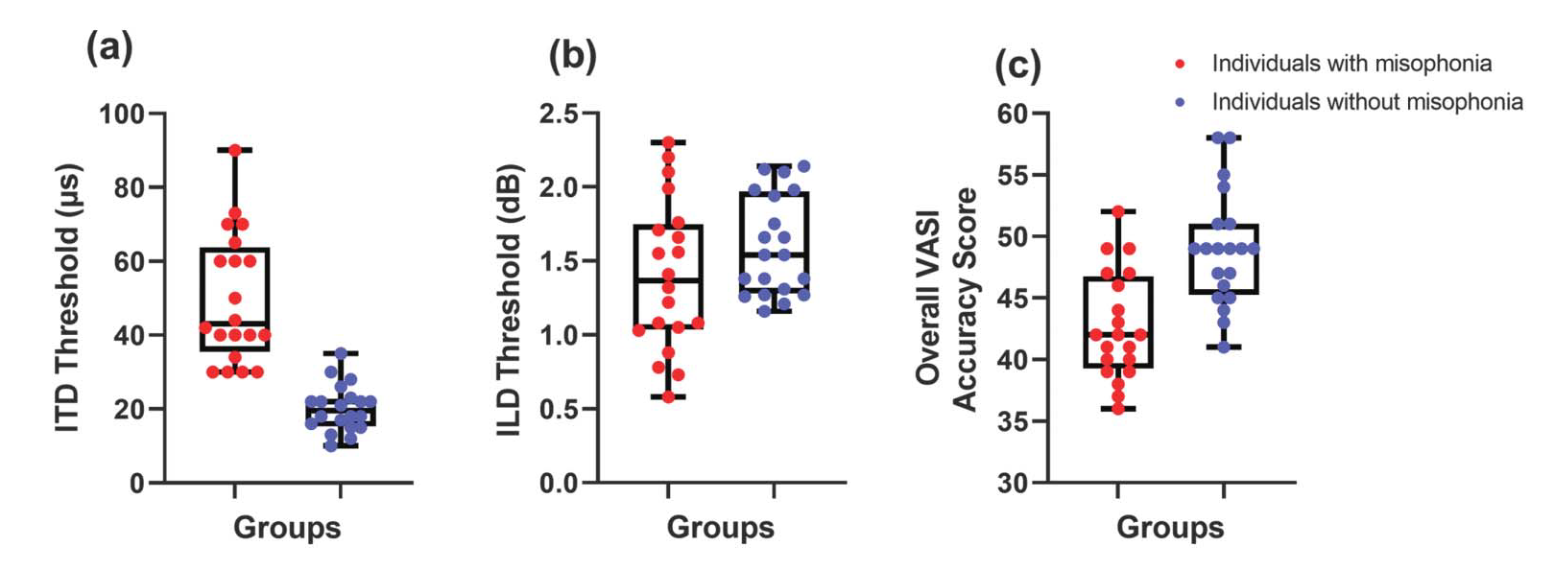
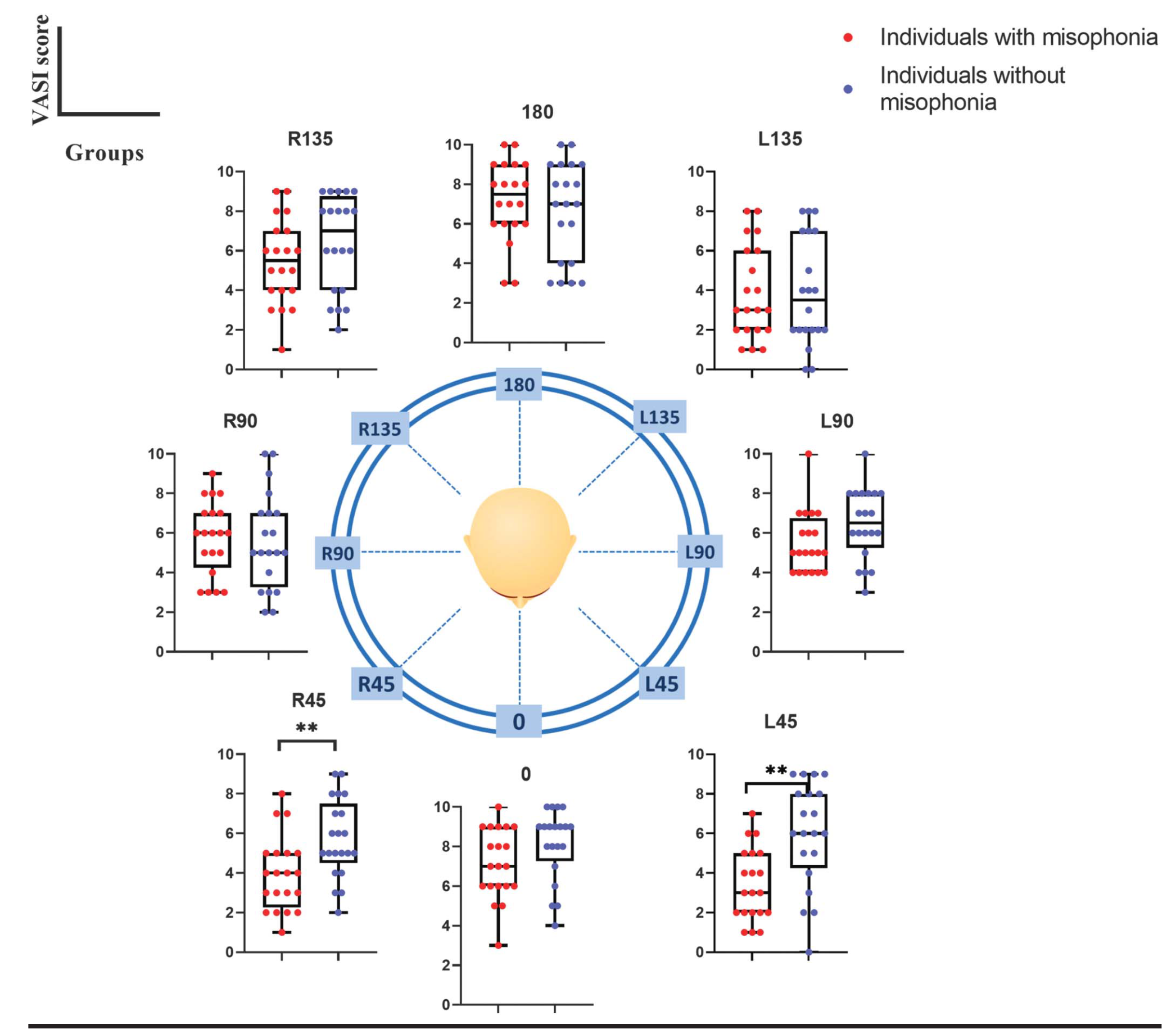
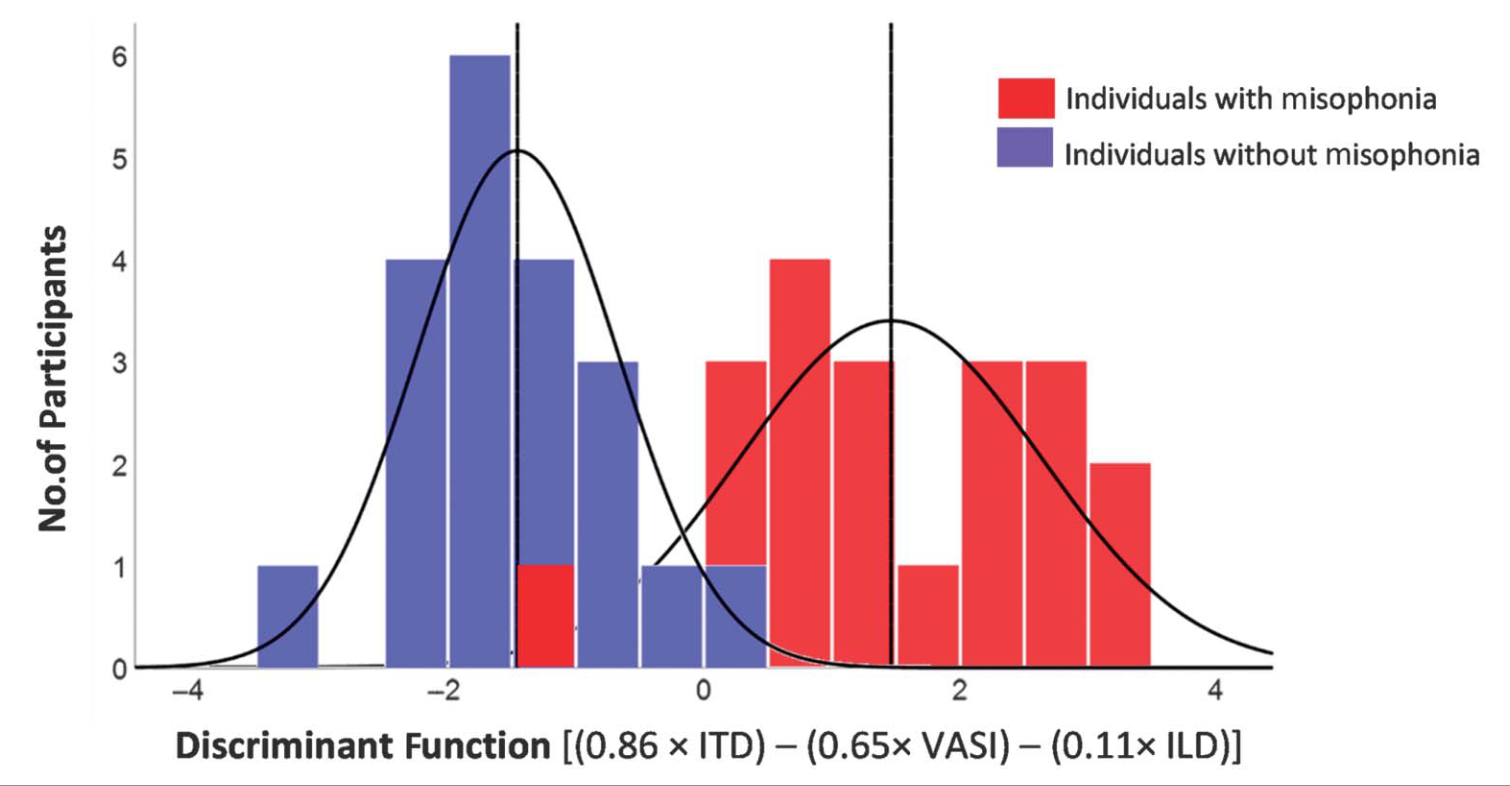
findings that ITD and VASI accuracy are robust diagnostic markers for spatial processing deficits in misophonia
contextual statement
In a 2026 study, Roy compared spatial hearing abilities in 40 normal-hearing young adults (20 with misophonia, 20 controls; ages 18–30) by assessing ITD thresholds, ILD thresholds, and VASI scores using closed-field behavioral paradigms and correlating results with A-MISO-S severity scores.
summary statement
In a 2026 study, Roy examined whether misophonia affects spatial auditory processing by administering ITD and ILD threshold tasks and a virtual acoustic spatial identification test (VASI) to 20 individuals with misophonia and 20 normal-hearing controls, along with the A-MISO-S severity questionnaire. They found that the misophonic group had elevated ITD thresholds and reduced overall VASI accuracy (particularly at R45 and L45 positions), while ILD thresholds did not differ between groups; misophonia severity negatively correlated with VASI accuracy, and ITD and VASI together classified group membership with high accuracy. From this they concluded that misophonia is associated with deficits in binaural temporal processing and spatial identification, likely secondary to attentional resource depletion and possible MSO-level temporal interaction disruption, while intensity-based binaural processing remains intact.
zettlekasten
finding of functional deficits in brainstem temporal binaural integration in Misophonia