Properties (13)
Id 71db4a18-5bf8-4ff8-ada3-7fc116e3c385
Year 2026
Abstract Background: Misophonia is a sound intolerance characterized by intense emotional and physiological responses to specific repetitive sounds, often impairing functioning. Childhood trauma (CT) may elevate the risk of misophonia through its impact on emotion regulation difficulties (ERDs). Methods: We conducted a cross-sectional study of university students (N = 294; mean age = 23.4 ± 5.0; 71.4% female). Participants completed the Childhood Trauma Questionnaire (CTQ), the Difficulties in Emotion Regulation Scale (DERS), and a misophonia Scale. Pearson correlations were calculated, and mediation analysis was performed to test DERS as a mediator between CTQ scores and misophonia. Results: CTQ, DERS, and misophonia were all positively correlated. CTQ showed a significant total effect on misophonia (b = 0.31, 95% confidence interval [CI]: 0.15, 0.46). When DERS was included in the model, the direct effect of CTQ on misophonia was not significant (b = 0.08, 95% CI: –0.06, 0.23), while the indirect effect via DERS was significant (b = 0.22, 95% CI: 0.13, 0.34). Conclusions: Findings are consistent with a full mediation model, with DERS statistically accounting for the association between CTQ and misophonia. Trauma-related impairments in emotion regulation may represent key factors contributing to misophonia. Longitudinal studies are needed to establish temporal and causal pathways.
Cssclasses
- purpleRed
Aliases
- (Kılınçel et al., 2026)
Import Date 10-03-2026
Initial Source
- Misophonia
Dv Authors Şenay Kılınçel, Furkan Bulut, Pelin Göksel, Erkut Etçioğlu, Oğuzhan Kılınçel, Miraç Barış Usta,
Dv Limitations • Cross-sectional design prevents establishing causal relationships; cannot definitively state that CT causes ERD, which in turn causes misophonia. • University student sample (average age, sociodemographic characteristics) limits generalizability to different age groups, educational levels, and clinical populations. • Sample had no misophonia diagnosis and clinical cutoff scores were not examined; a study with diagnosed individuals may yield different results. • Self-report scales; participants may have had difficulty recalling early life events.
Dv Future Directions • Longitudinal studies to clarify temporal and causal relationships between CT, ERD, and misophonia.
Dv Relevance • A good source for describing the impact of childhood trauma and emotional regulations on misophonia severity • A study looking at the relationship between childhood trauma emotional regulation difficulties and misophonia severity • found unsurprising relationships with emotional regulation difficulty, with Emotional regulation difficulties found to be a mediator for the relationship between childhood trauma and misophonia severity. • authors linked this finding to several broader claims about support for cognitive models of Misophonia, the social cognition perspective of Misophonia, Dialectical behavioral therapy as a potential intervention
Zotero Note Link Generated true
Checked For Zettle Notes true
The Mediating Role of Emotion Regulation Difficulties in the Relationship Between Childhood Trauma and Misophonia: A Cross-Sectional Study of University Students
Status:: #status/Bare-bones-review
Metadata
- Item Type: #journalArticle
- Authors:: Şenay Kılınçel, Furkan Bulut, Pelin Göksel, Erkut Etçioğlu, Oğuzhan Kılınçel, Miraç Barış Usta,
- Date Added: August 24, 2026
- URL:
- DOI: 10.31083/BP45905
- Cite Key: kilincelMediatingRoleEmotion2026
- Tags:: #Bare-bones-review-🦴, #Misophonia,
- PDF Attachments
Abstract
| Background/Purpose | Background- • Misophonic reactions can include anger, anxiety, disgust, panic, and physiological arousal, with responses varying across social, environmental, and relational contexts. • Persistent distress can impair social, academic, and occupational functioning. • Misophonia typically begins in childhood or early adolescence, suggesting that developmental factors may contribute to its etiology. • Current models characterize misophonia as a disruption of sensory-emotional integration rather than a primary auditory disorder, in which otherwise innocuous sounds acquire exaggerated threat or salience. • Childhood trauma may contribute to this process by altering stress-response, sensory-processing, and emotion-regulation systems, including heightened amygdala and insula reactivity and weaker prefrontal regulation. • Consistent with this account, childhood trauma is positively associated with later emotion regulation difficulties. • Misophonia has also been associated with emotion regulation difficulties, affective instability, anger, anxiety, disgust, and mental contamination, although the specific contribution of emotion regulation to symptom severity remains unclear. Purpose- • Examine whether difficulties in emotion regulation mediate the relationship between childhood trauma and misophonia symptoms. • Clarify one possible pathway linking early adverse experiences to the emotional reactivity that characterizes misophonia. |
| Participants/samples | • N = 294 university students; recruited through institutional e-mail invitations distributed to approximately 2600 students. • Mean age 23.4 years. • 71.4% female; 28.6% male. • General sample without a diagnosis of misophonia; clinical cutoff status on the Misophonia Scale not examined. • History of psychiatric illness in 12.9%; family history of psychiatric illness in 15.6%. |
| Measures | • Sociodemographic and Clinical Data Form – researcher-prepared; age, gender, marital status, history of previous psychiatric disorders. • Childhood Trauma Questionnaire (CTQ) – 28-item self-report; emotional, physical, and sexual abuse; emotional and physical neglect; 5-point Likert; Turkish adaptation. • Difficulties in Emotion Regulation Scale (DERS) – 36-item, 6-factor; subscales awareness, nonacceptance, clarity, strategies, impulses, goals; 5-point Likert; Turkish version. • Misophonia Scale- 17 items; aversive emotional and behavioral reactions to specific trigger sounds; 5-point Likert; Turkish version; emotion, behavior, and total scores analyzed. |
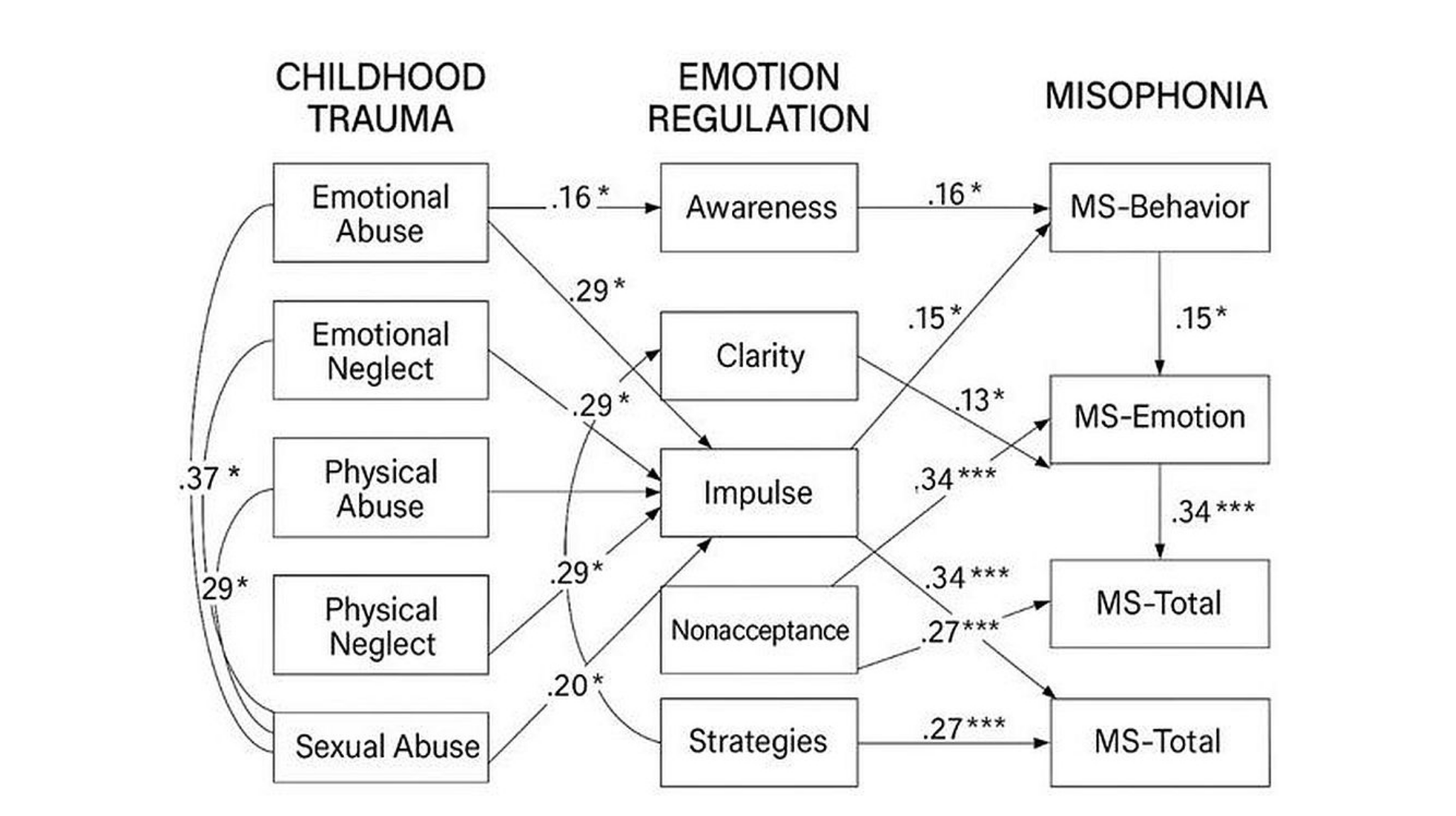
| Procedures | • Cross-sectional online survey; data collected April–August 2025; informed consent obtained electronically. • Monte Carlo power analysis for indirect effects conducted in R (RMediation); final sample exceeded required sample size. • Pearson correlations among CTQ, DERS, and misophonia total and subscale scores. • Series of mediation models estimated with PROCESS macro v4.3 and cross-checked via Monte Carlo simulation in R; each DERS subscale examined as mediator between CTQ subtypes and misophonia outcomes (emotion, behavior, total). • Indirect effects evaluated with 5000 bias-corrected bootstrap samples; Bonferroni correction applied across multiple comparisons. • Full-model path analysis in AMOS; fit evaluated with χ2/df, CFI, TLI, RMSEA, and SRMR. |
| Results | • Childhood trauma (CTQ) and emotion regulation difficulties (DERS) were positively associated with misophonia emotional, behavioral, and total scores. • DERS fully mediated the association between overall childhood trauma and misophonia: CTQ had a significant total effect, but its direct effect became non-significant after accounting for DERS, while the indirect effect remained significant. • Emotional abuse, physical abuse, physical neglect, and sexual abuse showed significant indirect effects on misophonia emotional, behavioral, and total scores. • Impulse-control difficulties were the most consistent and strongest mediator, linking each significant trauma type to all three misophonia outcomes. • Goals additionally mediated the effects of emotional and physical abuse on behavioral symptoms, while nonacceptance contributed an additional indirect effect of physical abuse. • Emotional neglect showed no significant total indirect effect on misophonia, although impulse-control difficulties remained a significant specific mediator for emotional and total symptoms. • The full structural model demonstrated acceptable fit. |
| Discussion/Limits | Conclusion- • The association between childhood trauma (CT) and misophonia is fully mediated by emotion regulation difficulties (ERD), particularly impaired impulse control, rather than by a direct trauma response. • This pattern is consistent with evidence linking misophonia to general stress rather than traumatic stress and supports models framing misophonia as involving emotion-processing impairments associated with early adversity, rather than as solely an auditory disorder. • Shared neurobiological mechanisms may help explain the trauma–misophonia relationship, including amygdala hyperactivity, reduced ventromedial prefrontal cortex activity/connectivity, and possible HPA-axis dysregulation. • Reduced amygdala–vmPFC connectivity may contribute to difficulties regulating emotional responses and the perceived lack of control over intense anger and behavioral reactions to trigger sounds. • Psychiatric comorbidity, including PTSD, may reflect shared etiological factors or mechanisms rather than a superficial association between trauma and misophonia. • Emotion regulation difficulties may also shape how individuals appraise sounds produced by others, linking these findings to social-cognitive accounts of misophonia. • Interventions should target regulation of sudden, intense emotional and behavioral reactions; Dialectical Behavior Therapy may be particularly relevant for addressing impulse-control and emotion-regulation difficulties. |
| Limitations:: | • Cross-sectional design prevents establishing causal relationships; cannot definitively state that CT causes ERD, which in turn causes misophonia. • University student sample (average age, sociodemographic characteristics) limits generalizability to different age groups, educational levels, and clinical populations. • Sample had no misophonia diagnosis and clinical cutoff scores were not examined; a study with diagnosed individuals may yield different results. • Self-report scales; participants may have had difficulty recalling early life events. |
| Future Directions:: | • Longitudinal studies to clarify temporal and causal relationships between CT, ERD, and misophonia. |
| Relevance:: | • A good source for describing the impact of childhood trauma and emotional regulations on misophonia severity • A study looking at the relationship between childhood trauma emotional regulation difficulties and misophonia severity • found unsurprising relationships with emotional regulation difficulty, with Emotional regulation difficulties found to be a mediator for the relationship between childhood trauma and misophonia severity. • authors linked this finding to several broader claims about support for cognitive models of Misophonia, the social cognition perspective of Misophonia, Dialectical behavioral therapy as a potential intervention |
Notes
key terms and concepts
- Misophonia – sound intolerance disorder characterized by intense discomfort and increased multifaceted (physiological, cognitive, behavioral) emotional responses to specific repetitive sounds made by others (e.g., chewing, nose-blowing, throat-clearing).
- Childhood trauma (CT) – emotional, physical, and sexual abuse and emotional and physical neglect during childhood, as assessed by the CTQ.
- Emotion regulation difficulties (ERD) – reduced capacity to tolerate, understand, and manage intense emotions.
- Full mediation – direct effect of CT on misophonia loses significance when ERD is included in the model, with a significant indirect effect via DERS.
my engagement notes
my questions
my comments
- They refer to the social cognition perspective of misophonia, but they don’t actually cite Berger, and their use of it doesn’t really seem to be in line with what that model is referring to. So I’m not entirely sure what they mean here (pdf)
Bookmarks
reading notes
Zettelkasten
- emotion regulation difficulties as a mediator of the relationship between childhood trauma and misophonia as support for cognitive models of misophonia
- Mediation of the misophonia–childhood trauma relationship as support for prioritizing skills training and the use of Dialectical Behavior Therapy as misophonia interventions
- Emotion regulation difficulties mediate the childhood trauma–misophonia relationship