Properties (16)
Id fd2a5d3b-3465-4f7d-814d-e090a5ed62e3
Year 2024
Abstract
Cssclasses
- purpleRed
Aliases
- Alterations in attentional processing in youth with misophonia
- (Murphy et al., 2024)
Key Terms
- Immediate Memory Task (IMT)
Import Date 03-25-2024
Template Version Notes • added the tag “noted” to the definition of comments to ignore ( like with the “in another note” tag. this is so that when making notes on chapters of a textbook, i can still export things for manual addition to the obsidian note without having to keep track of what has already been added ). Also moved the version notes to the yaml section • this version added the bookmarks section to auto collect all bookmarks. it also dropped the template auto fill of the initial source field because we never got it working and just overwrote it manually anyway. this version also added logic to handle “in another note” tag. annotations marked with this are completely ignored. used when i have information covered in a bigger note, but still want to highlight that part in text for visual clarity (so as to avoid duplicates of the same information) • running the import more then once will overwrite the file, so do not import again if you have made changes in obsidian that are not in the zotero article.
Dissertation Source Tags
- #Misophonia
- Attention
- Hyper Arousal/vigilance
- discriminability
- Immediate Memory Task (IMT)
Quick Cites 1
Checked For Zettle Notes true
Zotero Note Link Generated true
Dv Initial Source
- Misophonia
- My Dissertation MOC
Dv Status #status/reviewed
Dv Limitations • lack of healthy control group • use of numeric stim restricts conclusions for general perceptual processes. • methods were limited to what could be done virtually due to COVID • study give no info on the neurophysiological processes underlying Misophonia; • relationship b/w d’ and Misophonic trigger info needs expansion
Dv Relevance • was recommended by Rosenthal • provides info on the implications of Misophonia on attention • has a method that holds promise if translated to an in person setting • findings support the idea of Misophonia being characterized by hyperarousal and hypervigilance for triggers.
Alterations in attentional processing in youth with misophonia: A phenotypical cross-comparison with anxiety patients
Status:: #status/reviewed
Metadata
- Item Type: #journalArticle
- Authors: Nicholas Murphy, Marijn Lijffijt, Andrew G. Guzick, Matti Cervin, Jane Clinger, Eleanor E.A. Smith, Isabel Draper, Catherine E. Rast, Wayne K. Goodman, Sophie Schneider, Eric A. Storch,
- Date Added: December 19, 2023
- URL: https://linkinghub.elsevier.com/retrieve/pii/S0165032723014544
- DOI: 10.1016/j.jad.2023.11.088
- Cite Key: murphyAlterationsAttentionalProcessing2024
- Tags: #Misophonia, #in-review, #recommended-by-rosenthal
- PDF Attachments
Article Review Table: (Murphy et al., 2024)
| Background/Purpose | Background- • there is a lack of info on the neurological mechanism of the development of Misophonia symptoms , disagreement about Misophonia classification as a psychological/neurological/audiological issue, and no available pharmacological interventions targeted at Misophonia symptoms. • the development of key neurocognitive mechanisms behind misophonia onset and maintenance is required to determine clinical targets/design interventions Purpose- • goal of looking at the attentional processes in kids/adolescents Misophonics (page 2) • identify aspects of attentional processing differentially impacted by Misophonia in a youth population predictions • predict the ex-gaussian tau aspect of RT distributions will be a strong marker of Misophonia • predict heightened resposnes sensitivity and more liberal response bias in Misophonics showing functional differences inducing a hypervigilant state. (page 2) |
| Participants/samples | • 72 Misophonics and 89 anxiety patients recruited from a pool from a larger 102 children pool for a different study (page 3) |
| Measures | • Reaction times •Amsterdam Misophonia Scale (A-MISO-S) • Misophonia Inventory of Sound Triggers (MIST): developed for this study and gives a total trigger count • Misophonia Assessment Questionnaire (MAQ) • Glasgow Sensory Questionnaire (GSQ) • Multidimensional Anxiety Scale for Children (MASC) • Behavioral Inhibition-Activation Scales (BIS/BAS) • Cognitive Emotion Regulation Questionnaire (CERQ) • Youth Self Report (YSR) • Child and Adolescent Symptom Inventory (CASI-5) |
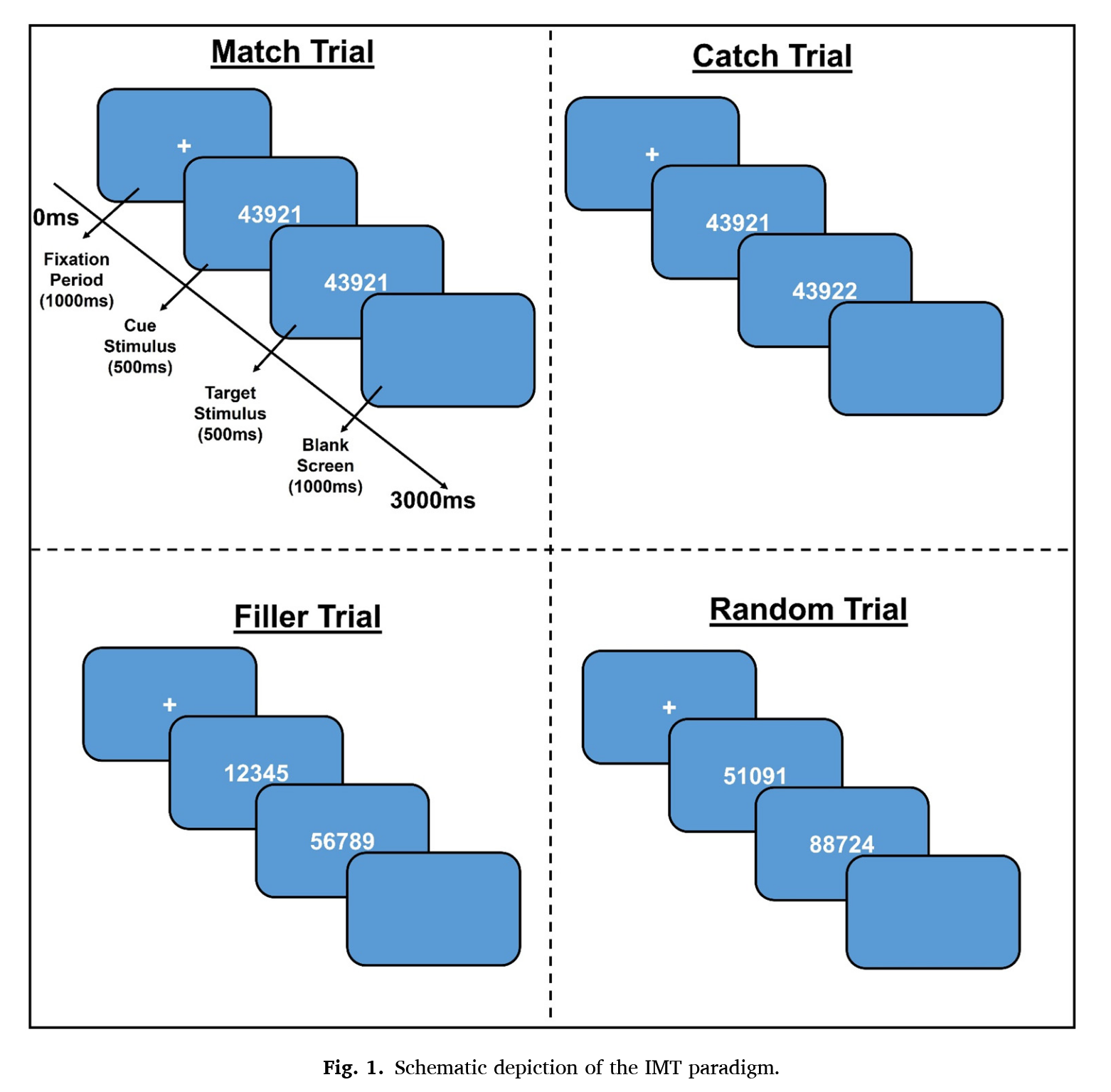
| Procedures | task • see figure 1 for more details. • stimuli: sequences of 5 digit numbers for both the cue and target. procedures • trials consisted of : fixation cross (1000ms) → cue (500ms) → target + Indicate same/diff using one of two buttons (500ms) → blanks screen (1000ms). inter stimulus interval = 500ms b/w end of response period and start of next fixation period • trial types: catch = difference of 1 digit; filler = cue/target are halves of same 10 digit sequence; random = cue/target completely different) • 25 trials per condition, total of 100 trials • additional 11 trail practice period at the start. • trials presented in random order (page 3) |
| Results | • found differences in responses sensitivity (d’) between the groups, with heighted discriminability in the Misophonic group compared to the anxiety group. • found a moderate contribution of age (note sex) to variance in d’ • found a positive relationship b/w total number of triggers and subjects d’ in the Misophonia group • no sig diff in response accuracy or RT between the groups |
| Discussion/Limits | Conclusion- • results support the idea that Misophonia is associated with increased states of hyper arousal/hypervigilance of stimuli in the environment. provides a neurocognitive foundation to direct future research into clinical targets. (page 1) • age related differences in d’ seen her could imply Misophonia specific differences in attention during early development that lessens over the course of cognitive development (the alternative is that the poor attention in youth is just the result of under developed executive functions) • the observed relationship b/w number of triggers and d’ supports past reports of increased attention alerting in Misophonia , implying that Misophonics attentional /perceptual systems are more sensitive for the purpose of identifying and avoiding triggers. ( alt idea is that elevated alertness comes before the Misophonia ) • lack of sig diff in response accuracy and RT between the groups suggest different affects of Misophonia on the arousal and cognitive function systems. (page 6) |
| Limitations:: | Limitations- • lack of healthy control group • use of numeric stim restricts conclusions for general perceptual processes. • methods were limited to what could be done virtually due to COVID • study give no info on the neurophysiological processes underlying Misophonia; • relationship b/w d’ and Misophonic trigger info needs expansion (page 6) |
| Future Directions:: | |
| Relevance:: | • was recommended by Rosenthal • provides info on the implications of Misophonia on attention • has a method that holds promise if translated to an in person setting • findings support the idea of Misophonia being characterized by hyperarousal and hypervigilance for triggers. |
Notes
my engagement notes
my questions
my comments
Bookmarks
-
bookmark for talking about Immediate Memory Task (IMT) (page 2)
-
bookmark talking about the ex-Gaussian modeling of RTs, (page 2)
reading notes
role of vigilance in Misophonia
- past research showing enhanced galvanic skin response, heart rate, and muscular tension in response to triggers suggests that elevated autonomic nervous system vigilance may be involved in Misophonia.
- changes in vigilance has implications for general cognitive functioning, including WM, and can impaired daily functioning
- vigilance in anticipation of triggers could at least partially explain Misophonia symptoms of altered sensitivity nd mood disturbances. - neuroimaging studies support the idea of altered use of processing resources in the salience network in Misophonia
- these neuro studies imply that Misophonics show heightened arousal resulting in lowered threshold for stimuli to be aversive.
- this can be observed behaviorally in Stroop tasks, where higher vigilance causes sensory stim to override cognitive processes., as in Daniels 2020 (page 2)
Immediate Memory Task (IMT)
- adapted from the continuous performance task (CPT).
- used to asses discriminability/impulsive rejection - goal of task is to indicate if a cue and target stimulus match or not.
- see figure 1 for full sequence description
- catch trial = 1 digit is different
- random trial= neither cue nor target match
- filler trail = cue and target are are two halves of a 10 digit sequence - benefits
- design helps to distinguish random and/or impulsive wrong resposnes from incorrect anticipatory response (commission errors)
- gives more robust estimation of responses sensitivity and response bias
- combined with signal detection theory (to resolve degree of response sensitivity/bias during the IMT) can be a good tool for looking at cognitive process related to orienting and executive attention n Misophonia (page 2)
- there is an idea that hyperarousal ( if present in Misophonia) could influence the allocation of cognitive resources during sensory processing (page 5)
zettelkasten
Murphy 2024 findings on altered attentional processing in Misophonia