Properties (15)
Id bcca6874-dd87-483f-bdf1-e45aacc6d5f6
Year 2025
Abstract ABSTRACT The relationship between misophonia and sleep‐related problems (SRPs) in youth is underexplored. This paucity of research is concerning because SRPs might be elevated among youth with misophonia. If left untreated, SRPs can contribute to long‐term health consequences. Thus, in this study we examined the link between misophonia and SRPs in youth aged 8 to 17. In this study, we compared SRPs in 102 children and adolescents with clinically significant misophonia to SRPs in a normative youth sample and a sample of 94 youth with anxiety disorders. We also examined the extent to which SRPs were associated with misophonia severity. Approximately 30% of youth with misophonia endorsed clinical levels of SRPs. SRPs were more prevalent in youth with misophonia compared to normative data from the general youth population ( d = 1.22) and similar to SRPs in youth with anxiety disorders ( d = 0.13). Youth with more severe misophonia symptoms had greater difficulties with SRPs and this association was attenuated but still significant when adjusting for gender, age, and internalizing and externalizing symptoms. In this study, we provided the first evidence of substantial issues with SRPs in youth with misophonia. Importantly, there was a moderate association between misophonia severity and SRPs, indicating that SRPs should be carefully assessed and potentially addressed in treatment for youth with misophonia. We discussed suggestions for clinical practice and future research.
Cssclasses
- purpleRed
Aliases
- (Wagner et al., 2025)
Import Date 06-05-2026
Template Version Notes •corrected error in rendering the linked PDF in metadata section • added the tag “noted” to the definition of comments to ignore ( like with the “in another note” tag. this is so that when making notes on chapters of a textbook, i can still export things for manual addition to the obsidian note without having to keep track of what has already been added ). Also moved the version notes to the yaml section • this version added the bookmarks section to auto collect all bookmarks. it also dropped the template auto fill of the initial source field because we never got it working and just overwrote it manually anyway. this version also added logic to handle “in another note” tag. annotations marked with this are completely ignored. used when i have information covered in a bigger note, but still want to highlight that part in text for visual clarity (so as to avoid duplicates of the same information) • running the import more then once will overwrite the file, so do not import again if you have made changes in obsidian that are not in the zotero article.
Dv Authors Kevin M. Wagner, Matti Cervin, Catherine E. Rast, Mered Parnes, Nicholas Murphy, Samuel Spencer, Eric A. Storch, Andrew G. Guzick,
Dv Initial Source Misophonia MOC
Dv Status #status/Bare-bones-review
Dv Limitations • Cross‐sectional design precludes causal inference. • Reliance on self‐ and observer‐report measures (response/recall bias). • Parent‐report only for SRPs; no child‐reported SRPs collected. • No detailed diagnostic data beyond misophonia and anxiety. • Focused on youth only. • Gender dichotomized as male vs non‐male. • Misophonia assessment has advanced since study began; each severity measure tested individually. • Pre‐pandemic norms applied to data collected during the COVID‐19 pandemic.
Dv Future Directions • Temporally dense longitudinal methods to examine temporal dynamics and bidirectionality. • Objective sleep measures (actigraphy, polysomnography). • Include child self‐reported SRPs. • Expand to other age groups. • Adequate representation of gender‐diverse youth. • More robust misophonia severity assessment; larger confirmatory studies. • Explore neurobiological mechanisms underlying the association.
Dv Relevance • study looked at sleep issues in Misophonia, finding significantly more incidence of sleep related problems in Misophonic youths compared to controls, signaling the need more attention and treatment efforts in this regard.
Notes Audited 2026-06-05T19:25:00
Audit Notes audited as review was done
•
Examining Sleep‐Related Problems in Youth With Misophonia
Status:: #status/Bare-bones-review
Metadata
- Item Type: #journalArticle
- Authors:: Kevin M. Wagner, Matti Cervin, Catherine E. Rast, Mered Parnes, Nicholas Murphy, Samuel Spencer, Eric A. Storch, Andrew G. Guzick,
- Date Added: December 12, 2025
- URL: https://onlinelibrary.wiley.com/doi/10.1002/jclp.70075
- DOI: 10.1002/jclp.70075
- Cite Key: wagnerExaminingSleepRelatedProblems2025
- Tags:: #Adolescents, #anxiety, #Bare-bones-review-🦴, #Misophonia, #sleep, #youth,
- PDF Attachments
Abstract
| Background/Purpose | Background- • Co‐occurring mental health problems are common among youth with misophonia. • Sound sensitivities, learning, and emotion regulation suggested as etiological pathways in misophonia. • Relation between misophonia and SRPs is underexplored, particularly in youth. • Misophonia typically begins in childhood or adolescence. • Internalizing problems elevated among youth with misophonia across three independent samples. • Internalizing symptoms can contribute to SRPs. • SRPs associated with significant mental and physical health consequences. • Trigger sounds at night could disrupt sleep; misophonia involves heightened sensitivity to trigger sounds. • Bidirectional association between anxiety and SRPs in youth is well‐established. • Case reports link misophonia and SRPs. • Biopsychosocial changes of youth disrupt sleep‐wake patterns, increasing susceptibility to SRPs. • SRPs rising among youth broadly; COVID‐19 pandemic associated with a rise in youth SRPs. Purpose- • Compare SRPs in misophonia and anxiety groups to normative population scores. • Compare SRPs across three subgroups (misophonia only, anxiety only, both). • Examine extent to which misophonia severity is related to SRPs, controlling for gender, age, internalizing and externalizing symptoms. |
| Participants/samples | • N = 196 youth; 102 misophonia, 94 anxiety. • Ages 8–17; full‐sample mean age 13.1. • Misophonia subgroups: misophonia and no anxiety (n = 45), misophonia and co‐occurring anxiety (n = 57). • Predominantly female in both groups. • Misophonia inclusion: A‐MISO‐S ≥ 10. • Anxiety inclusion: MASC t ≥ 60, anxiety disorder diagnosis on MINI‐KID, A‐MISO‐S ≤ 4. |
| Measures | • A‐MISO‐S – misophonia severity; five‐item version used. • C‐MAQ / P‐MAQ – child‐ and parent‐report misophonia severity. • PROMIS‐SD – parent‐proxy SRPs; raw scores converted to normed t‐scores. • CBCL – externalizing composite (rule‐breaking + aggressive); anxious/depressed subscale for internalizing. • MAI – Misophonia Assessment Interview. • MINI‐KID – structured diagnostic interview. |
| Procedures | • Secondary analysis of an existing pediatric misophonia/anxiety dataset (Guzick et al. 2023). • Recruitment via online clinical networks and misophonia/anxiety social media. • Telehealth screening, online questionnaires, and clinical interview. • Virtual study; IRB‐approved at Baylor College of Medicine. |
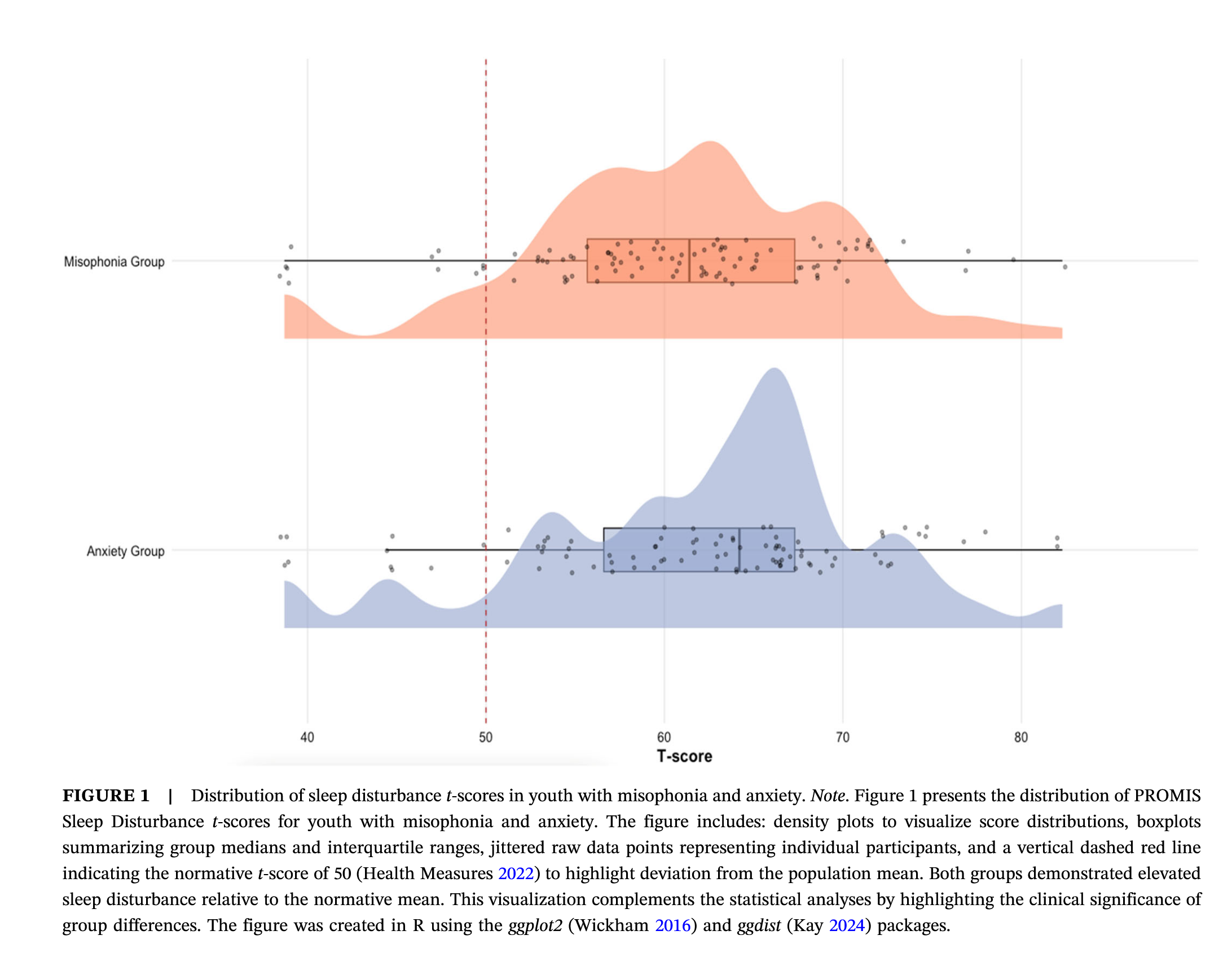
| Results | • Misophonia group SRPs significantly higher than normative mean (large effect). • Anxiety group SRPs significantly higher than normative mean (large effect). • No significant difference in SRPs between misophonia and anxiety groups. • All three subgroups significantly higher than normative mean. • No significant difference in SRPs among the three subgroups. • Misophonia severity associated with SRPs across all three measures after covariates; the A‐MISO‐S association only trended toward significance once covariates were added. |
| Discussion/Limits | Conclusion- • First study to specifically examine SRPs in youth with misophonia. • SRPs more frequent in youth with misophonia than in the general population. • SRP levels in misophonia comparable to those in youth with anxiety disorders. • Misophonia itself, independent of anxiety, may contribute meaningfully to sleep disturbance. • Misophonia may serve as a vulnerability factor for SRPs in youth. • Greater misophonia severity is linked with greater SRPs across measures. • The misophonia–sleep association may be bidirectional. • Unexplained variance indicates SRPs are one of many factors associated with misophonia severity. • Clinicians should incorporate sleep assessment into misophonia evaluation and treatment. |
| Limitations:: | • Cross‐sectional design precludes causal inference. • Reliance on self‐ and observer‐report measures (response/recall bias). • Parent‐report only for SRPs; no child‐reported SRPs collected. • No detailed diagnostic data beyond misophonia and anxiety. • Focused on youth only. • Gender dichotomized as male vs non‐male. • Misophonia assessment has advanced since study began; each severity measure tested individually. • Pre‐pandemic norms applied to data collected during the COVID‐19 pandemic. |
| Future Directions:: | • Temporally dense longitudinal methods to examine temporal dynamics and bidirectionality. • Objective sleep measures (actigraphy, polysomnography). • Include child self‐reported SRPs. • Expand to other age groups. • Adequate representation of gender‐diverse youth. • More robust misophonia severity assessment; larger confirmatory studies. • Explore neurobiological mechanisms underlying the association. |
| Relevance:: | • study looked at sleep issues in Misophonia, finding significantly more incidence of sleep related problems in Misophonic youths compared to controls, signaling the need more attention and treatment efforts in this regard. |
Notes
key terms and concepts
- Misophonia – strong physiological and emotional reactions (e.g., anger, anxiety, disgust) in response to specific trigger sounds and related visual stimuli; can lead to significant distress and impairment.
- SRPs (sleep‐related problems) – difficulties with falling asleep, staying asleep, and achieving restorative sleep.
- Internalizing symptoms – broader concept including problems associated with negative affect.
- A‐MISO‐S – Amsterdam Misophonia Scale; child self‐report measure of misophonia severity focused on functional interference and symptom severity.
- MAQ (C‐MAQ / P‐MAQ) – Misophonia Assessment Questionnaire; child‐ and parent‐report measures of misophonia distress and life impairment.
- PROMIS‐SD – 8‐item parent proxy of the PROMIS Sleep Disturbance Short Form; parent report of child SRPs over the past 7 days.
- CBCL – Child Behavior Checklist; source of externalizing composite and anxious/depressed (internalizing) subscale.
my engagement notes
my questions
my comments
Bookmarks
reading notes
contextual statement
In a 2025 study, Wagner attempted to examine the link between misophonia and sleep‐related problems in youth aged 8–17 by comparing parent‐report PROMIS‐SD scores in 102 youth with clinically significant misophonia, 94 youth with anxiety disorders, and normative population data, and by regressing SRPs on the A‐MISO‐S, C‐MAQ, and P‐MAQ.