Properties (17)
- purpleRed
- (Savard et al., 2022)
- #Misophonia
- signal detection
- SNR
- salience
•
Specificity of Affective Responses in Misophonia Depends on Trigger Identification
Status:: #status/complete
Metadata
- Item Type: #journalArticle
- Authors: Marie-Anick Savard, Anastasia G. Sares, Emily B. J. Coffey, Mickael L. D. Deroche,
- Date Added: July 2, 2023
- URL: https://www.frontiersin.org/articles/10.3389/fnins.2022.879583/full
- DOI: 10.3389/fnins.2022.879583
- Cite Key: savardSpecificityAffectiveResponses2022
- Tags: #Misophonia, #Signal-detection-Psychology, #role-of-context, #mental-health, #sound-sensitivity, #anxiety, #anger, #SNR, #MisoQuest, #auditory-cognition, #emotion-regulation
- PDF Attachments
Article Review Table: (Savard et al., 2022)
| Background/Purpose | Background- • little info exists on prevalence of Misophonia responses in the general public Purpose- • goal of characterizing the distribution of Misophonia symptoms in the general pop • determine if/the degree to which Misophonia resposnes are the result of acoustic salience of the sounds vs recognition of the sounds (page 1) • goal of characterizing the distribution f Misophonia symptoms in the general population (page 3) • goal of assessing if sounds must be identifiable in order to induce Misophonic responses. (page 3) • goal of examining the relationship between Misophonia and identification and memory (page 15) Hypothesis- • as SNR increases( it is easier to Id the target source) triggers will become more easy to ID the neutral/unpleasant sounds • the most Misophonic subjects will be best able to to detect trigger sounds at lower SNR’s • subjective ratings of aversiveness will be dependent on source identification, such that when SNR is to skewed for a correct identification , the least/most Misophonic groups will show similar subjective ratings. (page 3) • predicted higher MisoQuest scores for females compared to males (page 3) |
| Participants/samples | • 300 adults' recruited online from “Prolific” • inclusion criteria included: age ≥ 18; spoke English as a primary language • subdivide into most vs least Misophonic ()op/bottom 20% scores on the MisoQuest) (page 3) |
| Measures | • scores on the MisoQuest • self reports of stim pleasantness, resulting feelings of anger, disgust, and anxiety • 15 FCT self report of what they thought the stimulus was. |
| Procedures | stimuli • subset of 15 the stim from Kumar 2017, 5 triggers (all orofacial sounds) 5 unpleasant, 5 neutral. stimuli were shortened to representative 3s versions to speed up the session and avoid participant fatigue • manipulated identifiability of stimuli using multi talker babble. (page 1) • babble- multi-talker babble was selected as a masker due to it being a commonly encountered noise with greater ecological validity compared to artificial masks. babble consisted of 10 samples of differing SNR (-30,-20,-10,0,+10 dB) (page 5) • procedure • subjects pre-screened for Misophonia using the MisoQuest. they also reported the audio device they would be using in the exp and rate the quality (1-3). • completed three practice trials to familiarize selves with the subjective ratings and forced-choice source Identification tasks to be used. practice trials consisted of toddler crying, washing machine, and 3s version of an eating sound in that order. • task consisted of 75 trials alternating between trigger, unpleasant, and neutral sounds. SNR was also adjusted by embedding the target sounds in different levels of multi-talker babble. • each trial consisted of listing to a target sound, then rate the pleasantness (0-100) subjective anger disgust, and anxiety using sliders. trial concluded a 15-alternative force choice task, with different labels for the target sound, from which subjects selected what they believed the target was. all trials were completed in a single block, with the order of stim randomized within the block • session ended with open ended questioning of what subjects thought the goal of the study was, and what if anything they noticed odd about the sounds. (page 4) |
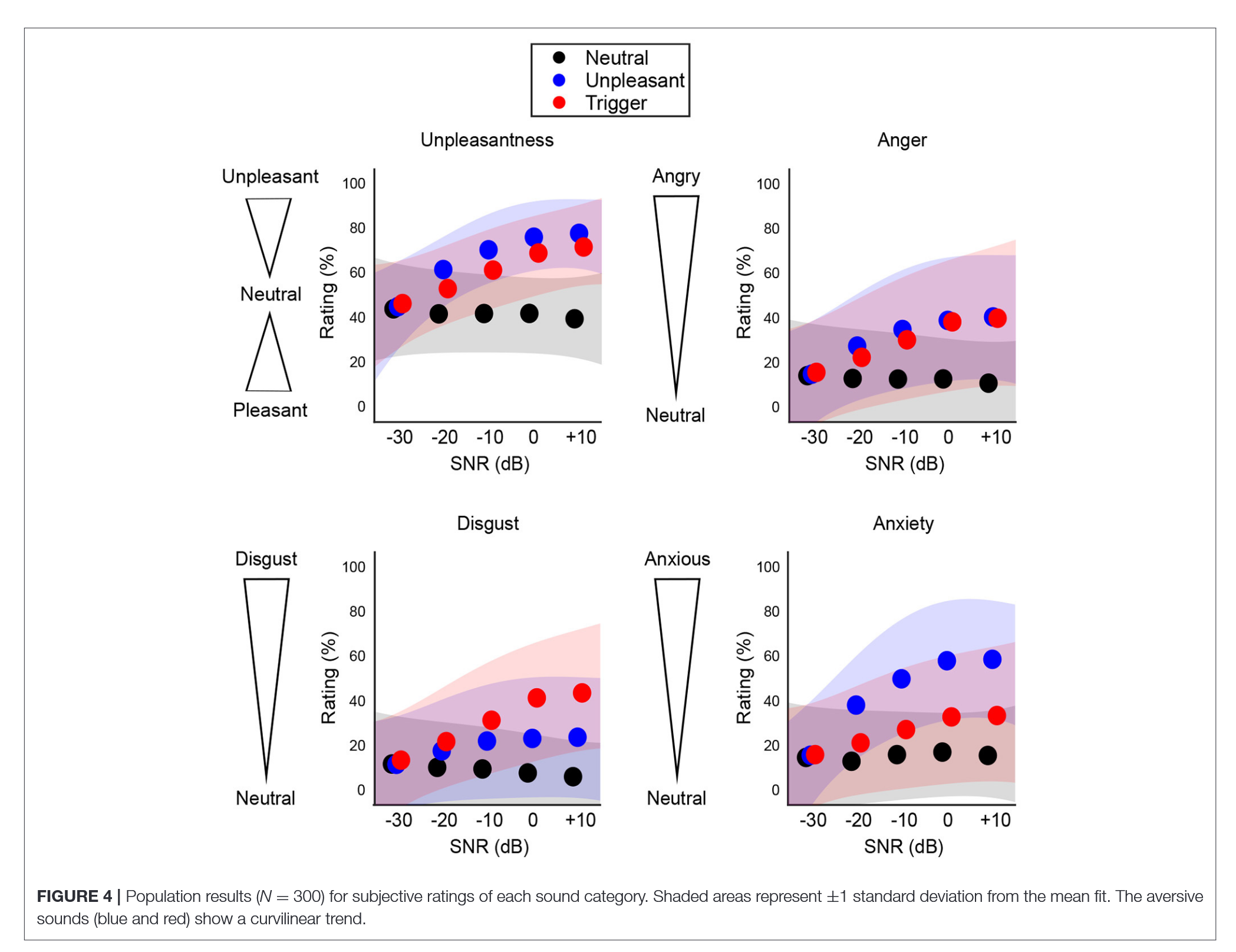
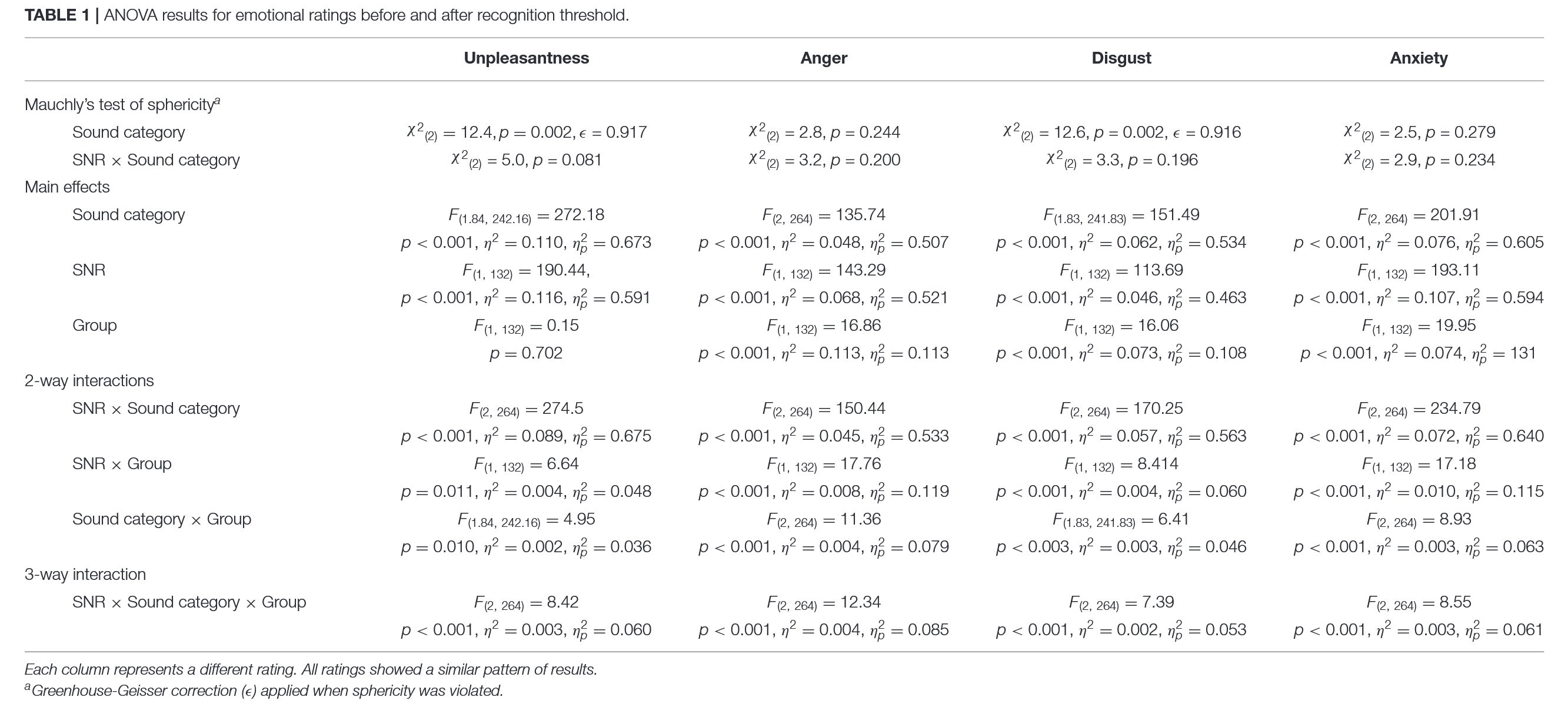
| Results | • first hyp was supported but the second hyp was contradicted (page 7) • results contradicts Kilic et al 2021 by failing to find a correlation between MisoQuest scores and age (i.e. no age effects) (page 12) • found that trigger sounds were better identified then unpleasant/ neutral sounds, supporting hypothesis 1. (page 13) • found that the least vs most Misophonic people did not differ in ability to detect triggers. this contradicts hyp 2, suggesting that Misophonia is not a bottom up process. this also contradicts past research suggesting differences in low level auditory processing in Misophonics ((Schröder et al., 2014)) (page 13) • on trials where subjects correctly identified triggers, the most Misophonic subjects reported the strongest resposnes. this was also true also for unpleasant sounds, but was more dramatic for triggers. tis acts as support for the top down process in Misophonia (page 14) |
| Discussion/Limits | Conclusion- •results suggest heightened salience of trigger sounds as well as a role of learning and higher order ( top-down) cognitive processing in the Misophonia response. (page 1) •concluded that the observed normal distribution of MisoQuest cores indicates sub-clinical people still experience Misophonia symptoms (page 11) •the author cites observations (Zhou et al., 2017) + their own observed MisoQuest score distribution to suggest that Misophonia symptoms happen to large number of people, and that having impairments from Misophonia represents being on the extreme end of of a normal distribution of Misophonia symptoms. this citation statement has not been yet (page 11) • results work against the idea of Misophonia being a bottom up issue. (page 13) • results suggest that hyper sensitivity to Misophonia triggers does not generalize to other sound sources. (page 15) |
| Limitations:: | • generalizability of sample ( although better then relying solely on undergrad students) is still limited due to the nature of using an online convenience sample. (page 13) • possible confounds from diff subjects having diff audio devices that could have impacted playback. (page 13) • one weakness of the MisoQuest is its low sensitivity, which increases the risks of false negatives. (page 11) |
| Future Directions:: | • assess the development of Misophonia symptoms over the lifespan and the prevalence of symptoms in diff age groups. (pdf) • implement physiological metrics to assess sex related physiological responses differences in situations with emotion provoking sounds. look at refining questionnaires/ weighing items to address possible sex differences in symptoms (pdf) • future online studies should standardize listing devices used and/or implement large sampled and loosely controlled methods to compliment the rigidly controlled lab studies. • continue assessing possible distinct acoustic properties of typical triggers (pdf) (page 12) |
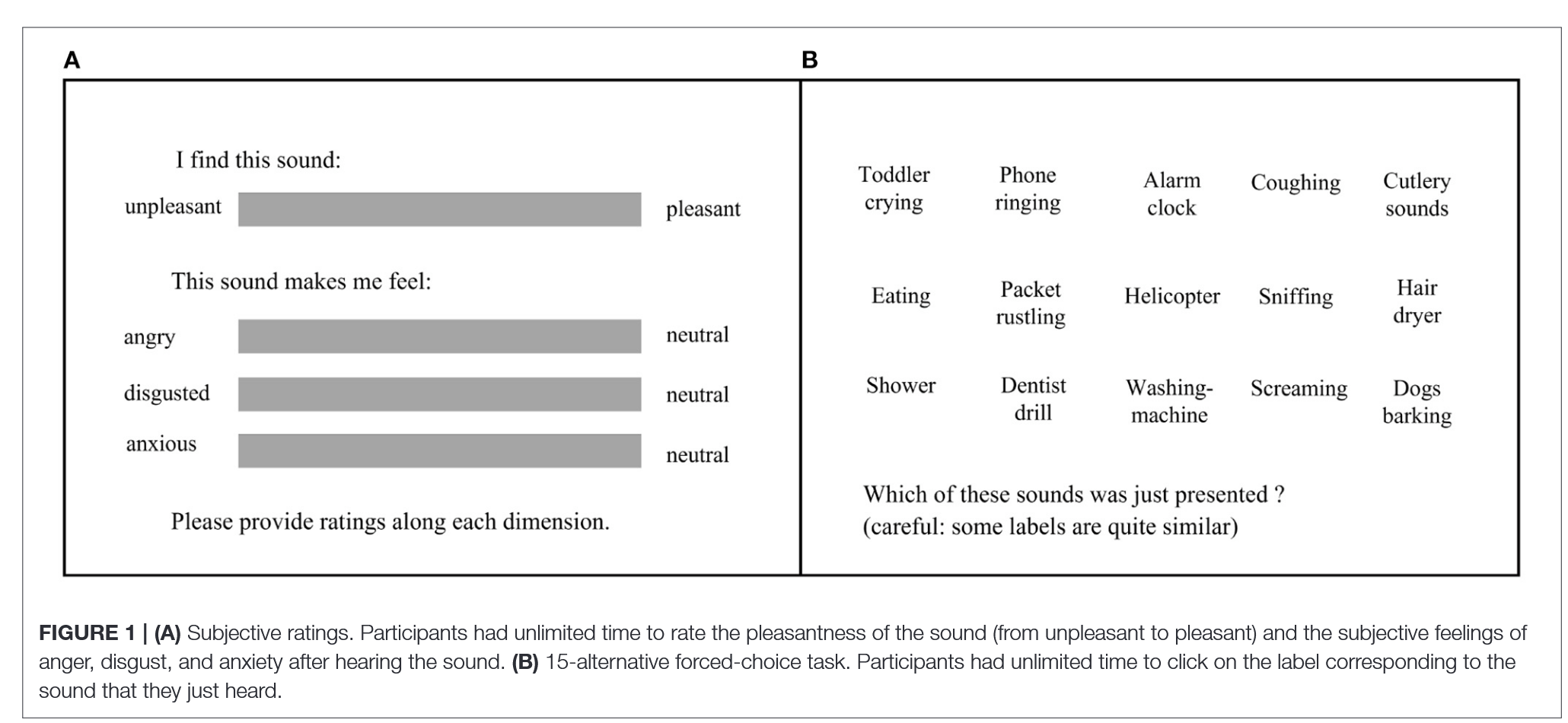
| Relevance:: | • article is a good source for info on the effect of signal to noise ratios on miso responses. it is also a good source for info on the influence of cognition and context on misophonia • data gives justification behind making sure that triggers are identifiable in my Misophonia measurement/ dissertation project • talks about the idea that Misophonia is one end of a continuum of a specific sound sensitivity spectrum, with Misophonia on one end and ASMR on the other. they did not give this idea a name so i will call it the specific sound sensitivity spectrum • discuses findings relating to sex and age differences in Misophonia symptoms. • results contradict an implication from Schröder 2014 that there are diffs in ability to detect triggers for Misophonics vs controls. • has multiple results that support the top-down process in Misophonia • the authors have an interesting method for measuring subject identification of stimuli using a 15-AFC. that could be useful in either my dissertation or a future project. see fig 1 for image of the UI • describes signal modulation as a acoustic prop that grabs peoples attention. |
Notes
my engagement notes
my questions
my comments
- the authors have an interesting method for measuring subject identification of stimuli using a 15-AFC. that could be useful in either my dissertation or a future project. see fig 1 for image of the UI (page 4)
Bookmarks
- bookmark for procedure (page 4)
- bookmark talking about the stim (page 4)
- bookmark for describing the MisoQuest (page 5)
- bookmark briefly talking about ideas around sex differences in Misophonia (page 12)
- bookmark discussing the lack of age effects in this study and further talks about age effects in general for Misophonia (page 12)
- bookmark of authors talking about Schröder 2014 in the context of Savard’s observations in this study (page 13)
- Bookmark for study summary (page 14)
reading notes
- author notes the question as to if Misophonia symptoms are a distinct thing or represent one exteme end on a spectrum of sound sensitivity symptoms (page 2)
past talks about potential demographic effects on Misophonia
the authors discuss some ideas about demographic effects on Misophonia
-
Sex differences: the authors note how most samples of Misophonics are primarily female. however this could also be because of the convenience sample of undergrad psych students. (pdf)
-
Age effects: the authors noted how past research has suggested greater prevalence of Misophonia in younger samples (page 2)
-
one acoustic property that tends to grab peoples attention is modulation. sound signals that are modulated tend to stand out from background noise, and some modulation rates are known to produce a “rough” sensation and are associated with greater perceptions of pleasantness/unpleasantness in some naturalistic sounds.
- such sounds are also thought to be processed through bottom-up mechanisms -
this has some implications for misophonia., as Misophonia triggers tend to share this feature (i.e. the modulation of chewing, modulation of leg swigging (leg position?) etc.) (page 2)
- talks about the idea that Misophonia is one end of a continuum of a specific sound sensitivity spectrum, with Misophonia on one end and ASMR on the other. they did not give this idea a name so i will call it the specific sound sensitivity spectrum. a limitation of the MisoQuest is that it cannot assess both ends of this possible spectrum (page 11)
zettelkasten
- observation of person focused specificity of trigger responses
- diverging future directions for Misophonia based on the importance of depending on the top down or bottom up nature of of Misophonic responses
- observed top down influence in Misophonia triggers suggests interventions targeted at breaking trigger associative links
- Savard 2022 findings arguing against bottom up processes in Misophonia
- Savard 2022 findings in support of top down processes in Misophonia
- Savard 2022 on commonality of trigger symptoms and the spectrum nature of Misophonia
- Savard 2022 findings against generalized sound sensitivity in Misophonia