Properties (16)
- purpleRed
- Selective Disruption of Salience‐Network Anterior Insula Connectivity in Misophonia
- (Hansen et al., 2026)
•
Selective Disruption of Salience‐Network Anterior Insula Connectivity in Misophonia: A Disorder‐Specific Neural Signature
Status:: #status/reviewed
Metadata
- Item Type: #journalArticle
- Authors:: Heather A. Hansen, Jordan E. Norris, Catherine M. Bain, Lauren E. Ethridge, Christine L. Tardif,
- Date Added: February 17, 2026
- URL: https://onlinelibrary.wiley.com/doi/10.1002/hbm.70468
- DOI: 10.1002/hbm.70468
- Cite Key: hansenSelectiveDisruptionSalienceNetwork2026
- Tags:: #Misophonia, #anxiety, #depression, #insula, #resting-state-connectivity, #salience-network, #seed-based-connectivity, #Fmri
- PDF Attachments
Abstract
| Background/Purpose | Background- • Misophonia affects 5%–20% of the population; neural mechanisms remain largely unknown. • Prior neuroimaging studies implicate anterior insula activation and connectivity differences in small samples. • Anterior insula connectivity alterations also reported in anxiety, depression, and autism. • Behavioral co-occurrence findings with anxiety, depression, and autism are mixed. • Misophonia symptoms proposed to lie on a spectrum. Purpose- • sought to study Misophonia etiology thorough its neural profile and associations with other disorders (page 2) • Ascertain anterior insula connectivity profile of misophonia and its relationship to symptom severity. • Determine extent of overlap between misophonia connectivity profile and anxiety, depression, and autism. • Examine misophonia as a continuous spectrum rather than binary grouping. • |
| Participants/samples | • WAND dataset: N=162 adults; 153 included in connectivity analyses after quality control; general UK population. • Oklahoma dataset: N=777 adults; used to train misophonia prediction model. • WAND: mean age ~30; mixed sex distribution. • Oklahoma: mean age ~19; predominantly university sample. |
| Measures | Misophonia • MQ (Oklahoma). • Predicted MQ total score in WAND derived via regression from 30 AASP sensation avoiding/sensitivity items. Sensory sensitivity- AASP (both samples). Anxiety/Depression- Hospital Anxiety and Depression Scale (HADS) (WAND). Autism- Autism-Spectrum Quotient Short (AQ-S) (WAND). Neuroimaging- Resting-state 3T fMRI (10 min 38 s); bilateral anterior insula seeds; CONN toolbox; seed-to-voxel connectivity. |
| Procedures | Modeling- Linear regression trained in Oklahoma sample to predict MQ total from 30 AASP items; validated in held-out test set; applied to WAND AASP data. Connectivity analyses- • Seed-to-voxel analyses from bilateral anterior insula. • Continuous misophonia severity and binary group models tested. • Additional analyses with Schaefer 100 atlas insular subdivisions. • Separate and combined models including anxiety, depression, autism, age, and sex as covariates. |
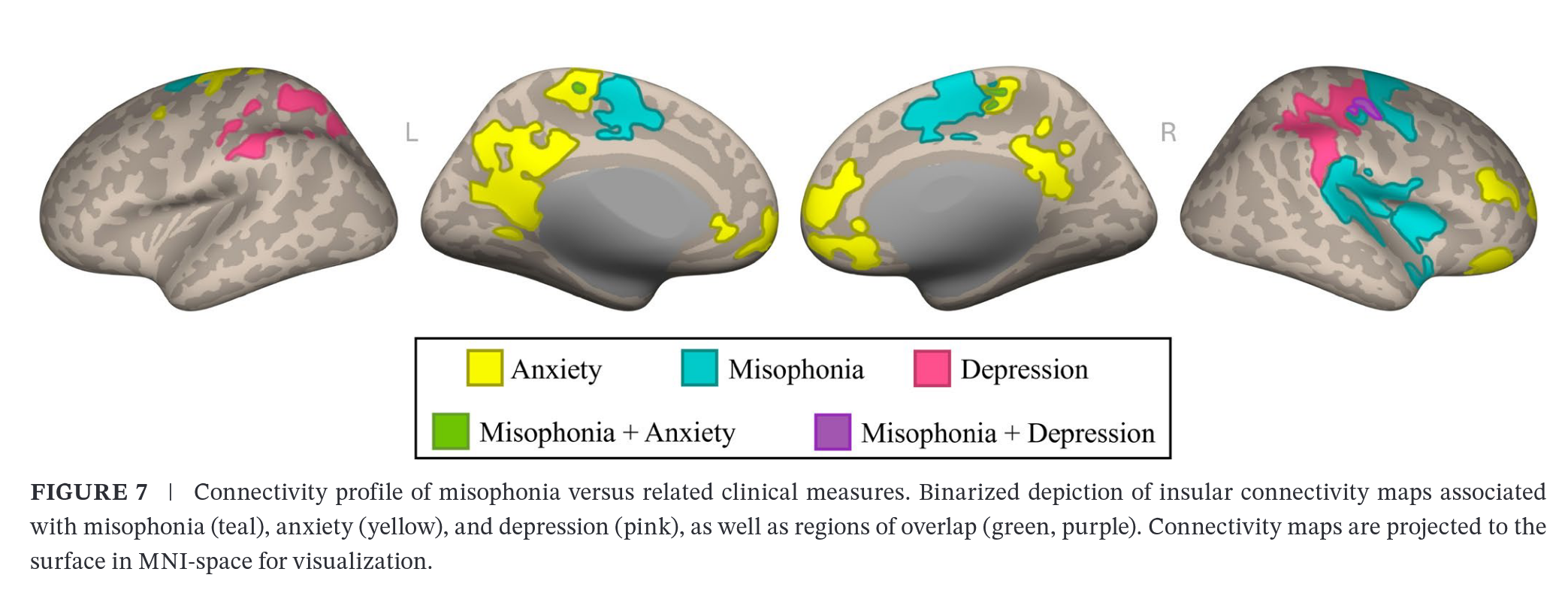
| Results | • results suggest a relationship between Misophonia symptom severity and anterior insula connectivity strength (specifically in relation to salience network). • results suggest an independence of the insular connectivity profile of Misophonia from anxiety depression, or autistic traits. (pdf) Model validation • Predicted MQ scores correlated with actual MQ scores in Oklahoma test set. • Model classification outperformed null model. • Three AASP items significantly predicted MQ total. Misophonia severity (continuous) • Greater misophonia severity associated with stronger anterior insula connectivity to clusters overlapping planum temporale, operculum, precentral gyrus, supplementary motor area, superior frontal gyrus, posterior cingulate gyrus, and temporal pole. • No negative associations observed. Binary grouping : No significant clusters when using misophonia patient vs control grouping at primary thresholds. Insular specificity • Significant associations observed for salience/ventral attention insular subdivisions. • No significant associations for default mode or somatomotor insular subdivisions. • Both left and right anterior insula contributed; bilateral pattern resembled combined model. Behavioral associations • No significant correlations between predicted misophonia severity and anxiety, depression, or autistic traits in WAND. • Small positive associations between MQ total and binary anxiety, depression, and autism diagnoses in Oklahoma. Connectivity comparisons • Anxiety and depression each showed distinct anterior insula connectivity patterns not overlapping misophonia clusters. • No significant anterior insula connectivity as a function of autistic traits. • Misophonia-related clusters remained significant after controlling for anxiety, depression, autism, age, and sex. |
| Discussion/Limits | Conclusion- • The authors conclude that misophonia symptom severity is associated with increased anterior insula connectivity strength. • The findings indicate that misophonia-related connectivity is specific to anterior insula subdivisions affiliated with the salience network. • The authors conclude that the misophonia connectivity profile overlaps somatomotor, auditory (planum temporale), and higher-order cognitive regions. • The findings indicate that misophonia involves abnormal integration of stimulus salience with higher-order auditory and cognitive processes rather than simple acoustic sensitivity. • The authors conclude that misophonia’s insular connectivity profile is neurally distinct from anxiety, depression, and autism. • The data support conceptualizing misophonia as a spectrum disorder rather than a binary condition. • The authors conclude that open-access datasets can be leveraged to study misophonia via indirect modeling approaches. |
| Limitations:: | • Misophonia not directly assessed in WAND; scores predicted via regression. • General population sample; not clinically diagnosed misophonia. • No assessment of audiological conditions (e.g., tinnitus, hyperacusis). • Resting-state only; no trigger stimuli presented. • Reliance on MQ; lack of consensus assessment scale. |
| Future Directions:: | • Recruit clinically severe misophonia samples with rigorous audiological screening. • Use task-based fMRI with trigger stimuli. • Examine internal imagination of triggering scenarios. • Replicate findings with updated and multiple misophonia assessment scales. • Incorporate continuous analytic approaches. |
| Statistics:: | • Oklahoma model: r=0.55; adjusted R²=0.326; sensitivity=0.48; specificity=0.90; AUC=0.796; PPV=0.74; NPV=0.75; χ²(1)=8.31, p=0.004; permutation p<0.001. • Significant predictors (Bonferroni p<1.7×10⁻³): relocate with strong odors β=0.140, SE=0.038; limit distractions β=−0.130, SE=0.039; distracted by noise β=0.145, SE=0.045. • WAND predicted MQ: range 8.9–45.1; mean=24.2; 19% ≥30. • HADS anxiety: M=5.27, SD=3.67; 13% clinical; 12% borderline. • HADS depression: M=2.67, SD=2.72; 2% clinical; 4% borderline. • AQ-S: M=58.07, SD=10.10; 19% above cutoff. • Oklahoma diagnoses: anxiety 23%; depression 20%; autism 0.6%. • Point-biserial correlations (Oklahoma): anxiety rpb=0.15; depression rpb=0.13; autism rpb=0.16; all p<0.001. • Connectivity thresholding: voxel p<0.01; cluster p-FWE<0.025 (one-tailed). |
| Relevance:: | • paper by heather Hansen looking at changes in salience network connectivity as a biomarker of Misophonia • sought to study Misophonia etiology thorough its neural profile and associations with other disorders • authors operationalized Misophonia as a spectrum disorder to better capture the variability of real world symptoms. • the study demonstrates the feasibility of using large open-access neuroimaging databases to study Misophonia. specifically they showed it is possible to extrapolate Misophonia status by training a model with a separate sample on a feature included in the datasets (see notes) • finds evidence for non orofacial (x finger) and nonmotor explanations for Misophonia (the way they emphasize this feels like a jab at Kumar ) |
Notes
key terms and concepts:
-
Misophonia – decreased tolerance to specific sounds (“triggers”) resulting in atypically strong negative emotional, physiological, and behavioral responses.
-
Anterior insula – cortical region implicated in processing of disgust, subjective evaluation of pain, goal-directed attentional control, and interoception.
-
Salience network – network involved in determining salience and attending to stimuli.
-
Seed-based connectivity – functional connectivity approach estimating correlations between a predefined seed region and all other brain voxels.
-
Adolescent/Adult Sensory Profile (AASP) – 60-item sensory questionnaire with subscales of sensation avoiding, sensory sensitivity, sensation seeking, and low registration.
-
Misophonia Questionnaire (MQ) – self-report measure including Symptoms, Emotions/Behaviors, and Severity scales assessing misophonia.
my engagement notes
my questions
my comments
Bookmarks
- bookmark talking about the significance of the anterior insular cortex (page 2)
- bookmark for talking about Misophonia Symptom Severity Is Associated With Anterior Insula Connectivity Strength, Specifically in Affiliation With the Salience Network (page 11)
reading notes
leveraging two datasets
- The study leveraged two independent datasets.
- The Oklahoma dataset (N=777) consisted primarily of university students and community adults who completed the Misophonia Questionnaire (MQ), the Adolescent/Adult Sensory Profile (AASP), and demographic items via online survey; these data were used to train and validate a regression model predicting MQ total scores from sensory sensitivity items.
- The WAND dataset (Welsh Advanced Neuroimaging Database; N=162, 153 included after quality control) comprised adults from the general UK population who completed resting-state 3T fMRI and multiple trait questionnaires (including AASP, HADS for anxiety/depression, and AQ-S for autistic traits), but did not include a direct misophonia measure, necessitating model-based estimation of misophonia severity. (page 2)