Properties (16)
- purpleRed
- (Shan et al., 2024)
- Misophonia
Network analysis of misophonia symptoms using the Duke Misophonia Questionnaire
Status:: #status/Bare-bones-review
Metadata
- Item Type: #journalArticle
- Authors:: Yanyan Shan, Marta Siepsiak, Kibby McMahon, Rachel Guetta, Lisalynn Kelley, Tao Chen, M. Zachary Rosenthal,
- Date Added: November 1, 2024
- URL: https://linkinghub.elsevier.com/retrieve/pii/S0165032724017944
- DOI: 10.1016/j.jad.2024.10.105
- Cite Key: shanNetworkAnalysisMisophonia2024
- Tags:: #Misophonia, #Bare-bones-review-🦴, #clinical, #questionnaire, #network-model, #impairment, #symptom,
- PDF Attachments
Abstract
| Background/Purpose | Background- • Misophonia = strong aversion or decreased tolerance to specific sounds evoking attentional, behavioral, physiological, and affective reactions; first defined by Jastreboff and Jastreboff (2001); estimated to affect ~20% of the population, with ~6% exhibiting clinically significant symptoms with associated impairment across work, school, social, and family domains • Consensus definition (Swedo et al., 2022) is explicitly noted as non-conclusive, given limited evidence base and the rapid increase in publications since its release; definition expected to be refined as psychometrically validated research accumulates • Multiple validated self-report measures exist (MisoQuest, S-Five, BMQ, DVMSQ, SMS, MRS); DMQ is additionally distinguished by coverage of treatment-relevant constructs (coping, beliefs) not uniformly present in other measures • DMQ has strong psychometric support via factor analysis and IRT, but relative importance of specific subscales and items for researchers and clinicians remains unclear • Factor analysis and IRT identify latent constructs via correlations among items; network analysis instead explores direct interrelationships among elements and can identify which components are most central to the overall structure Purpose- • Apply network analysis to DMQ data to identify the most central subscales and items across four models: overall misophonia, symptoms, beliefs, and impairment • Explore sex differences in network structure and centrality measures • Provide guidance on efficient, prioritized use of the DMQ in research and clinical settings |
| Participants/samples | • N=144 adults drawn from a larger parent study (Rosenthal et al., 2022) on mental health in misophonia; ages 18-65 (M=36.8 years); 70.1% female (n=101), 29.9% male (n=43) • Recruited via Duke Center for Misophonia and Emotion Regulation website and associated online channels; online screening and consent via REDCap • Varying misophonia severity (clinical to subclinical to asymptomatic); some participants may have enrolled out of general curiosity about sound sensitivity • Exclusion criteria: current psychotic disorder diagnosis, current mania, current anorexia, inability to read English; assessed via SCID-5 |
| Measures | • Duke Misophonia Questionnaire (DMQ; Rosenthal et al., 2021): 86 items, 9 subscales (trigger frequency, affective responses, physiological responses, cognitive responses, coping before/during/after triggers, impairment, beliefs); two composite scales (symptoms, coping); in current sample overall α=0.97; subscale alphas ranged 0.75 (physiological, coping during) to 0.94 (beliefs); AUC=0.82 for discriminant validity; convergent validity correlations with other misophonia measures 0.43-0.87 |
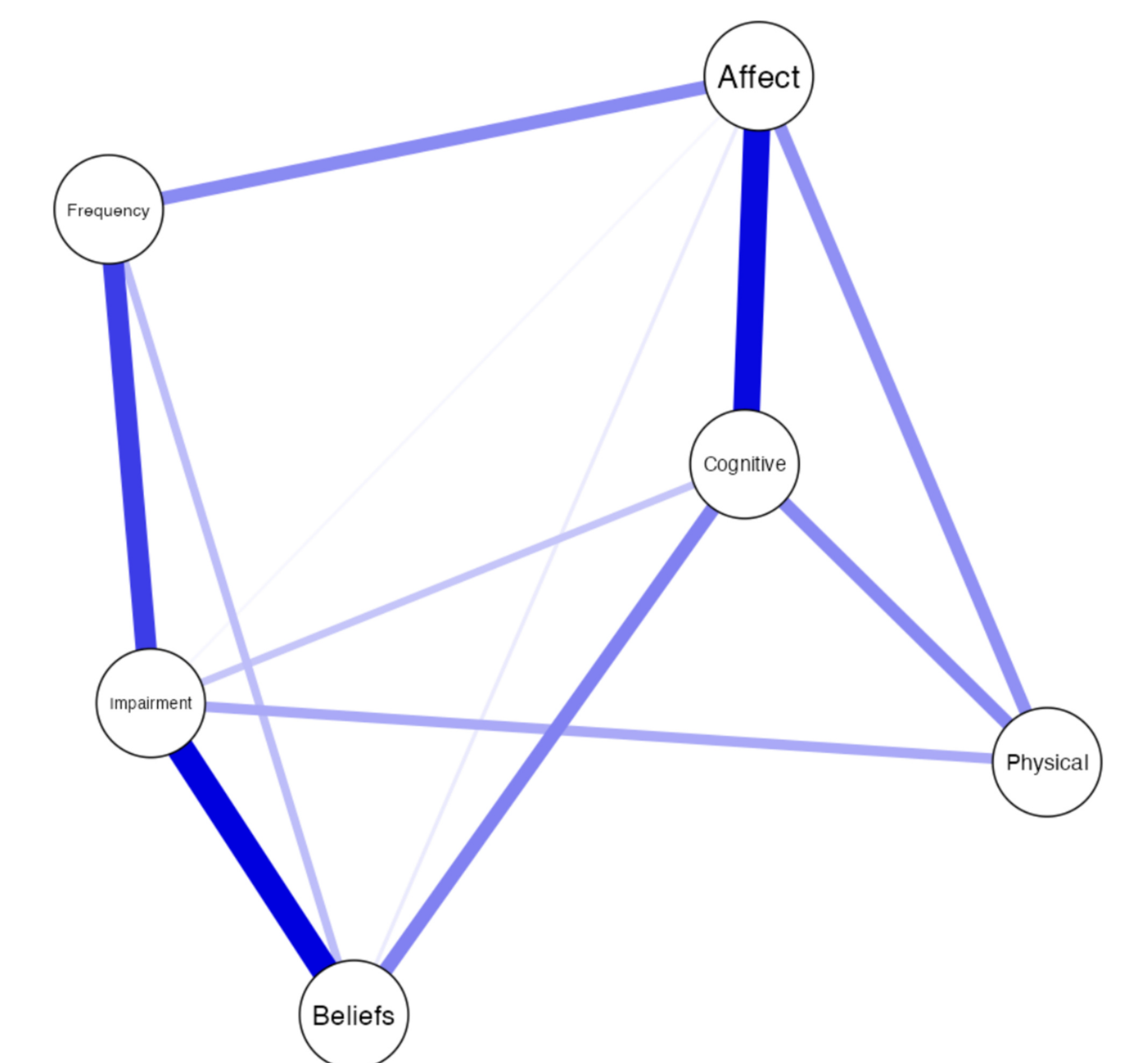
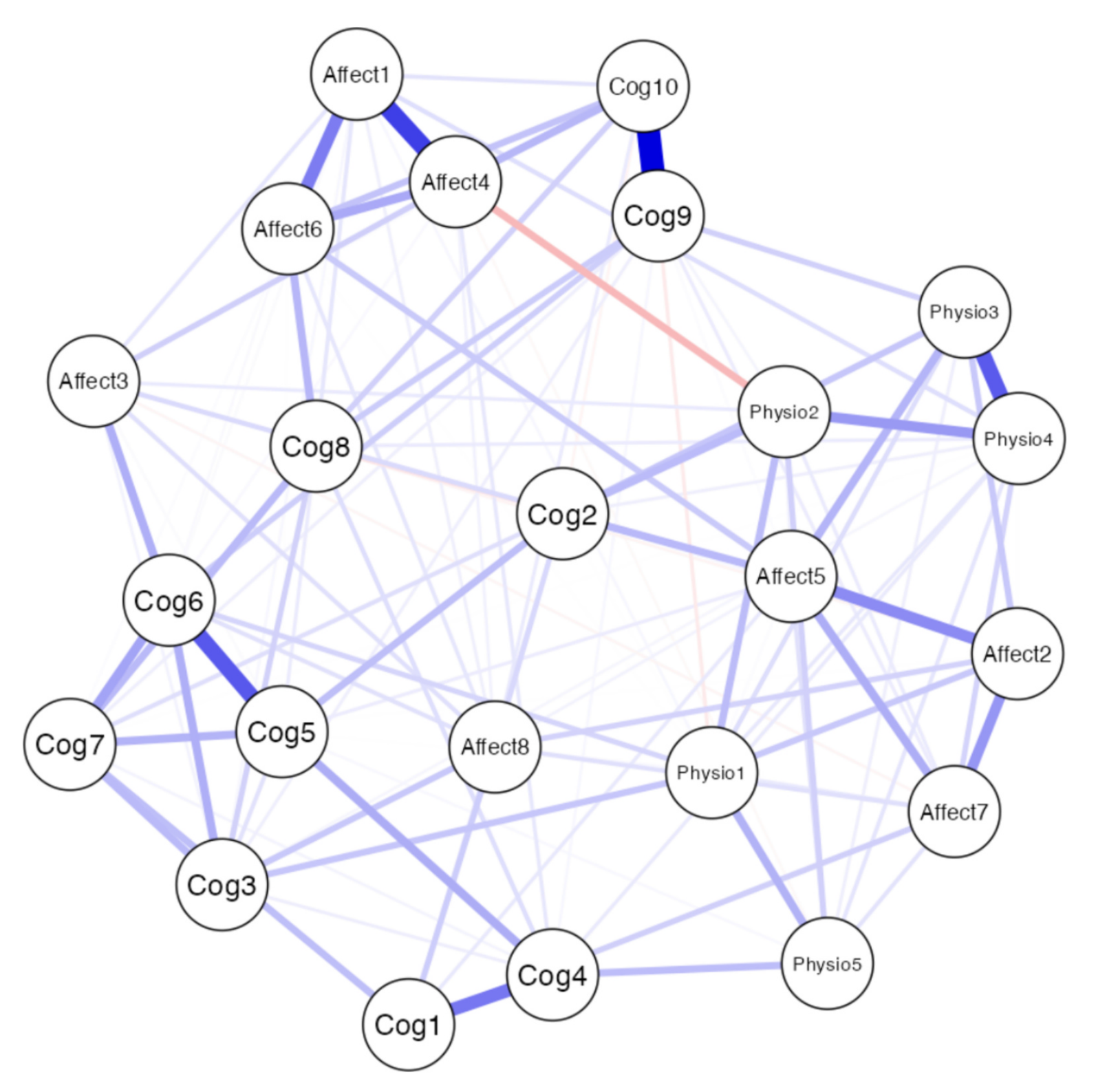
| Procedures | • EBIC gLASSO network model (tuning parameter=0.5); implemented in R and JASP (v0.17.2.1) • Four network analyses: (1) overall subscale-level network (6 nodes: Trigger Frequency, Affective, Physiological, Cognitive, Impairment, Beliefs); (2) symptom item-level network (23 items: affective, cognitive, physiological responses); (3) belief item-level network (14 items); (4) impairment item-level network (12 items) • Primary centrality metric: expected influence; betweenness, closeness, and strength also reported to align with common practices in the field • Sex comparisons on subscale scores via independent samples t-tests • Stability: case-dropping subset bootstrap with CS-coefficient target >0.5; edge weight accuracy via 95% CIs using non-parametric bootstrapping (1000 iterations) |
| Results | Overall network (subscale level) • Impairment subscale had the highest expected influence -- most central for both males and females; Cognitive Responses were moderately central; Physiological Reactions showed the lowest expected influence for both sexes • Strong positive partial correlations: Impairment-Beliefs, Cognitive-Affective Responses • Sex differences in the overall network: Affective Responses more influential for males than females; Trigger Frequency-Impairment partial correlation stronger for females; Trigger Frequency-Affective Responses partial correlation stronger for males Symptom network (item level, 23 items) • Highest expected influence: internalizing cognitive response "I need to get away from the sound" (Cog6) and affective response "I felt panic" (Affect5) • Moderate influence: externalizing cognitive response "I thought about physically hurting the person making the sound" (Cog10) and affective response "I felt angry" (Affect1) • Lowest expected influence: "I felt disgusted" (Affect3) and "I trembled or shuddered" (Physio2) • Strong positive partial correlations: Cog9-Cog10 (pushing/shoving and physical harm ideation); Affect1-Affect4 (anger and hateful) Belief network (item level, 14 items) • Highest expected influence: non-acceptance belief "I hate being like this" (Belief1); second: "I am weak" (Belief8) • Lowest expected influence: "I should have known how to cope earlier" (Belief11) • Strong positive partial correlation: "I should get over it" (Belief6) and "I should be able to control my reaction to these sounds" (Belief9) Impairment network (item level, 12 items) • Highest expected influence: "My self-esteem" (Imp7); second: "The quality of my relationships with my friends" (Imp9) • Lowest expected influence: "The quality of my romantic relationship" (Imp3) and "My ability to function in daily activities without help" (Imp4) • Strong positive partial correlations: Imp7-Imp12 (self-esteem and ability to be myself); Imp1-Imp5 (ability to be with other people and time with family) Sex differences in subscale scores • Females reported significantly higher cognitive and physiological responses than males; no significant sex differences in affective responses, impairment, or beliefs Stability • Strength centrality CS-coefficient remained above 0.7 even when up to 70% of the sample was excluded; edge weights precisely estimated with narrow CIs, not substantially influenced by sampling variability |
| Discussion/Limits | Conclusion- • Impairment is the most influential subscale for both sexes, suggesting functional disruption is a key factor in misophonia maintenance and severity; consistent with prior research on daily functioning impacts and with the DMQ Impairment subscale's strong convergent validity with other misophonia measures • Authors recommend clinicians and researchers may prioritize the DMQ Impairment subscale for efficient use; monitoring impairment changes across treatment may gauge intervention effectiveness and guide adjustments • Centrality of impairment aligns with the DSM framework in which functional impairment is a key diagnostic criterion; authors identify it as a key factor for future discussions about classifying misophonia as a distinct clinical entity (pdf) • Strong cognitive-affective relationship and strong impairment-beliefs correlation align with CBT principles and cognitive theories of psychopathology; prior CBT-based interventions for misophonia show promising results, and findings provide indirect support for their use (pdf) • Physiological responses were least influential in the overall network but are not characterized as insignificant; the finding aligns with the expert committee's challenge to definitions of misophonia as primarily a physical reflex condition • In the symptom sub-network, panic and anger along with escape ideation and physical harm ideation were most central; reflects both internalizing and externalizing symptom profiles documented in prior research • Centrality of panic specifically supports the consensus definition's emphasis that misophonia should not be defined solely as "hatred of sound" (pdf) • Non-acceptance ("I hate being like this") and negative self-perception ("I am weak") were the most central beliefs; characterized as possible core cognitive structures that may either arise from or exacerbate misophonic experiences, making them critical therapeutic targets; cognitive restructuring and ACT are suggested relevant approaches • Self-esteem was the most central impairment factor; consistent with prior studies linking misophonia to lower self-esteem; low self-esteem is a transdiagnostic factor; targeting it in interventions may yield improvements in overall mental health and functioning • Sex differences suggest females may experience misophonia with more severe cognitive and physiological symptoms leading to greater functional disruptions, while males may experience heightened emotional reactivity; proposed explanations include sociocultural norms, differential coping strategies (rumination/internalization vs. avoidance/suppression), and neurobiological differences in sensory processing |
| Limitations:: | • Cross-sectional design precludes causal inference or examination of temporal dynamics between symptoms • Centrality in a cross-sectional network does not guarantee that targeting central symptoms in treatment will reduce overall symptom severity • Sample includes varying levels of misophonia severity (not exclusively treatment-seeking), which may have influenced network structure and centrality; generalizability to well-defined clinical samples is uncertain • Additional cross-cultural validation and test-retest reliability data for the DMQ are needed • Network analysis should be treated as complementary to other analytic approaches, not a replacement |
| Future Directions:: | • Longitudinal network studies to examine how symptom interrelationships evolve over time and in response to treatment • Replication in well-defined, treatment-seeking, and more diverse populations • Qualitative and quantitative research on social dynamics, stigma, and their influence on misophonia-related beliefs • Investigation of sex-specific mechanisms to inform personalized therapeutic approaches • Combining network analysis with other methodologies for more comprehensive understanding |
| Relevance:: | • did a network analysis to look at the interconnections of the subscales in the DMQ, to find the most central factors of the DMQ. • identified major networks for overall Misophonia, symptoms, beliefs, and impairment • found the impairment subscale and specific items were the most central in each network might represent key aspects of Misophonia symptomology, and may be good targets of focus for future intervention approaches |
Notes
key terms and concepts
Duke Misophonia Questionnaire (DMQ) -- 86-item psychometrically validated self-report measure with 9 subscales covering trigger frequency, affective/physiological/cognitive reactions, coping strategies before/during/after triggers, impairment, and beliefs; developed via stakeholder-driven grassroots process and refined through factor analysis and item response theory.
Network analysis -- statistical approach in which variables ("nodes") are connected by "edges" representing partial correlations; centrality measures quantify each node's influence within the network based on its connections.
Expected influence centrality -- primary centrality metric used in this study; accounts for both strength and direction (positive/negative) of connections; preferred over betweenness and closeness in correlational/psychological networks because it does not treat correlations as physical distances.
EBIC gLASSO -- Extended Bayesian Information Criterion graphical LASSO; sparse network estimation model applied with tuning parameter 0.5 for parsimony and interpretability.
CS-coefficient (correlation stability coefficient) -- quantifies robustness of centrality estimates under case-dropping bootstrap; values above 0.5 indicate stable estimates.
my engagement notes
my questions
my comments
Bookmarks
-
he central factors and interrelationships in the impairment network (page 6)
-
The central factors and interrelationships in the overall misophonia network (page 8)
-
The central factors and interrelationships in the symptom network (page 8)
-
The central factors and interrelationships in the belief network (page 8)
-
The central factors and interrelationships in the impairment network (page 9)
reading notes
contextual statement
In a 2024 study, Shan applied EBIC gLASSO network analysis to DMQ data from 144 adults with varying misophonia severity to identify the most central subscales and items across four network models (overall misophonia, symptoms, beliefs, impairment), with additional exploration of sex differences in network structure and subscale-level centrality.
summary statement
In a 2024 study, Shan identified the most central components of misophonia symptomatology as measured by the Duke Misophonia Questionnaire by applying network analysis to data from 144 adults with varying symptom severity. They found that the Impairment subscale was the most influential node in the overall network for both sexes, with internalizing/externalizing cognitive and affective symptoms, non-acceptance beliefs, and self-esteem deterioration emerging as the most central items within their respective sub-networks. From this they concluded that these central components may represent key targets for efficient DMQ use and potentially for clinical intervention, while noting that cross-sectional design and sample heterogeneity limit causal and generalizability claims.
Zettelkasten
Centrality of panic specifically supports the Swedo definitions emphasis on emotions beyond hatred
network analysis finding cog-affective relationships support CBT principles