Properties (15)
- purpleRed
- (Podoly et al., 2025)
•
A randomized controlled trial evaluating an mHealth intervention for anger-related cognitions in misophonia
Status:: #status/Bare-bones-review
Metadata
- Item Type: #journalArticle
- Authors:: Tamar Yonit Podoly, Hadar Even-Ezra, Guy Doron,
- Date Added: April 23, 2025
- URL: https://linkinghub.elsevier.com/retrieve/pii/S0165032725003982
- DOI: 10.1016/j.jad.2025.03.060
- Cite Key: podolyRandomizedControlledTrial2025
- Tags:: #Misophonia, #Bare-bones-review-🦴, #treatment, #clinical, #anger, #metacogntions, #DMHI, #RCT,
- PDF Attachments
Abstract
| Background/Purpose | Background- • Misophonia involves strong aversive emotional and physiological reactions (e.g., irritation, disgust, anger, loss of control) to specific human-generated sounds. • Triggers (e.g., chewing, sniffing) often generalize from familiar to unfamiliar individuals; self-produced sounds rarely elicit responses. • Prevalence is ~6–20%, with onset in childhood or adolescence; no DSM-5 or ICD-10 diagnostic criteria. • Associated with anxiety, depression, OCD, Tourette’s, eating disorders, and ADHD; not supported as an auditory neurological dysfunction. • Linked to maladaptive anger-related beliefs (e.g., attributing selfish or uncaring intent to others). • CBT-based approaches (including exposure and Unified Protocol) show modest evidence but are limited by small, uncontrolled designs. • Cognitive models propose maladaptive interpretations and anger rumination sustain emotional reactivity; modifying these processes improves regulation and sensitivity. • mHealth interventions provide accessible, low-cost, scalable delivery. • The GGtude platform has RCT evidence across multiple psychopathologies showing symptom reduction. • mHealth interventions for misophonia remain under-researched. Purpose- • Overall goal: evaluate whether an mHealth app (GGanger) targeting anger-related maladaptive cognitions reduces misophonia symptoms and associated anger-related cognitions in a randomized controlled design. • Specific goals: (1) test between-group differences in misophonia symptoms and anger cognitions at T1; (2) examine within-group pre–post and follow-up effects for both groups; (3) test whether changes in anger rumination and metacognitions mediate intervention effects on misophonia symptoms. |
| Participants/samples | • N = 85 Hebrew-speaking adults who self-reported misophonia (12 of 97 enrolled dropped out before T0 and were excluded). • iApp: N = 40; dApp: N = 45. • Mean age = 36.55 years (SD = 11.26); range not explicitly stated; minimum age 17. • Gender: 74 female (87.1%), 11 male. • Inclusion: age ≥ 17; AMISOS-R score above moderate level (21–30). • No gender-based exclusions. • Recruited via Facebook and WhatsApp misophonia groups. • Groups did not differ significantly at baseline on any demographic or self-report variable. |
| Measures | - • A-MISO-S (Amsterdam Misophonia Scale): 8-item; 5-point scale; 6 numerically rated items used; assesses past 7 days; lower reliability across timepoints (α = 0.59–0.66). • AMISOS-R (Amsterdam Misophonia Scale–Revised): 12-item; 5-point scale; 10 items used; assesses past 3 days; acceptable reliability (α = 0.80–0.87). • MISO-SCREE (Misophonia Screening Scale): 14-item; 5-point scale; assesses broader misophonia symptoms; acceptable reliability (α = 0.72–0.87). • ARS (Anger Rumination Scale): 19-item; 4-point Likert; four subscales (angry afterthoughts, thoughts of revenge, angry memories, understanding of causes); high reliability (α = 0.81–0.93). • MAP-R (Metacognition and Anger Processing Scale–Rumination): rumination subscale only (10 items) of 31-item MAP; 4-point scale; high reliability (α = 0.71–0.92). • STAXI-T (State-Trait Anger Expression Inventory–Trait Anger): 10-item trait anger subscale used for baseline group comparisons only; 4-point scale (α = 0.85 at T0). |
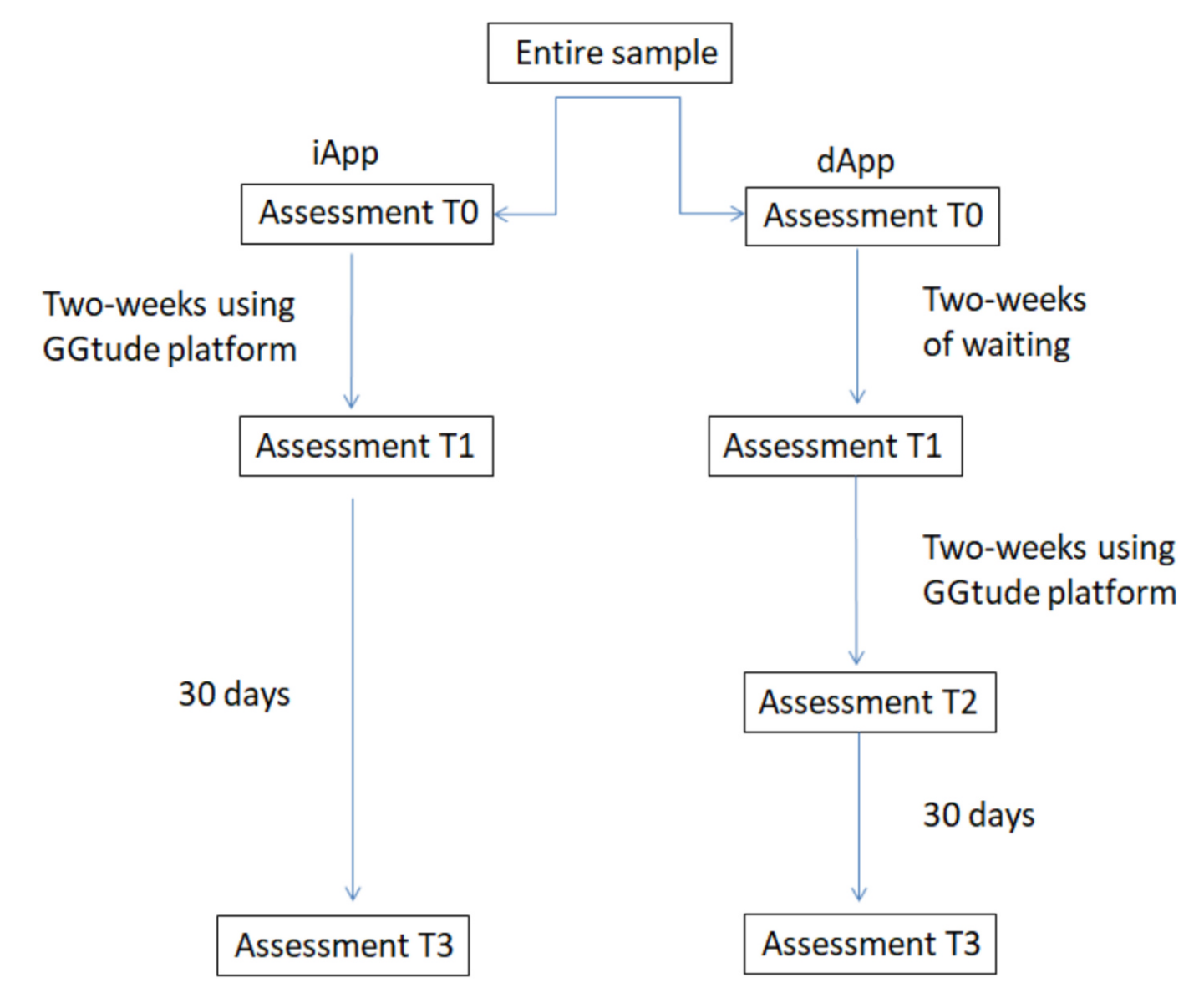
| Procedures | • T0 (baseline): demographic survey + all measures administered to both groups. • iApp group: 15 days of GGanger app use → T1 assessment → 30-day follow-up (T3). • dApp group: 2-week waitlist → T1 assessment → 15 days of GGanger app use → T2 assessment → 30-day follow-up (T3). • GGanger consists of 56 levels grouped into 14 days; users complete a tutorial, then engage in gamified swipe-based exercises identifying adaptive vs. maladaptive cognitions; includes breathing relaxation at end of each practice day. • Targeted cognitions include anger-related metacognitions, perfectionism, negative perceptions of others, and self-critical beliefs. • No exposure to misophonia trigger sounds was involved. • Intention-to-treat analysis with multiple imputation (multivariate imputation by chained equations) for missing data. |
| Results | Between-group (iApp vs. dApp at T0–T1) • iApp showed greater reduction than dApp on MISO-SCREE (significant interaction) and AMISOS-R (marginal). • No significant group × time interaction for A-MISO-S. • iApp showed greater reduction than dApp on both MAP-R and ARS (significant interactions for both anger measures). Within-group: iApp (T0, T1, T3) • AMISOS-R, MISO-SCREE, and MAP-R decreased significantly from T0 to T1; ARS did not decrease significantly at T1. • Reductions in AMISOS-R, MISO-SCREE, and MAP-R maintained at T3 (no significant change T1 to T3). • ARS showed significant reduction only at T3 compared to T0. Within-group: dApp (T0, T1, T2, T3) • No significant change from T0 to T1 (waitlist period) on any measure. • Significant reductions from T1 to T2 on AMISOS-R, MISO-SCREE, ARS, and MAP-R. • Reductions maintained at T3; no significant change from T2 to T3 on any measure. Baseline correlations • Higher misophonia symptoms associated with higher anger rumination and higher trait anger. Mediation analysis • Intervention condition had a significant direct effect on post-intervention misophonia symptoms (MISO-SCREE) controlling for baseline. • Intervention significantly reduced post-intervention ruminations; however, ruminations did not significantly predict post-intervention misophonia symptoms. • Intervention did not significantly predict post-intervention anger metacognitions; anger metacognitions did not significantly predict post-intervention misophonia symptoms. • Total and specific indirect effects via rumination and anger metacognitions were nonsignificant. • Demographic covariates (gender, age) were nonsignificant. |
| Discussion/Limits | Conclusion- • The GGanger reduced anger-related ruminations and metacognitions, with effects sustained at 1-month follow-up and • The findings indicate that targeting anger-related cognitions via mHealth is associated with reductions in some misophonia symptoms (primarily MISO-SCREE). • The authors conclude that variability across misophonia measures reflects differences in instrument sensitivity (structure, timeframe, reliability). • The findings indicate that anger rumination reductions emerged later, suggesting metacognitive change requires time and practice. • The authors conclude that mediation by rumination and metacognitions was not supported, indicating direct intervention effects or other unmeasured cognitive mechanisms. • The findings indicate discrepancies between ANOVA and mediation results reflect methodological differences (baseline control vs raw change). • The authors conclude that mHealth metacognitive interventions offer a scalable, low-cost alternative to CBT without requiring exposure. • The data support that improvements are maintained at short-term follow-up. • The authors conclude that future interventions should target misophonia-specific beliefs (e.g., intent attributions). |
| Limitations:: | • Dropout rate of 21.18%, though lower than typical unguided internet-based CBT attrition. • Sample predominantly female (87.1%), limiting generalizability. • Reliance on self-report measures only; no physiological or objective assessments of misophonia. • Relatively short follow-up period (1 month); long-term maintenance of effects unknown. • Small sample size reduced statistical power for mediation analyses. • Strong baseline predictor variance in metacognitions may have attenuated mediation detection. • Misophonia not formally diagnosed; self-report of condition used for inclusion. • Competing interest: lead author (GD) is co-founder of GGtude Ltd. |
| Future Directions:: | • Larger-scale longitudinal mediation models to capture dynamic change and improve sensitivity to indirect effects. • Explore additional unmeasured mechanisms (e.g., perfectionism, negative perceptions of others) that may mediate symptom reduction. • Develop and test an adapted intervention version explicitly targeting misophonia-specific trigger beliefs. • Include objective and physiological measures of misophonia. • Recruit more diverse samples by gender, age, and ethnicity. • Examine long-term maintenance effects and necessity of booster sessions. • Explore whether integration of app-based approaches with therapist guidance enhances outcomes. |
| Relevance:: | • study looked at the treatment efficacy of a mobile app to treat several aspects of Misophonia . they found some evidence of improvements in some aspects, namely in symptoms and anger related outcomes, but still needs more research on other aspects such as rumination or anger related metacognitions. |
Notes
key terms and concepts
- misophonia – condition in which individuals react negatively to patterns of sound produced by others in specific situations, often accompanied by intense anger, disgust, and loss of self-control.
- mHealth (DMHI) – mobile health; digital mental health intervention delivered via smartphone application.
- GGanger – module within the GGtude/ocd.app platform designed to target maladaptive metacognitions associated with anger difficulties via gamified cognitive training.
- anger rumination – repetitive, perseverative thinking about anger-provoking events, including angry afterthoughts, thoughts of revenge, angry memories, and understanding of causes.
- metacognitions (anger-related) – beliefs about one's own cognitive processes related to anger (e.g., "I can't control my anger"; "My extreme anger keeps me safe").
- iApp – immediate app use group; began GGanger intervention directly after baseline assessment.
- dApp – delayed app use group; served as waitlist control before crossover to intervention.
- intention-to-treat (ITT) – analytic approach including all randomized participants regardless of completion, using multiple imputation for missing data.
- MAP-R – Metacognition and Anger Processing Scale–Rumination subscale; measures rumination factor of anger metacognitions.
- ARS – Anger Rumination Scale; 19-item measure assessing trait-level anger rumination across four factors.
- MISO-SCREE – misophonia screening scale assessing symptom severity.
my engagement notes
my questions
my comments
- interestingly, one module of the app is specific to treating OCD. might count the success of the app as a point in the OCD pile? (page 2)
Bookmarks
reading notes
Intervention design note
GGanger does not use traditional exposure; its mechanism relies on repeated gamified cognitive training to increase accessibility of adaptive cognitions and reduce rigidity of maladaptive metacognitions. This is theoretically distinct from standard CBT behavioral components.
Measure sensitivity note
Authors attribute differential results across misophonia measures to instrument properties: MISO-SCREE (14 items, nuanced scale) showed significant effects; AMISOS-R (3-day window) showed marginal effects; A-MISO-S (8 items, lower reliability) showed null effects. This has implications for measure selection in future misophonia intervention research.
Conflict of interest
Corresponding author (GD) is co-founder of GGtude Ltd., which develops the platform evaluated in this study. This represents a significant financial competing interest that should be considered when interpreting effect sizes and conclusions.
contextual statement
In a 2025 study, Podoly attempted to evaluate the efficacy of a gamified mHealth app (GGanger) targeting anger-related metacognitions and rumination in reducing misophonia symptoms by randomly assigning 85 Hebrew-speaking adults with self-reported misophonia to an immediate or delayed 15-day app use condition, using multiple self-report measures of misophonia severity, anger rumination (ARS), and anger metacognitions (MAP-R).
Zettelkasten
app based treatment of Misophonia and implications of a lack of mediation effects