Properties (12)
- purpleRed
- Triggering Misophonia
- (Kazazis et al., 2024)
- Misophonia
- My Dissertation MOC
Triggering Misophonia: The Importance of Spectral Information, Temporal Information, and Action Identification
Status:: #status/reviewed
Metadata
- Item Type: #journalArticle
- Authors: Savvas Kazazis, Iza Korsmit, Stephen McAdams,
- Date Added: January 13, 2024
- URL: https://www.tandfonline.com/doi/full/10.1080/25742442.2024.2302295
- DOI: 10.1080/25742442.2024.2302295
- Cite Key: kazazisTriggeringMisophoniaImportance2024
- Tags: #Misophonia, #role-of-context, #action-identification, #psychological-disorders, #spectral-information, #temporal-information
- PDF Attachments
Abstract
| Background/Purpose | Background- • Misophonia is not yet recognized in the DSM-5 but has increasing research interest • Previous studies suggest misophonia has physiological, neurophysiological, and neurobiological bases • Some research indicates misophonia may be influenced by visual cues and source identification Purpose- • Investigate the importance of spectral and temporal acoustic information in triggering misophonia • Test whether action identification affects the severity of misophonic responses • Examine how spectral and temporal modifications of trigger sounds impact aversiveness ratings |
| Participants/samples | • 18 participants (16 female) with severe misophonia • Average age: 36.1 years (SD = 14.1; range: 19-61) • Average Misophonia Assessment Questionnaire (MAQ) score: 44.83 out of 63 (severe misophonia) • Average Amsterdam Misophonia Scale (A-MISO-S) score: 15.44 out of 24 (severe misophonia) |
| Measures | • Misophonia Assessment Questionnaire (MAQ) • Amsterdam Misophonia Scale (A-MISO-S) • Misophonia Coping Responses questionnaire (MCR) • Aversiveness ratings on a 9-point scale • Action identification task |
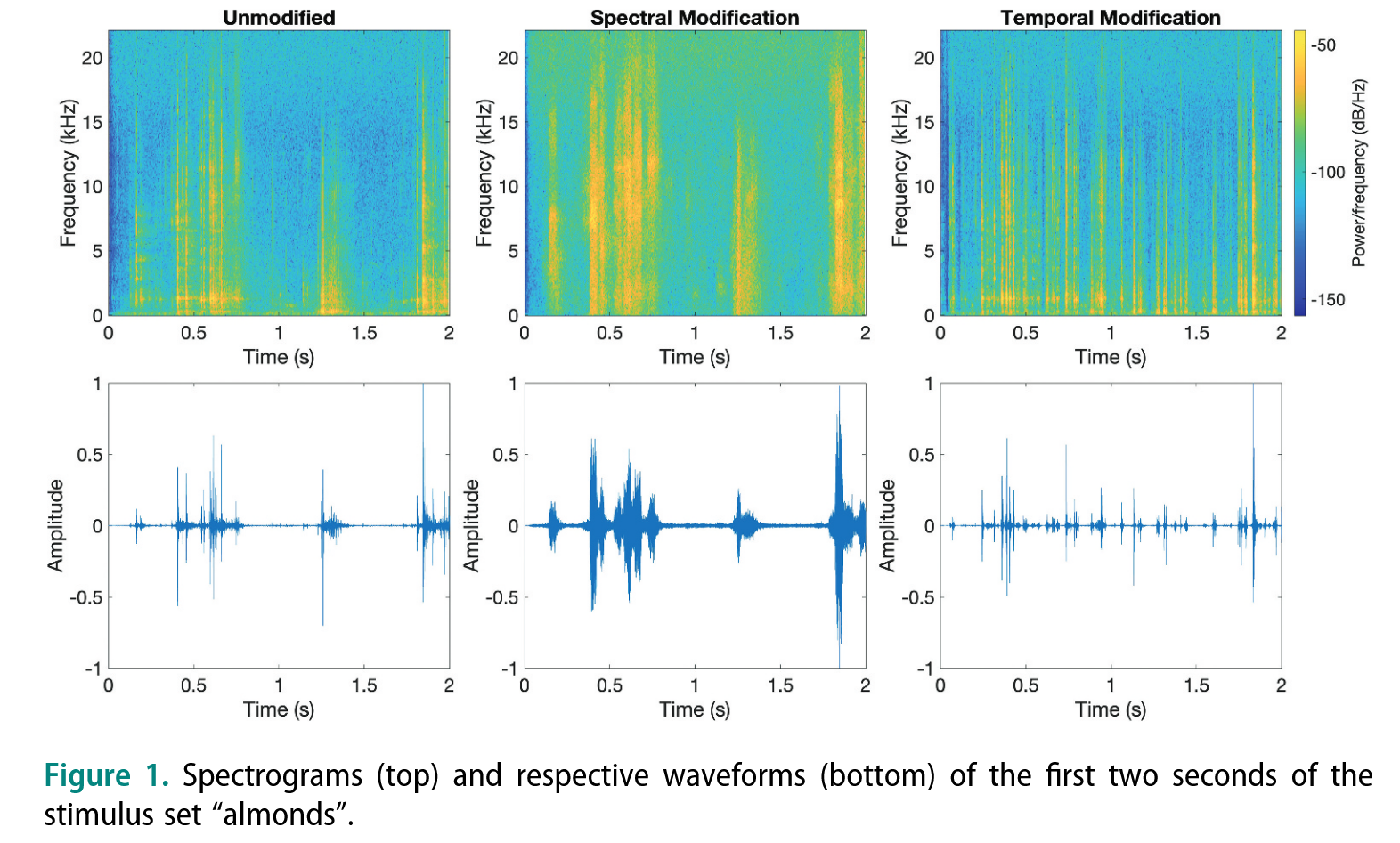
| Procedures | Stimuli used - Three stimulus sets were used: - Unmodified sounds: Recorded sounds that are either common misophonic triggers or neutral sounds. - Temporally modified sounds: Achieved by segmenting the audio signal into short overlapping frames of 25 ms and shuffling them over a radius of 250 ms. The frames were Hann-windowed, and shuffling was performed by a random permutation of the frames within the given radius, conditioned by a Gaussian probability distribution to minimize audible artifacts. - Spectrally modified sounds: Achieved through spectral whitening while preserving the global amplitude envelope. This was done by estimating the spectral envelope of the input signal on 20-ms frames through a 13th-order Linear Predictive Coding (LPC) model. The signal was resynthesized by feeding white noise into the filter’s structure, and the amplitude envelope was controlled by the gain of the filter. Procedures: - Three stimulus sets: unmodified, temporally modified, and spectrally modified sounds - Participants rated aversiveness and identified actions for each sound - Online experiment with pre-screening and post-experiment surveys - Trials: - Participants were presented with a stimulus and asked to rate its aversiveness on a continuous 9-point analogical-categorical scale. - Participants then identified the action that produced the sound from a drop-down menu. - No feedback was provided on the correctness of their responses. - Participants could replay each stimulus as many times as needed before making their judgments. - The presentation order of each stimulus was randomized for each participant. - Post-Experiment: Participants filled out a post-experimental survey including the Amsterdam Misophonia Scale (A-MISO-S) and the Misophonia Coping Responses questionnaire (MCR). |
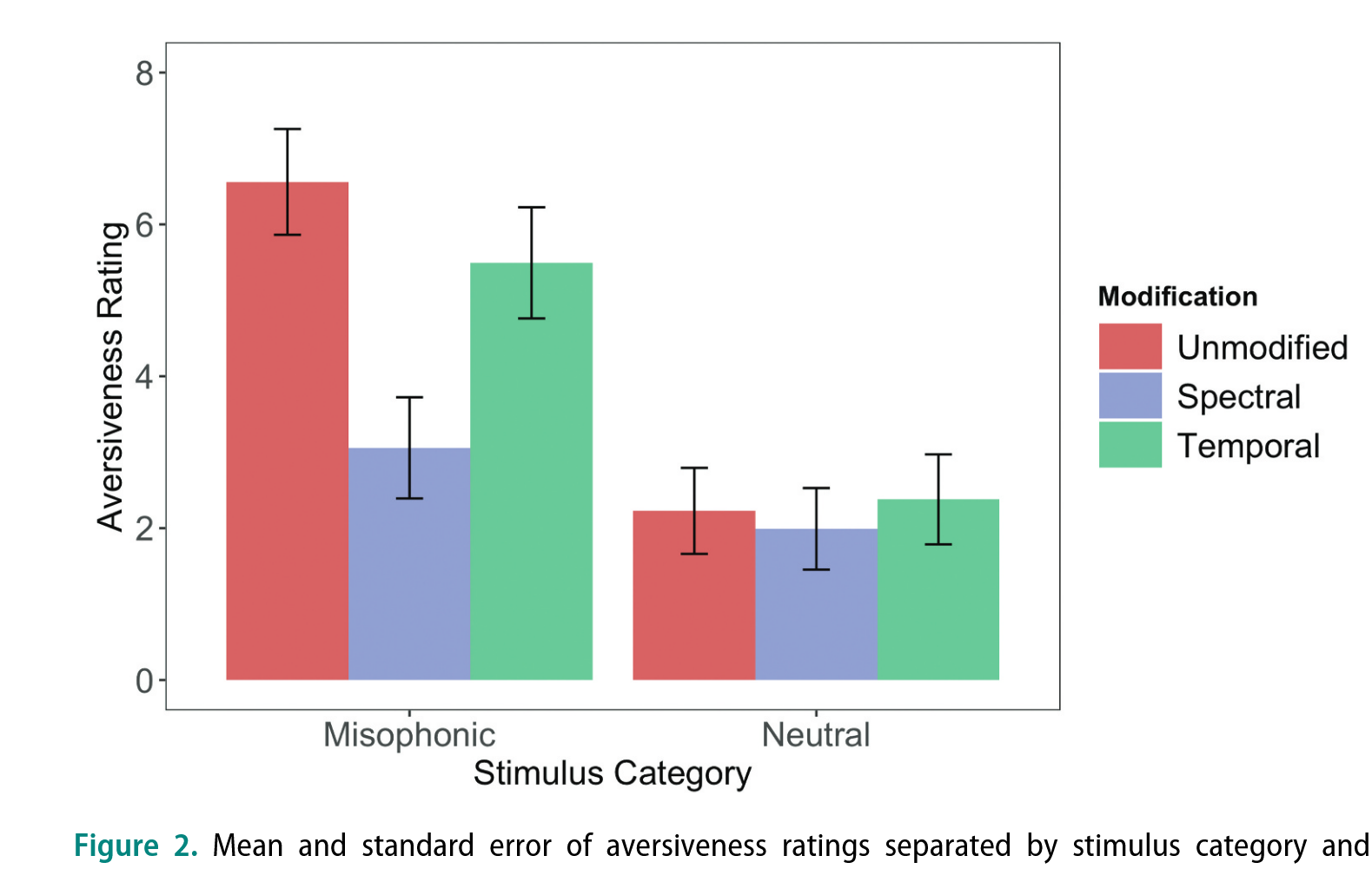
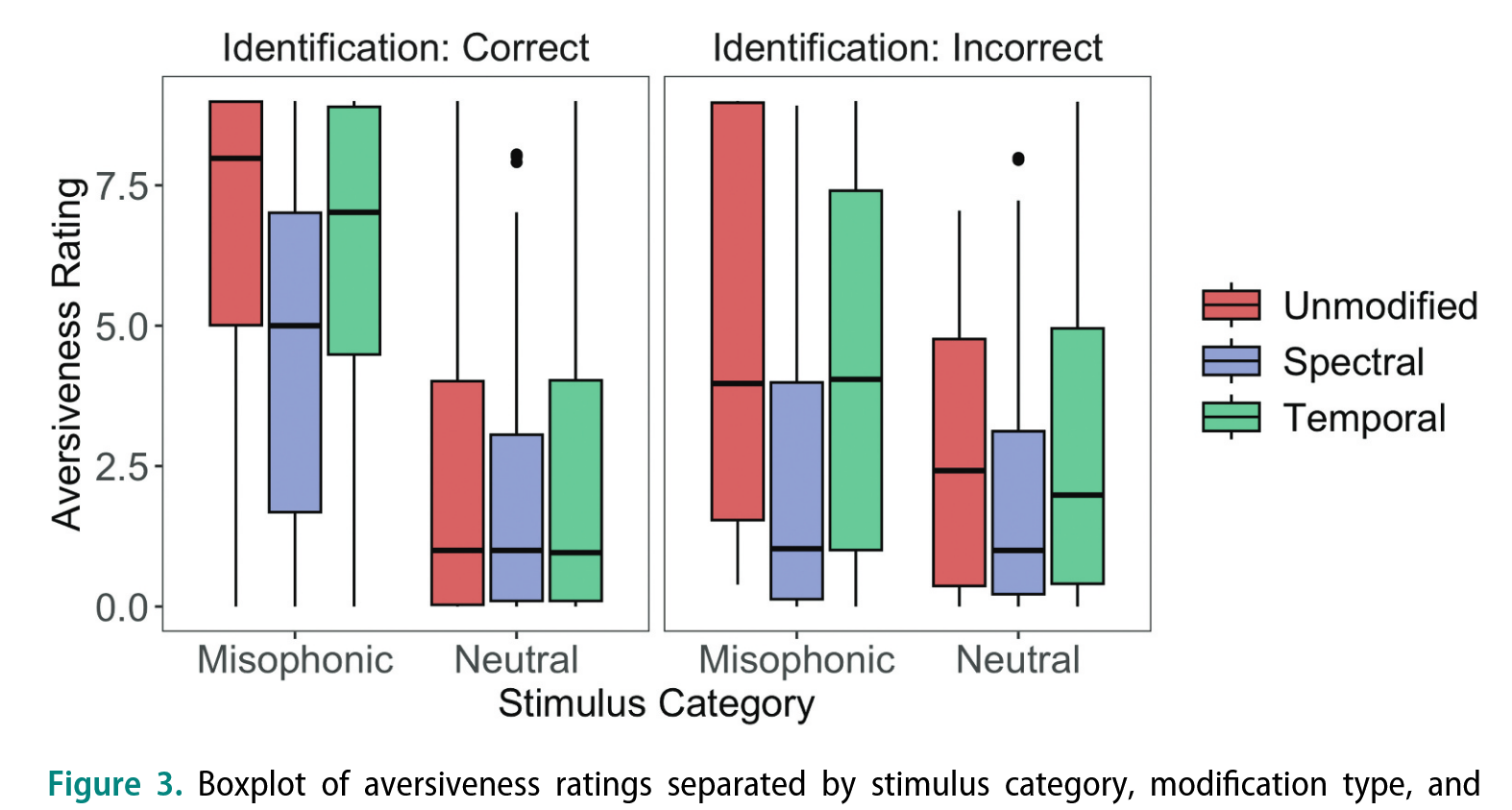
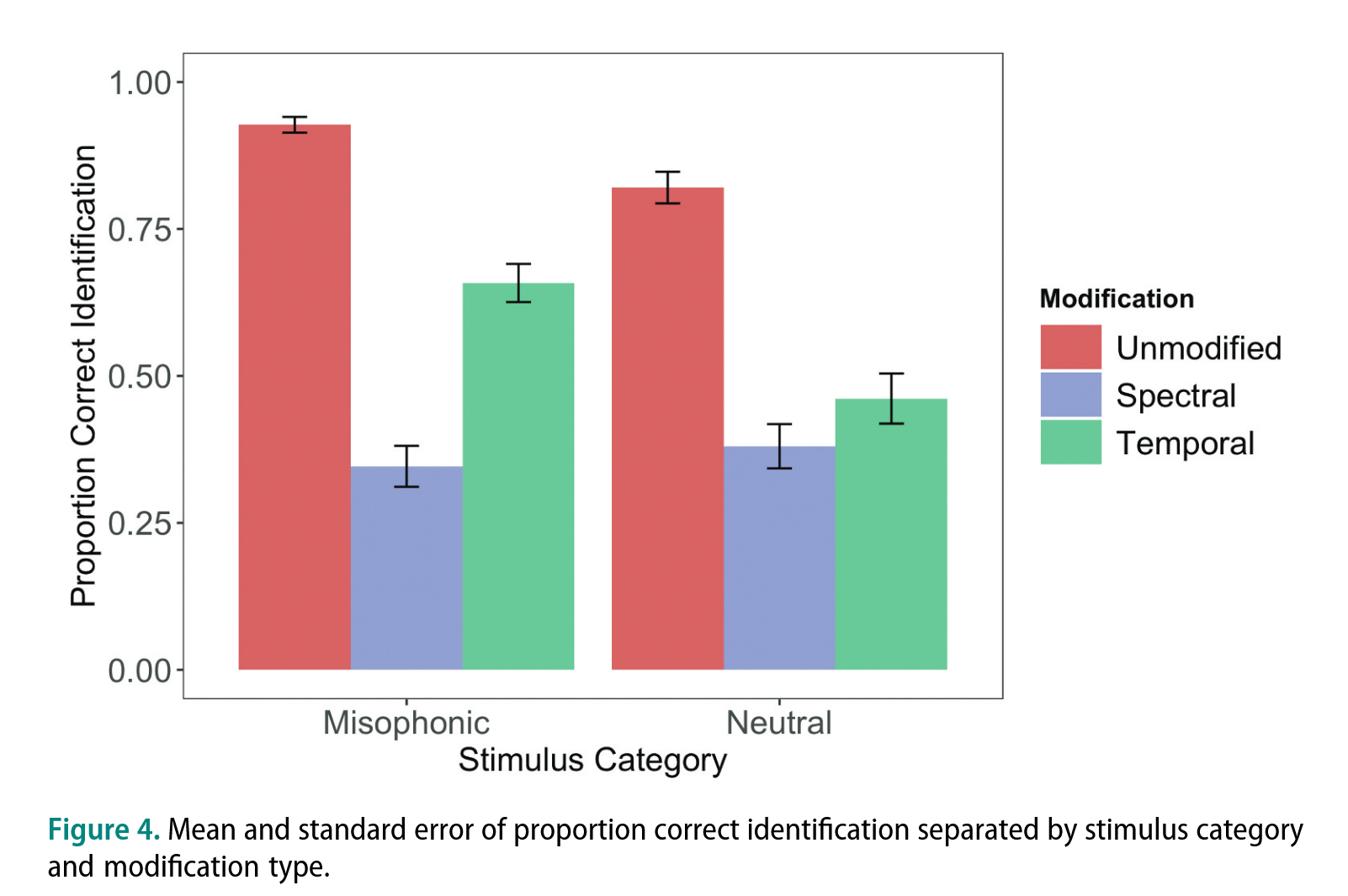
| Results | - Unmodified trigger sounds rated significantly more aversive than neutral sounds - Main effects of modification type and identification on aversiveness were significant - Spectrally modified sounds rated significantly less aversive than unmodified and temporally modified sounds - Correctly identified stimuli rated as significantly more aversive than incorrectly identified stimuli - Interaction between modification type and identification was marginally significant - Identification effect was largest for spectrally modified stimuli |
| Discussion/Limits | Conclusion- - Both action identification and spectral information play important roles in triggering misophonia - Spectral information averaged over 250 ms is important in triggering misophonia - Temporal micro-fluctuations did not significantly affect misophonic responses - Spectral modifications significantly reduced aversiveness ratings • authors conclude that the lack of an effect on temporal modualtion on aversivness suggests that the average spectral info over a 250ms time course is sig for miso. (page 11) - Results support previous findings on the role of action identification in misophonia • conclude that the sig (but weak) identifcation effect on temporally modualted stim plus the reltativly high proportion correct for identifying temporally modulated stim, suggest that both spectral and action identification are importnat to aversiveness. (page 12) |
| Limitations:: | • Relatively small number of participants • High variance in ratings, especially for incorrect identifications of unmodified stimuli |
| Future directions:: | • Examine the importance of individual amplitude and frequency modulation rates |
| Relevance:: | • Looked at how action identification via modifying features of auditory stim ( temporal modification vs spectral) impacted the aversiveness of triggers. results support role of correct identification for the aversive miso response. • Found not effect of temporal modification, but spectral modification caused reduction in aversiveness. Identifiability also impacted aversiveness, with stim modified to be less identifiable showing less aversiveness • Authors use this to support an important role of spectral characteristics, But honestly I think it is more about the fact that changing the spectral characteristics inherently impacts its identifiability . • the authors, bring up an interesting idea that systemic miss identification of triggers. Sources could have explained some of their weird results. For example, they talk about how one person might systemically miss label one sound as chewing where the experiment is labeled it as slurping. Be interesting to consider this kind of systemic identification in the context of my dissertation and my piloting data. pdf • uses the lack of effect from temporal modulation to claim that spectral averaging over a times scale of 250 ms is important in Misophonia responses. Not entirely sure if I agree or even understand where they’re getting this conclusion from. |
Notes
key terms and concepts
my engagement notes
my questions
my comments
-
uses the lack of effect from temporal modulation to claim that spectral averaging over a times scale of 250 ms is important in Misophonia responses. Not entirely sure if I agree or even understand where they’re getting this conclusion from. (page 1)
-
a bit of a pet peeve, but this article has one of the most egregious examples of something i commonly see and hate. it is really obtuse about how large the sample was. in the methods it talks about 33 completed a pre screener, 30 were invited, and 18 participated.... just say the sample was 18. for fucks sake, i cant for the life of me imagen why anyone would care about all the people that weren’t included. maybe if they were dropping peoples data, but we are talking about people who did not participate at all... so it has zero impact on the power of the study and really annoys the fuck out of me. (page 4)
Bookmarks
reading notes
zettelkasten
Kazazis 2024 support for the role of trigger source identification in the Misophonic response
Kazazis 2024 findings suggesting an important role of spectral averaging over 250ms time scales
Kazazis 2024 discussion of the impact of systemic mis-identification of sound sources