Properties (15)
Id
3f5dd087-a10e-4152-847f-446aa800f026
Year
2026
Abstract
Background and Objectives: This study aimed to examine the severity of misophonia symptoms in individuals diagnosed with obsessive–compulsive disorder (OCD) and to evaluate the pattern of the relationship between misophonia and OCD symptom severity in relation to anxiety sensitivity and mindfulness. Materials and Methods: This comparative and cross-sectional study included 108 patients diagnosed with OCD according to DSM-5 criteria and 81 healthy control subjects without any psychiatric diagnosis. Participants completed the Misophonia Symptom List (MSL), Anxiety Sensitivity Index-3 (ASI-3), Mindful Attention Awareness Scale (MAAS), Yale–Brown Obsessive Compulsive Scale (Y-BOCS), and Beck Anxiety Inventory (BAI). Statistical analyses included group comparisons, Pearson correlations, multiple linear regression, and mediation analyses using the PROCESS macro. Results: MSL scores were significantly higher in the OCD group compared to the control group (104.10 ± 33.00 vs. 87.56 ± 20.07, p < 0.001). ASI-3 (33.53 ± 18.72 vs. 18.12 ± 11.55, p < 0.001) and BAI scores (20.74 ± 13.14 vs. 11.04 ± 8.47, p < 0.001) were higher; MAAS scores were lower (53.23 ± 14.92 vs. 60.72 ± 12.70, p < 0.001). In the OCD group, MSL scores were positively correlated with anxiety sensitivity (r = 0.626, p < 0.001) and Beck anxiety (r = 0.515, p < 0.001) and negatively correlated with MAAS (r = −0.357, p < 0.001). In multiple regression analysis, anxiety sensitivity was identified as the only variable significantly predicting misophonia severity (β = 0.523, p < 0.001). Mediation analyses showed that anxiety sensitivity emerged as the dominant indirect pathway between OCD symptom severity and misophonia, whereas the contribution of mindfulness was not independent of anxiety sensitivity in the serial mediation model. Conclusions: The findings indicate that misophonia symptoms are significantly elevated in individuals diagnosed with OCD and that these symptoms are particularly associated with cognitive-emotional variables such as anxiety sensitivity and mindfulness. Given the cross-sectional design, the mediation findings should be interpreted as indirect associations rather than evidence of causal pathways. Considering these variables may be useful in assessing misophonia symptoms accompanying OCD and planning clinical approaches.
Cssclasses
- purpleRed
Aliases
- Misophonia in Individuals with Obsessive–Compulsive Disorder
- (Karaytuğ et al., 2026)
Import Date
02-26-2026
Template Version Notes
•corrected error in rendering the linked PDF in metadata section
• added the tag “noted” to the definition of comments to ignore ( like with the “in another note” tag. this is so that when making notes on chapters of a textbook, i can still export things for manual addition to the obsidian note without having to keep track of what has already been added ). Also moved the version notes to the yaml section
• this version added the bookmarks section to auto collect all bookmarks. it also dropped the template auto fill of the initial source field because we never got it working and just overwrote it manually anyway. this version also added logic to handle “in another note” tag. annotations marked with this are completely ignored. used when i have information covered in a bigger note, but still want to highlight that part in text for visual clarity (so as to avoid duplicates of the same information)
• running the import more then once will overwrite the file, so do not import again if you have made changes in obsidian that are not in the zotero article.
Zotero Note Link Generated
true
Checked For Zettle Notes
true
Dv Authors
Mahmut Onur Karaytuğ, Lut Tamam, Mehmet Emin Demirkol, Zeynep Namlı, Caner Yeşiloğlu, Sinem Çetin Demirtaş, Ali Meriç Kurt, Hale Nur Çakar, Efsun Damla Altın, Mahmut Gürbüz,
Dv Initial Source
Misophonia MOCMisophonia
Dv Limitations
• Cross-sectional design prevents causal inference.
• Mediation interpreted as indirect association only.
• Misophonia assessed via self-report; no structured diagnostic interview.
• Only symptom severity subscale used for misophonia.
• Control group not assessed with structured diagnostic instrument.
• Illness duration and pharmacological treatment not systematically collected.
• Common method variance possible.
• Other relevant mechanisms (emotion regulation, metacognition, avoidance) not assessed.
Dv Future Directions
• Longitudinal studies to clarify directionality and mechanisms.
• Broader cognitive-emotional models including additional processes.
• Comprehensive clinical assessment of misophonia dimensions.
• Further research in diverse samples.
Dv Statistics
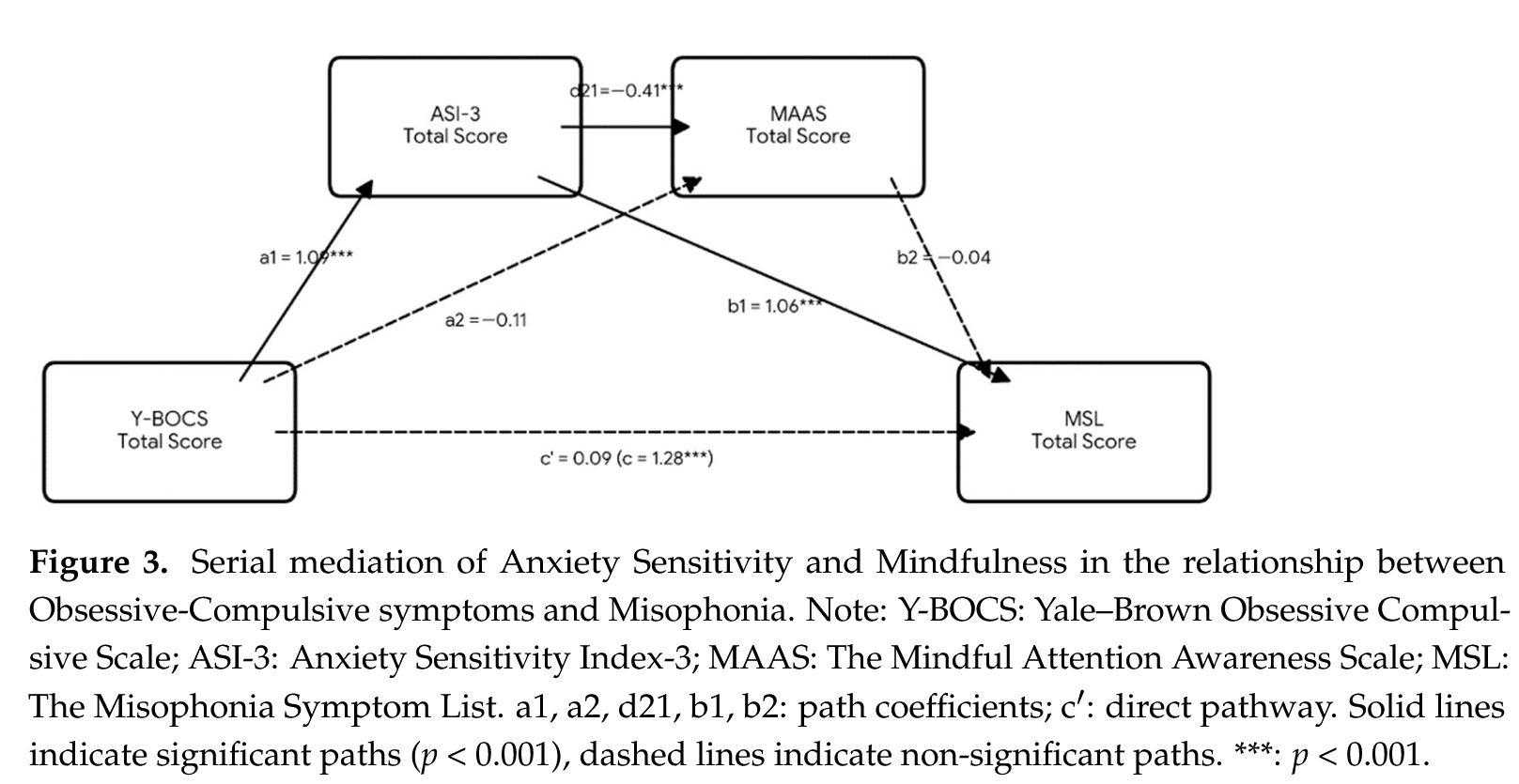
Sample: OCD n=108; Control n=81. Age: 30.81±10.75 vs 32.77±12.75; p=0.268. Education: 14.30±1.80 vs 14.67±2.10; p=0.207. Gender: 56.5% vs 56.8% female; p=0.966. MSL: 104.10±33.00 vs 87.56±20.07; p<0.001; d=0.59. ASI-3: 33.53±18.72 vs 18.12±11.55; p<0.001; d=0.96. BAI: 20.74±13.14 vs 11.04±8.47; p<0.001; d=0.85. MAAS: 53.23±14.92 vs 60.72±12.70; p<0.001; d=0.53. Y-BOCS (OCD only): 19.06±8.82. Correlations (OCD group): • Y-BOCS–MSL r=0.319; Y-BOCS–ASI-3 r=0.486; Y-BOCS–BAI r=0.455; Y-BOCS–MAAS r=−0.309. • MSL–ASI-3 r=0.626; MSL–BAI r=0.515; MSL–MAAS r=−0.357. • ASI-3–BAI r=0.652; ASI-3–MAAS r=−0.549. • MAAS–BAI r=−0.572. Multiple regression predicting MSL: • Model F=18.118; R²=0.41; adjR²=0.39. • ASI-3 β=0.523; p<0.001. • BAI β=0.206; p=0.059. • Y-BOCS β=−0.015; p=0.861. • MAAS β=0.043; p=0.651. Hierarchical regression: • Step 1 R²=0.218. • Step 2 R²=0.430; ΔR²=0.211; F-change=38.18; p<0.001. Mediation (ASI-3): a=0.49; b=0.62; c=0.32; c′=0.02; indirect=0.30; all p<0.001 except c′ p=0.82. Mediation (MAAS): a=−0.31; b=−0.29; c=0.32; c′=0.23; indirect=0.09; p=0.009. Serial mediation: • Model R²=0.39; total effect b=1.28; p<0.001. • Direct effect b=0.09; p=0.78. • Indirect via ASI-3 b=1.16; 95% CI [0.66,1.76]. • Indirect via MAAS NS. • Serial indirect NS.
Dv Relevance
• findings suggest the the Misophonia- OCD link is primarily mediated by increased anxiety sensitivity
• an example of applying mediation analysis to Misophonia/other disorders
• study that looked at the severity of Misophonia symptoms in people with OCD and looked at relationship between Misophonia/OCD in relation to anxiety sensitivity and mindfulness
• found elevated rates of Misophonia symptoms in those with OCD, with symptoms associated with cognitive-emotional variables like anxiety sensitivity and mindfulness.
• a newer take on the Misophonia- OCD link, though I do not believe they are claiming them to be one and the same.
•
Misophonia in Individuals with Obsessive–Compulsive Disorder: Its Relationship with Anxiety Sensitivity and Mindfulness
Status:: #status/Bare-bones-review
Metadata
- Item Type: #journalArticle
- Authors:: Mahmut Onur Karaytuğ, Lut Tamam, Mehmet Emin Demirkol, Zeynep Namlı, Caner Yeşiloğlu, Sinem Çetin Demirtaş, Ali Meriç Kurt, Hale Nur Çakar, Efsun Damla Altın, Mahmut Gürbüz,
- Date Added: January 28, 2026
- URL: https://www.mdpi.com/1648-9144/62/1/216
- DOI: 10.3390/medicina62010216
- Cite Key: karaytugMisophoniaIndividualsObsessive2026
- Tags: #Misophonia, #ocd, #anxiety-sensitivity, #mindfulness, #mediation-analysis
- PDF Attachments
Abstract
| Background/Purpose | Background- • OCD involves impairments in cognitive-emotional processes including emotion regulation. • Misophonia involves intense anger, disgust, and anxiety in response to specific sounds. • Conceptual and phenomenological overlap reported between OCD and misophonia. • Anxiety sensitivity identified as a transdiagnostic vulnerability factor; associated with OCD and misophonia. • Lower mindfulness associated with increased psychopathology; mindfulness-based interventions reduce OCD symptoms. • Cognitive-emotional mechanisms linking OCD and misophonia insufficiently understood. Purpose- • Examine severity of misophonia symptoms in individuals with OCD. • Test relationship between OCD symptom severity and misophonia. • Evaluate mediating roles of anxiety sensitivity and mindfulness. • Hypotheses: OCD severity positively associated with misophonia; anxiety sensitivity positively associated; mindfulness negatively associated; both mediate OCD–misophonia relationship. |
| Participants/samples | • OCD group: N=108; age 18–65; DSM-5 OCD diagnosis; exclusions: psychotic disorders, bipolar disorder, substance use, intellectual disability, illiteracy, current major depressive disorder, mild cognitive impairment. • Control group: N=81; no psychiatric diagnosis or treatment history. • Groups matched on age, gender, education. • Hearing impairment excluded. • Cross-sectional, comparative design. |
| Measures | • Misophonia Symptom List (MSL) – symptom severity subscale only. • Mindful Attention Awareness Scale (MAAS). • Anxiety Sensitivity Index-3 (ASI-3). • Yale–Brown Obsessive Compulsive Scale (Y-BOCS). • Beck Anxiety Inventory (BAI). • Sociodemographic Data Form. |
| Procedures | • Face-to-face DSM-5–based clinical interviews by psychiatrist. • Self-report scales administered in same assessment session. • Group comparisons, Pearson correlations, multiple regression, hierarchical regression, mediation (PROCESS Models 4 and 6; bootstrap). |
| Results | • the reported association of Misophonic symptoms and anxiety sensitivity held even when accounting for general anxiety levels (page 13) • Group differences • OCD group showed greater misophonia severity, higher anxiety sensitivity, higher general anxiety, and lower mindfulness than controls. • No group differences in sociodemographic variables. • Correlations in OCD group • OCD severity positively associated with misophonia, anxiety sensitivity, and general anxiety; negatively associated with mindfulness. • Misophonia positively associated with anxiety sensitivity and general anxiety; negatively associated with mindfulness. • Anxiety sensitivity positively associated with general anxiety and negatively associated with mindfulness. • Regression • When entered simultaneously, only anxiety sensitivity independently predicted misophonia severity. • OCD severity and mindfulness were not significant predictors in multivariate model; general anxiety showed no independent effect. • Anxiety sensitivity explained additional variance beyond OCD severity, general anxiety, and mindfulness. • Mediation (simple models) • Anxiety sensitivity fully mediated the association between OCD severity and misophonia. • Mindfulness partially mediated the association. • Serial mediation • Indirect pathway from OCD severity to misophonia through anxiety sensitivity significant. • Indirect pathway through mindfulness alone not significant. • Serial pathway (OCD → anxiety sensitivity → mindfulness → misophonia) not significant. • Direct association between OCD severity and misophonia not significant when mediators included. |
| Discussion/Limits | Conclusion- • a critical finding was that anxiety sensitivity acted as a mediator for the OCD and Misophonia severity scores (page 11) • findings suggest the the Misophonia- OCD link is primarily mediated by increased anxiety sensitivity (page 12) • finding that only anxiety sensitivity predicted Misophonic severity, the authors suggest the Misophonic responses may stem from the cognitive-emotional sensitivity reflected by anxiety sensitivity (page 12) • The authors conclude that misophonia symptoms are elevated in individuals with OCD. • The findings indicate that anxiety sensitivity functions as a central cognitive-emotional mechanism linking OCD symptoms and misophonia. • The data support that mindfulness is associated with misophonia severity but its effect is not independent of anxiety sensitivity. • The authors conclude that misophonia accompanying OCD may relate more to heightened interoceptive and threat sensitivity than to core obsessive-compulsive severity. • The findings indicate that assessing anxiety sensitivity and mindfulness may inform clinical evaluation and treatment planning. • The authors conclude that integrating mindfulness-based approaches and addressing anxiety sensitivity may provide clinical benefit. |
| Limitations:: | • Cross-sectional design prevents causal inference. • Mediation interpreted as indirect association only. • Misophonia assessed via self-report; no structured diagnostic interview. • Only symptom severity subscale used for misophonia. • Control group not assessed with structured diagnostic instrument. • Illness duration and pharmacological treatment not systematically collected. • Common method variance possible. • Other relevant mechanisms (emotion regulation, metacognition, avoidance) not assessed. |
| Future Directions:: | • Longitudinal studies to clarify directionality and mechanisms. • Broader cognitive-emotional models including additional processes. • Comprehensive clinical assessment of misophonia dimensions. • Further research in diverse samples. • |
| Statistics:: | Sample: OCD n=108; Control n=81. Age: 30.81±10.75 vs 32.77±12.75; p=0.268. Education: 14.30±1.80 vs 14.67±2.10; p=0.207. Gender: 56.5% vs 56.8% female; p=0.966. MSL: 104.10±33.00 vs 87.56±20.07; p<0.001; d=0.59. ASI-3: 33.53±18.72 vs 18.12±11.55; p<0.001; d=0.96. BAI: 20.74±13.14 vs 11.04±8.47; p<0.001; d=0.85. MAAS: 53.23±14.92 vs 60.72±12.70; p<0.001; d=0.53. Y-BOCS (OCD only): 19.06±8.82. Correlations (OCD group): • Y-BOCS–MSL r=0.319; Y-BOCS–ASI-3 r=0.486; Y-BOCS–BAI r=0.455; Y-BOCS–MAAS r=−0.309. • MSL–ASI-3 r=0.626; MSL–BAI r=0.515; MSL–MAAS r=−0.357. • ASI-3–BAI r=0.652; ASI-3–MAAS r=−0.549. • MAAS–BAI r=−0.572. Multiple regression predicting MSL: • Model F=18.118; R²=0.41; adjR²=0.39. • ASI-3 β=0.523; p<0.001. • BAI β=0.206; p=0.059. • Y-BOCS β=−0.015; p=0.861. • MAAS β=0.043; p=0.651. Hierarchical regression: • Step 1 R²=0.218. • Step 2 R²=0.430; ΔR²=0.211; F-change=38.18; p<0.001. Mediation (ASI-3): a=0.49; b=0.62; c=0.32; c′=0.02; indirect=0.30; all p<0.001 except c′ p=0.82. Mediation (MAAS): a=−0.31; b=−0.29; c=0.32; c′=0.23; indirect=0.09; p=0.009. Serial mediation: • Model R²=0.39; total effect b=1.28; p<0.001. • Direct effect b=0.09; p=0.78. • Indirect via ASI-3 b=1.16; 95% CI [0.66,1.76]. • Indirect via MAAS NS. • Serial indirect NS. |
| Relevance:: | • findings suggest the the Misophonia- OCD link is primarily mediated by increased anxiety sensitivity • an example of applying mediation analysis to Misophonia/other disorders • study that looked at the severity of Misophonia symptoms in people with OCD and looked at relationship between Misophonia/OCD in relation to anxiety sensitivity and mindfulness • found elevated rates of Misophonia symptoms in those with OCD, with symptoms associated with cognitive-emotional variables like anxiety sensitivity and mindfulness. • a newer take on the Misophonia- OCD link, though I do not believe they are claiming them to be one and the same. |
Notes
key terms and concepts:
-
Misophonia – decreased tolerance to specific sounds characterized by intense emotional and physiological reactions.
-
Anxiety sensitivity – tendency to interpret anxiety-related physical, cognitive, or social sensations as harmful.
-
Mindfulness – deliberate and non-judgmental awareness of present-moment experience.
-
Obsessive–Compulsive Disorder (OCD) – chronic mental disorder characterized by obsessions and compulsions.
my engagement notes
my questions
my comments
Bookmarks
reading notes
zettlekasten
Karaytuğ 2026 findings on the Misophonia-OCD link and anxiety sensitivity
Karaytuğ 2026 suggestion of integrating mindfulness into treatment approach’s